UV-Protection Polyester Yarn —
UPF Ratings & Anti-UV Fabric Explained
"UPF 50+" is printed on sun shirts, beach umbrellas, kids' swimwear and outdoor workwear — and buyers increasingly ask suppliers for "anti-UV yarn" to make it. But here's the question that trips up many first-time sourcing projects: does buying UV-protection yarn automatically give you a UPF 50+ fabric? The honest answer is no — and understanding why saves you from failed lab tests and unhappy customers. ☀️
This guide explains what UV radiation actually is, how polyester blocks it, what UPF ratings mean, which factors help or hurt, and the test standards you'll be asked to meet. If you've read our functional yarn guide, this is the deep dive on one of its functions. ✅
☀️ UV Radiation in 60 Seconds
Ultraviolet (UV) light is the part of sunlight just beyond visible violet. It is split into three bands by wavelength, and only two of them reach the ground: 🌍
UVC
Absorbed by the atmosphere. Doesn't reach skin or fabric outdoors, so it isn't part of UPF testing.
UVB
The main cause of sunburn. Mostly absorbed at the skin surface. Strongest around midday and in summer.
UVA
Penetrates deeper into skin, linked to premature ageing. Present all day and year-round, and passes through glass and thin fabrics more easily than UVB.
A good UV-protective fabric has to block both UVB and UVA — which is why serious standards (covered below) measure both, not just a single number. 🔬
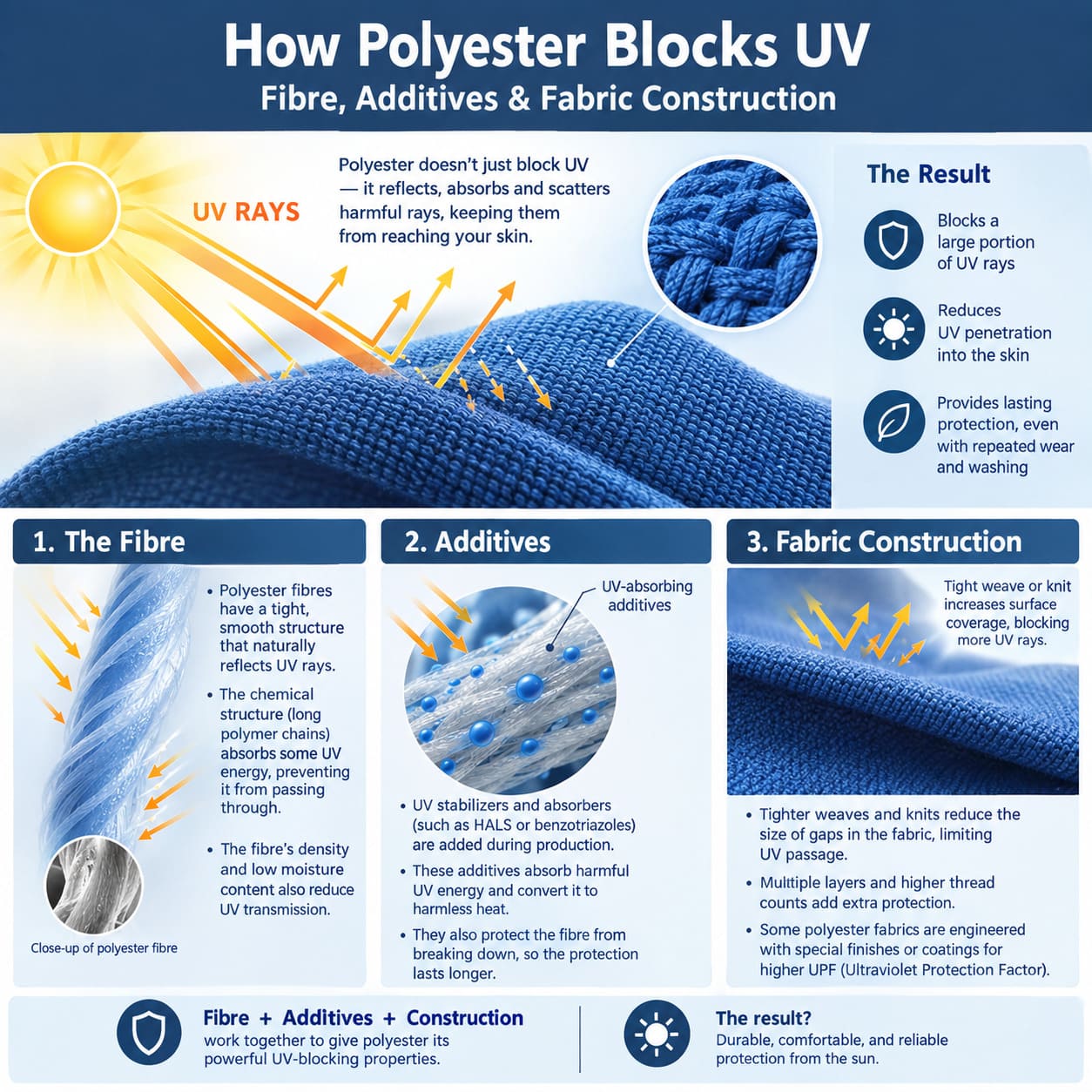
🧵 How Polyester Blocks UV — Three Sources of Protection
1. The Fibre Itself
Polyester's molecular chains contain aromatic (benzene) rings that naturally absorb UV, especially in the UVB range. This is why polyester generally protects better than cotton or viscose of a comparable weight and construction — but a thin, light, white polyester fabric on its own is still not enough for a high UPF.
2. Additives in the Fibre
Mineral particles such as titanium dioxide (TiO₂) and zinc oxide (ZnO), or organic UV absorbers, are blended into the polymer before spinning. They scatter or absorb UV that would otherwise pass through the gaps between fibres. Because they're inside the fibre, they don't wash out.
3. Fabric Construction
UV that reaches the skin mostly passes through the gaps in the fabric, not through the fibre itself. Denser weaves and knits, heavier weights, and darker colours close those gaps and absorb more UV. This is why construction usually matters more than the yarn alone.
UPF (Ultraviolet Protection Factor) is measured on finished fabric, not on yarn. Anti-UV yarn helps you reach a target UPF, but the final number depends on weave or knit density, weight, colour, finishing, stretch and wear. A UV-additive yarn knitted into a loose, lightweight, pale fabric can still fail UPF 50+, while a well-constructed fabric from ordinary yarn can sometimes reach UPF 30–40. Always plan and test at fabric level.
📏 UPF Ratings Explained
UPF tells you how much more UV a fabric blocks compared with bare skin. A UPF of 50 means only about 1/50th (2%) of the UV radiation passes through. Under the widely used Australian/New Zealand classification, ratings fall into three protection categories: 📊
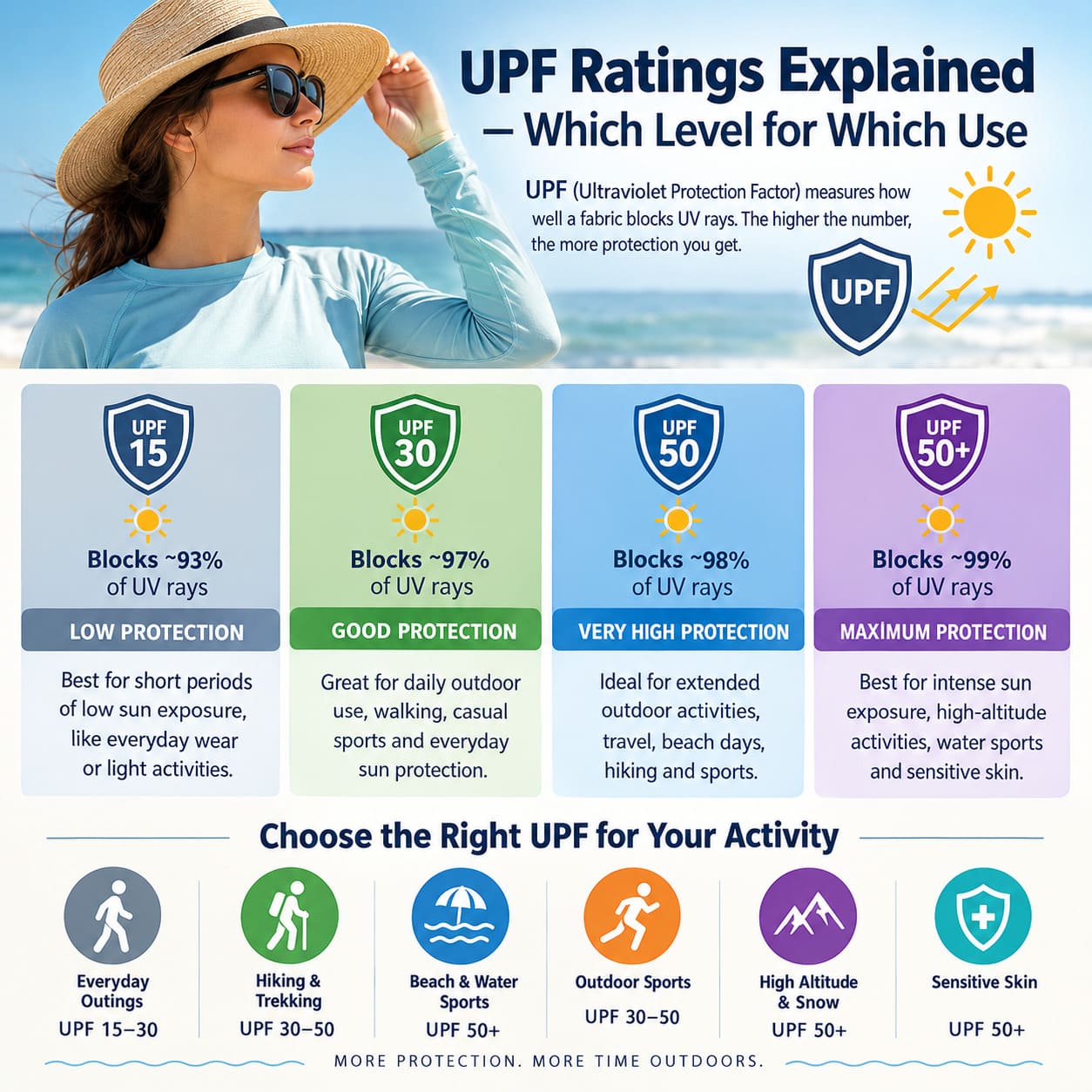
SPF (Sun Protection Factor) rates sunscreen creams and mainly reflects protection against UVB. UPF rates fabric and covers both UVB and UVA. You should never write "SPF 50" on a garment — the correct term for textiles is UPF, and using the wrong one can create labelling problems in regulated markets.
🎛️ What Raises — and Lowers — a Fabric's UPF
Because construction matters so much, here are the main factors mills and buyers should control: ⚙️
Less open space between yarns means less UV passing through. Higher thread count and cover factor are the most effective levers.
Thicker, heavier fabric generally blocks more UV — but at the cost of comfort and breathability, so there's a design trade-off.
Dyes absorb UV. Deep shades usually score higher than the same fabric in white or pastel. See our dyeing guide for how disperse dyes work.
Built-in mineral or organic absorbers block UV that slips through gaps and thin spots — especially valuable for lightweight fabric.
Stretching opens the gaps between yarns. Stretch and elastic fabrics can lose a meaningful share of their UPF when worn under tension — test them stretched, not just relaxed.
Light, translucent, undyed fabric lets far more UV through. This is where additive yarn helps most — but rarely fixes it alone.
Surface UV finishes can wash out or wear away, and fabric can thin with use. Built-in additives hold up better — see the next section.
Fluorescent whitening agents can change how a fabric behaves under UV testing. Ask your dye house how the finishing recipe affects test results.
✨ A Practical Detail: Lustre and UV Blocking
Here's a link many buyers miss. The titanium dioxide used to make polyester matte is itself a UV blocker — so the lustre level of your yarn affects UV performance. Our lustre guide explains the three grades; here's the UV angle: 🔍
| Lustre Grade | TiO₂ Content | UV-Blocking Tendency | Note |
|---|---|---|---|
| Bright (BR) | Virtually none | Lowest | Glossy, translucent fibre lets more UV through |
| Semi-Dull (SD) | Low (~0.3%) | Moderate | Common baseline for apparel yarn |
| Full-Dull (FD) | Higher (~2%) | Higher | Matte fibre scatters and blocks more UV |
| Anti-UV masterbatch yarn | Dedicated UV additive package | Highest | Designed specifically for UV protection targets |
🔒 Built-In vs Finished: Which Lasts?
Just like the built-in vs coated distinction in our functional yarn guide, UV protection can come two ways: 🧪
| Method | How It Works | Durability | Best For |
|---|---|---|---|
| Built-in (masterbatch in yarn) | UV additive blended into the polymer before spinning | Permanent — cannot wash out | Sportswear, workwear, umbrellas, anything washed often |
| Finishing (applied to fabric) | UV-absorber chemical applied in the dye house | Fades with washing and wear | Short-life products, or added on top of built-in protection |
This is also why dope dyed yarn is a good fit for UV products: the colour pigment is inside the fibre too, contributing to UV absorption and holding up under long sun exposure. ☀️
🔬 UPF Test Standards You'll Meet
A UPF claim is only credible with a test report from an accredited lab. These are the standards buyers most often reference: 📋
| Standard | Region | What It Does |
|---|---|---|
| AS/NZS 4399 | Australia / New Zealand | Defines the UPF calculation and the 15–24 / 25–39 / 40–50+ classification; also sets labelling requirements |
| AATCC 183 | USA / international | Test method for UVA and UVB transmittance and UPF of fabric; widely used by brands and retailers |
| EN 13758-1 | Europe | Test method and requirements for solar UV-protective apparel textiles |
| GB/T 18830 | China | Chinese standard: to be labelled "UV-protective", fabric must reach UPF above 40 and keep average UVA transmittance below 5% |
| UV Standard 801 | International (private) | Tests under more realistic conditions — such as stretched, wet or worn fabric — for a stricter real-world rating |
- Which standard and market? The required test method depends on where the product will be sold
- Test at fabric level — on the final dyed, finished fabric, not on yarn or grey fabric
- Test after washing — request results after repeated laundering, not only on new fabric
- Test stretched fabric if it's an elastic or knit product
- Check both UPF and UVA transmittance where the market requires it (e.g. GB/T 18830)
🎯 Which Level for Which Product?
| Product | Typical Target | Yarn / Fabric Approach |
|---|---|---|
| Everyday summer apparel | UPF 15–25 | Standard polyester, dark or mid colours, medium weight; anti-UV optional |
| Outdoor / hiking / fishing wear | UPF 30–50+ | Anti-UV masterbatch yarn, tighter construction, medium-dark colours |
| Sun shirts & rash guards | UPF 50+ | Built-in UV additive, dense knit, test stretched and after washing |
| Children's sun-protective wear | UPF 50+ | Built-in additive; consider antimony-free yarn and safety certification |
| Umbrella & parasol fabric | UPF 50+ (often UV coated) | Dense woven polyester, dark colour, additive yarn or coating |
| Awnings, tents, shade cloth | High UV block + weather durability | Heavier woven fabric; dope dyed yarn for colour and UV stability |
| Workwear (outdoor trades) | UPF 30–50 | Medium-heavy weight, durable weave, anti-UV yarn for wash durability |
Yaakan supplies anti-UV polyester yarn with built-in UV additives, alongside full-dull and Differential Yarn Series options. Tell us your target UPF, fabric construction and market, and we'll recommend a yarn — and we'll be upfront that the final UPF must be confirmed by testing your finished fabric. Free samples are available so you can knit or weave a trial fabric and send it for testing.
📝 Summary
- ☀️ UV has three bands — UVC is blocked by the atmosphere; good protective fabric must block both UVB (burns) and UVA (ageing)
- 🧵 Three sources of protection: the fibre's own chemistry, built-in additives (TiO₂, ZnO, absorbers), and fabric construction
- ⚠️ UPF is a fabric property, not a yarn property — anti-UV yarn helps but doesn't guarantee UPF 50+
- 📏 UPF bands: 15–24 good (≈93–96% blocked), 25–39 very good (≈96–97.4%), 40–50+ excellent (≥97.5%)
- 🎛️ Raise UPF with tighter construction, heavier weight, darker colour and UV additives; watch out for stretch, thin/pale fabric and wash wear
- ✨ Full-dull yarn blocks more UV than bright yarn thanks to TiO₂ — a useful low-cost detail
- 🔒 Built-in additives last; surface finishes fade with washing
- 🔬 Test the finished fabric to the standard your market requires — AS/NZS 4399, AATCC 183, EN 13758-1 or GB/T 18830 — including after washing and, for stretch fabric, stretched
Developing a UV-protective fabric? Contact Yaakan — tell us your target UPF and construction, and we'll recommend the right anti-UV yarn and send free samples for your fabric trials. 👇
Source Anti-UV Polyester Yarn
Built-in UV additives for permanent protection. Tell us your target UPF, fabric and market; we'll send a quote and free samples within 24 hours.