Antimony-Free Polyester Yarn —
The Eco-Catalyst Complete Guide
Almost every polyester fibre made today contains a trace of a metal most buyers have never heard of — antimony. It's not in the yarn by accident; it's a manufacturing necessity. But for baby wear, skin-contact products, and increasingly for eco-conscious brands, "antimony-free" has become a real specification, not just marketing language. 🧪
This guide explains what antimony is doing in ordinary polyester, why an antimony-free alternative exists, the real safety picture (not exaggerated, not dismissed), which regulations actually apply, and when you genuinely need to specify it. ✅
🧪 Why Is Antimony in Polyester At All?
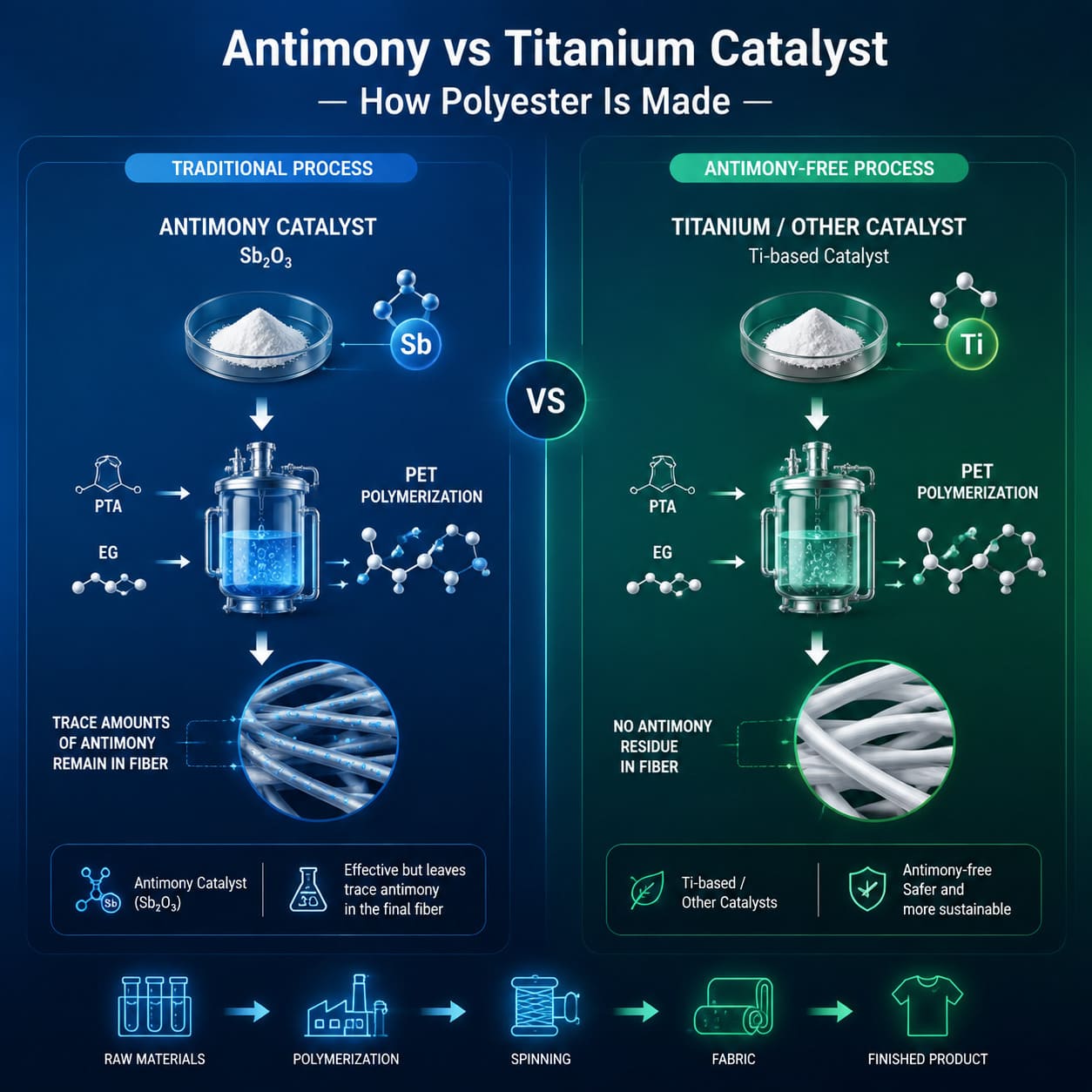
Polyester (PET) is made by a polymerisation reaction that needs a catalyst to proceed efficiently at an industrial scale. Since the 1950s, the overwhelmingly dominant catalyst for this reaction has been antimony trioxide (Sb₂O₃) — it's effective, well-understood, and inexpensive. As a result, well over 80% of polyester produced globally today is made using antimony catalysis, leaving trace residual antimony (typically 150–300 ppm) locked within the finished fibre. 🔬
It's important to understand that antimony isn't added for any functional benefit to the yarn (unlike, say, a cooling additive or a dye). It's a manufacturing catalyst that helps the polymerisation reaction happen efficiently — most of it stays chemically bound within the finished polymer, not loose or free within the fibre.
⚗️ Antimony vs Titanium — The Two Catalyst Systems
🏭 Where the Catalyst Fits in Production
🔬 The Honest Safety Picture
This is a topic where marketing on both sides sometimes overstates the case. Here's a balanced, evidence-based look: 📊
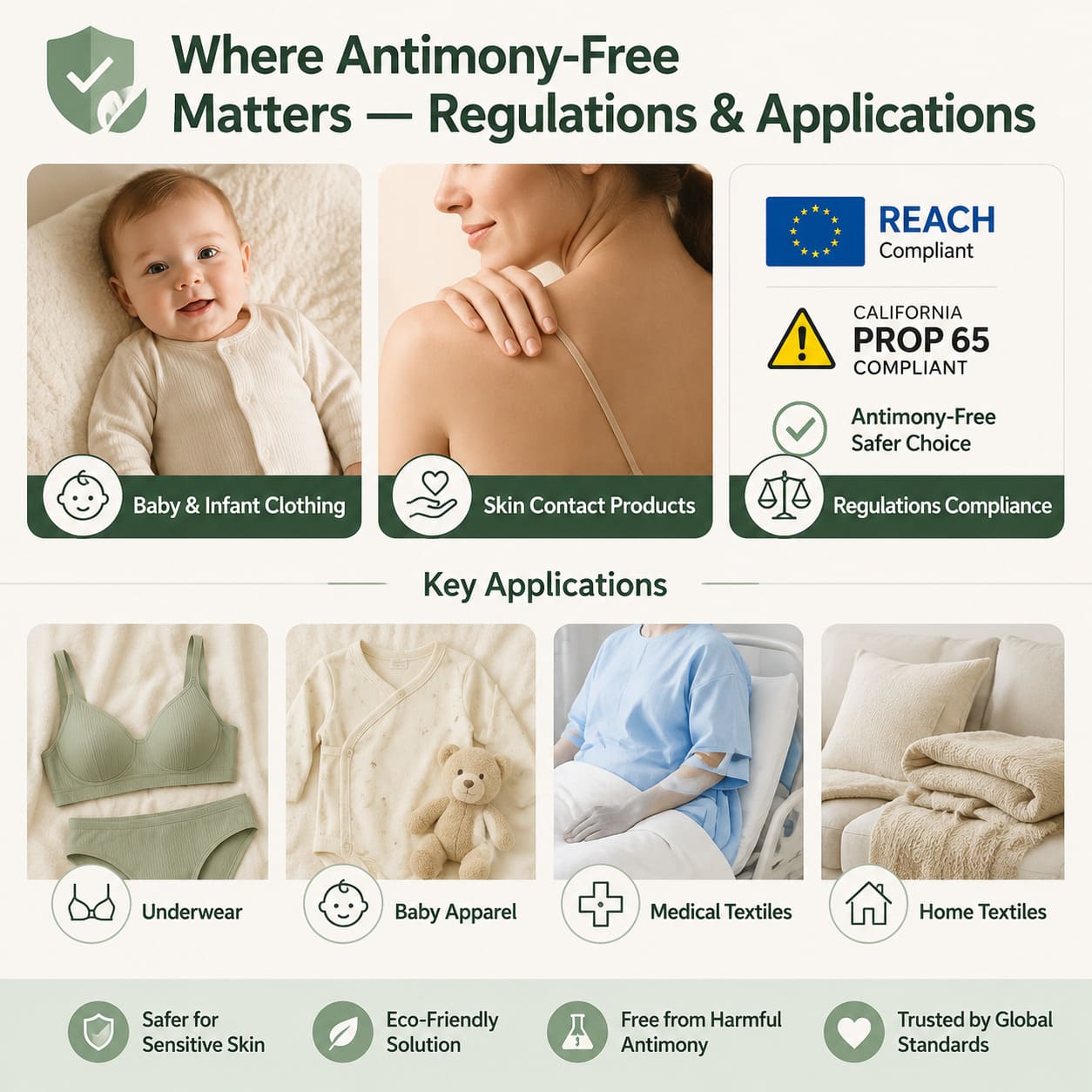
Regulatory caution around antimony is disproportionately focused on infant and children's products — because babies have thinner, more permeable skin, put fabric in their mouths, and have developing organ systems more sensitive to trace exposures over time. This is why antimony-free polyester is most commonly specified for baby wear, infant bedding, and children's skin-contact products, even though the general adult-wear risk is considered low by most assessments.
📜 Which Regulations Actually Apply?
| Standard / Region | What It Covers | Antimony Relevance |
|---|---|---|
| OEKO-TEX Standard 100 | Global voluntary textile safety certification | Sets limits on extractable antimony, esp. Product Class I (baby) |
| EU REACH | EU chemical safety regulation | Antimony trioxide is on the REACH candidate/monitoring list |
| EN 71-3 (EU) | Safety of toys — migration limits | Sets specific antimony migration limits (relevant for some textile toys) |
| CPSIA (USA) | US children's product safety | Focuses primarily on lead/phthalates; antimony less directly regulated |
| GB standards (China) | China national textile safety standards | GB 31701 sets limits for infant textile products, including antimony |
No major market currently bans antimony-catalysed polyester outright for general apparel. But OEKO-TEX certification (which many brands require) does set migration limits, and infant-specific standards (GB 31701 in China, similar frameworks elsewhere) apply stricter limits to baby products specifically. If you're supplying certified or infant-market fabric, check the exact limit your certification requires — conventional antimony-catalysed polyester can often still pass, but antimony-free removes the question entirely.
🎯 When Should You Specify Antimony-Free?
| Application | Antimony-Free Recommended? | Reasoning |
|---|---|---|
| Baby & infant wear | ✓ Strongly recommended | Highest sensitivity, most affected regulations, brand expectation |
| Infant bedding & toys (textile) | ✓ Strongly recommended | Mouth contact + skin sensitivity + specific standards |
| OEKO-TEX certified products | ~ Check specific limit | May pass with conventional polyester; verify test results |
| Premium/eco-branded adult apparel | ~ Brand-dependent | Some eco-conscious brands specify it as a differentiator |
| Standard adult apparel | Not typically required | General risk assessment considers this low priority |
| Industrial / technical textiles | Not typically required | No skin-contact concern in most applications |
💰 Cost & Availability Considerations
Antimony-free polyester is real, available, and increasingly requested — but buyers should know the practical trade-offs: 📊
- 💰 Higher cost — titanium and alternative catalysts typically cost more than antimony trioxide, and the polymerisation process can require more careful control, adding a premium (commonly 5–15% depending on scale and colour)
- 📦 Less universal availability — not every polyester producer runs antimony-free lines; sourcing may mean working with fewer suppliers or planning lead time
- 🎨 Colour considerations — some antimony-free formulations can have slightly different clarity/whiteness characteristics that dye houses account for
- ✅ Worth it where it matters — for baby wear and infant products, the cost premium is typically justified by both safety margin and market/brand requirements
Yaakan supplies antimony-free polyester DTY yarn (50D–300D) as part of our Differential Yarn Series, made with alternative catalyst technology for baby wear, skin-contact products, and eco-certified applications. We can provide relevant test documentation to support your certification needs — ask us for details specific to your target market and standard.
📝 Summary
- 🧪 Antimony trioxide is the dominant catalyst used to make polyester — a manufacturing necessity, not a functional additive, leaving trace residue (~150–300 ppm) in most conventional polyester
- 🟢 Titanium-based catalysts achieve the same polymerisation without antimony — "antimony-free" polyester
- 🔬 Safety reality: low risk for general adult wear (chemically bound, low migration); higher caution warranted for infants (thinner skin, mouth contact)
- 📜 Regulations: OEKO-TEX sets migration limits; infant-specific standards (e.g. China's GB 31701) apply stricter limits; no blanket ban on conventional polyester for general apparel
- 🎯 Specify antimony-free for: baby wear, infant bedding/toys, and where your certification or brand requires it
- 💰 Trade-offs: 5–15% cost premium, fewer suppliers, worth it where safety margin matters
Need antimony-free polyester yarn for baby wear or certified products? Contact Yaakan — we supply antimony-free DTY with supporting documentation for your certification needs. Free samples available. 👇
Source Antimony-Free Polyester Yarn
For baby wear, skin-contact and eco-certified products. Tell us your application and certification requirement; we'll send a quote, documentation and free samples within 24 hours.