Semi-Dull, Full Dull or Bright —
The Complete Polyester Yarn Lustre Guide
You're ordering polyester yarn and the spec sheet says: 150D/48F SD DTY. Or maybe the sample you received looks different from what you expected — too shiny, or not shiny enough. The difference almost certainly comes down to one letter: SD, FD or BR — the lustre code. 💡
Lustre is one of the most important yet most misunderstood yarn specifications. The wrong lustre choice can make your fabric look cheap, too formal, or completely unsuitable for its intended application. This guide explains exactly what each lustre type means, how it's made, and which one to choose for your fabric. ✅
💎 What Is Yarn Lustre — And Why Does It Matter?
Polyester yarn lustre refers to how much light the yarn reflects. It is controlled during production by adding titanium dioxide (TiO₂) — a white opacifying agent — to the polymer melt before spinning. TiO₂ particles scatter light rather than reflecting it directly, reducing the yarn's natural shine.
The more TiO₂ added, the duller (more matte) the yarn appears. No TiO₂ = maximum shine (bright). Small amount = semi-dull. High amount = full dull. 🔬
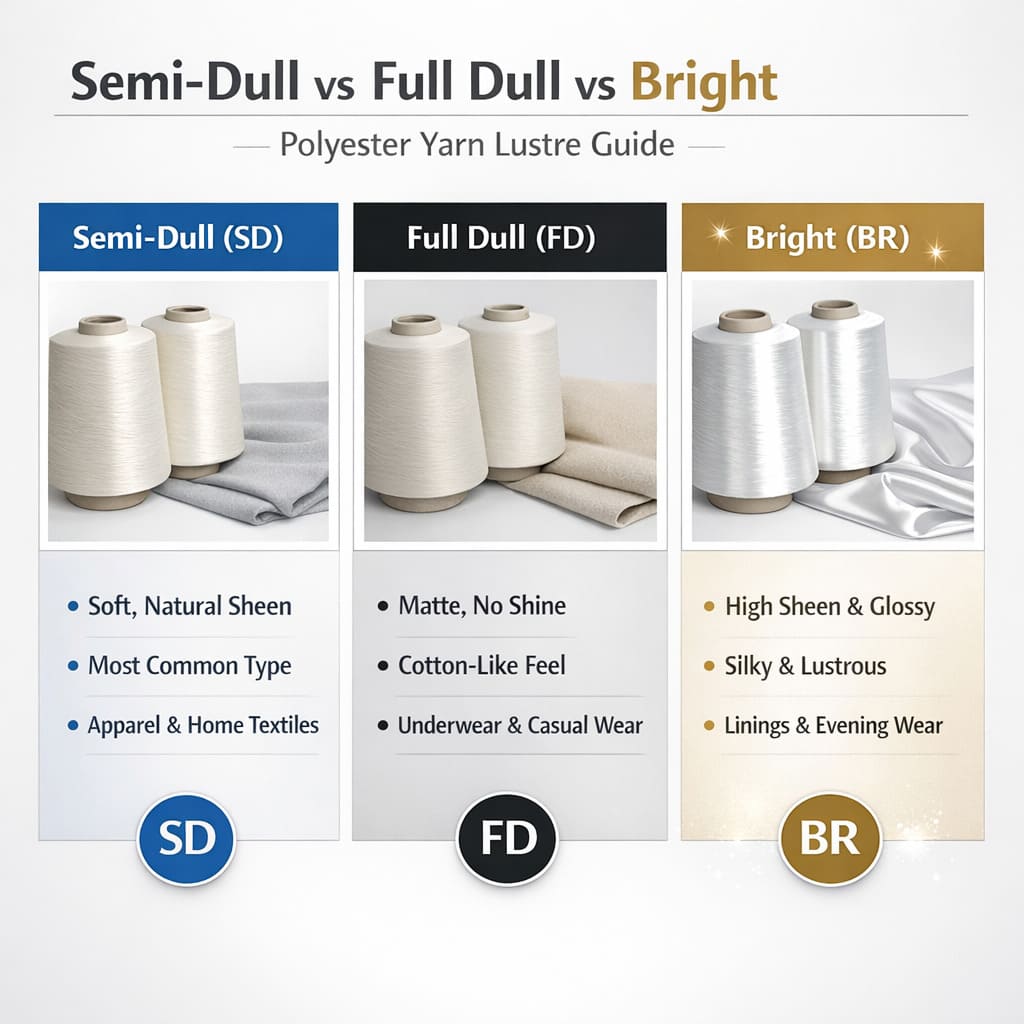
🎨 The Three Lustre Types — In Detail
🔬 How TiO₂ Controls Lustre — The Science in Plain English
Pure polyester polymer is naturally transparent and highly reflective — like clear plastic. When light hits an unmodified polyester filament, it reflects in a single direction, creating intense shine. To reduce this, manufacturers add titanium dioxide (TiO₂) powder to the molten polymer before it is extruded through the spinneret. 🏭
TiO₂ particles are microscopic and opaque — they scatter incoming light in multiple directions rather than reflecting it cleanly. The more TiO₂ particles present, the more light scattering occurs, and the duller the resulting yarn appears. Think of it as the difference between a clean glass window (bright) and frosted glass (semi-dull) and a painted wall (full dull). 🪟
The exact TiO₂ percentage varies slightly by mill and standard, but as a general reference: Full Dull ≥ 1.5% TiO₂ · Semi-Dull ≈ 0.3–0.5% TiO₂ · Bright = 0% TiO₂. Because TiO₂ is added in the melt, it is permanent — lustre cannot be changed after the yarn is produced.
✨ Special Type — Trilobal Bright (三叶亮光)
Within the Bright category, there is an important sub-type: Trilobal Bright (also called Tri-lobal, Trilobal, or 三叶型有光). Instead of a standard round filament cross-section, trilobal yarn has a three-lobed (Y-shaped) cross-section. 🔺
This shape creates a stronger multi-angle light reflection effect — more intense, diamond-like sparkle compared to round-filament bright yarn. Trilobal bright is the standard for satin fabric, high-end lining, and warp-knit fabric where maximum visual impact is desired. It is widely used in South Asian markets for sarees, kurta fabric and formal dress material.
- Standard Bright (round filament): Smooth, uniform shine — for lining, taffeta, standard satin. Good colour reproduction, easier to dye evenly.
- Trilobal Bright (Y-shaped filament): Intense multi-angle sparkle — for premium satin, saree fabric, jacquard. Fabric appears richer and more luxurious. Slightly more difficult to dye to deep, even colours.
📋 Full Comparison — SD vs FD vs Bright
| Property | 🔵 Semi-Dull (SD) | ⚫ Full Dull (FD) | ✨ Bright (BR) |
|---|---|---|---|
| TiO₂ content | ~0.3–0.5% | ~1.5–2.5% | 0% |
| Light reflection | Soft, diffused | Almost none — matte | High — shiny/silky |
| Appearance | Natural, clean | Cotton-like, flat | Silk-like, lustrous |
| Feel of fabric | Standard soft | Slightly dry/natural | Smooth, silky |
| Dyeability | ✓ Easy, even | ✓ Good | Good (deeper needed) |
| Colour vibrancy | Good | Slightly muted | ✓ Brightest colours |
| Most common use | Sportswear, casual, home | Fashion, workwear, military | Lining, formal, decorative |
| Market preference | ✓ Universal — all markets | EU fashion, eco buyers | South Asia, Middle East, formal wear |
| Price vs SD | Baseline | Similar to SD | Similar to SD |
| Availability | ✓ Widest range | Good range | Good range |
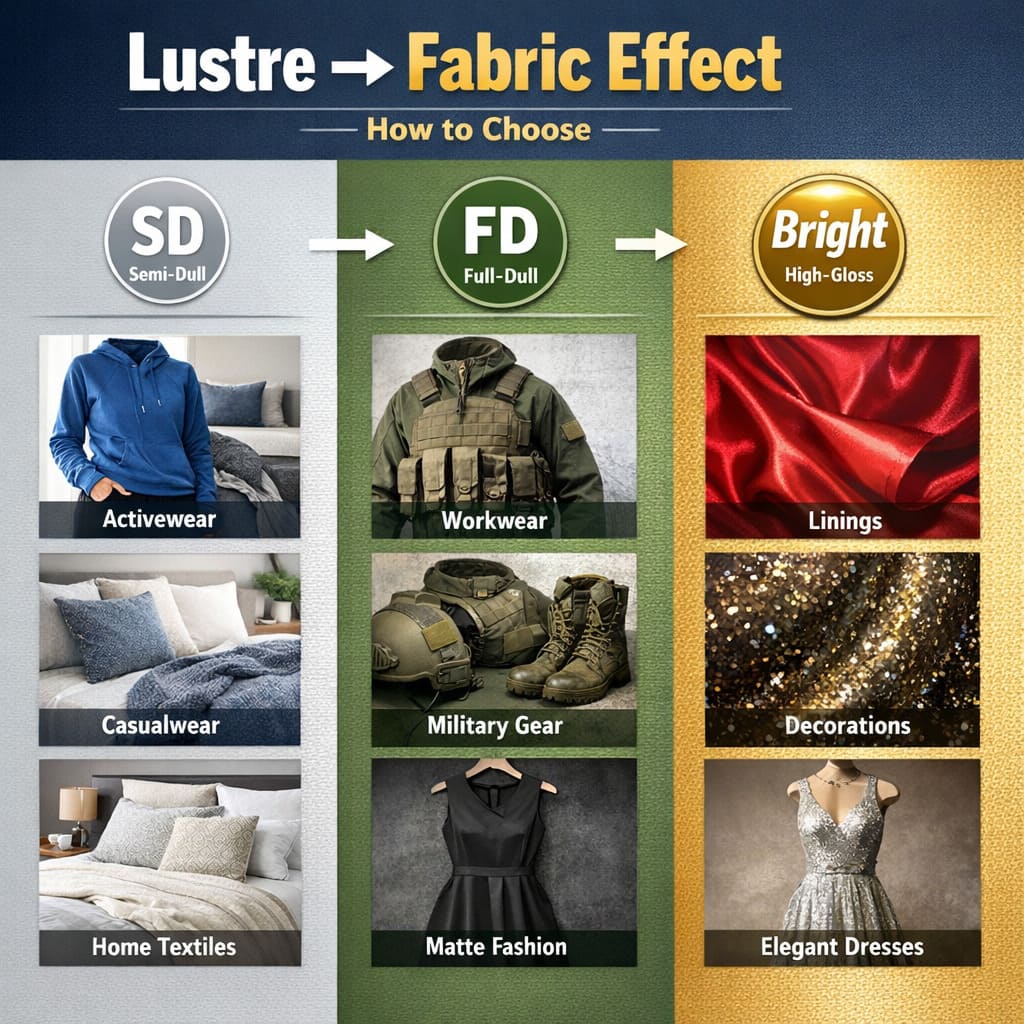
🎯 Which Lustre for Which Product?
| Fabric / Application | Recommended Lustre | Reason |
|---|---|---|
| Sportswear & activewear | Semi-Dull (SD) | Natural look, no synthetic shine in motion |
| T-shirts & casual knit | Semi-Dull (SD) | Cotton-like appearance, widely accepted |
| Workwear & uniform | SD or FD | SD most common; FD for premium/fashion workwear |
| Denim-look & stretch fabric | Full Dull (FD) | Must avoid synthetic shine for denim appearance |
| Military & tactical | Full Dull (FD) | Zero reflectivity required for field use |
| Premium fashion fabric | Full Dull (FD) | Natural, organic appearance preferred by EU brands |
| Woven lining & taffeta | Bright (BR) | Shine enhances luxury feel; standard for lining |
| Formal & evening wear | Bright / Trilobal | Maximum visual impact and colour brilliance |
| Embroidery thread | Bright (BR) | High shine essential for embroidery visual effect |
| Satin & jacquard | Trilobal Bright | Multi-angle sparkle for premium appearance |
| Saree & dress fabric (South Asia) | Bright / Trilobal | Strong cultural preference for high lustre |
| Home textiles (bedding) | Semi-Dull (SD) | Soft appearance, comfortable for daily use |
| Curtains & drapes | SD or Bright | SD for casual; Bright for formal/luxury drapes |
| Children's clothing | Full Dull (FD) | Non-reflective, soft appearance preferred |
📖 Reading Lustre Codes on Yarn Specifications
When you receive a yarn specification or quotation, the lustre code appears as part of the yarn description. Here's how to read it: 🔍
| Specification Example | Denier / Filament | Lustre Code | Yarn Type | Winding |
|---|---|---|---|---|
| 150D/48F SD DTY NIM | 150D, 48 filaments | SD = Semi-Dull | DTY | NIM |
| 75D/72F FD DTY SIM | 75D, 72 filaments | FD = Full Dull | DTY | SIM |
| 100D/36F BR FDY | 100D, 36 filaments | BR = Bright | FDY | — |
| 75D/72F TBR FDY | 75D, 72 filaments | TBR = Trilobal Bright | FDY | — |
| 150D/144F CD DTY | 150D, 144 filaments | CD = Cationic Dyeable | DTY | — |
You may also see CD in the lustre position — this stands for Cationic Dyeable, not a lustre type. CD yarn is usually semi-dull in appearance but accepts a different class of dye. If you see CD BR in a spec, it means Cationic Dyeable + Bright lustre — two separate properties combined. See our Cationic Series for more on CD yarn.
🎨 Does Dope Dyed Yarn Have a Lustre?
Yes — dope dyed (solution dyed) yarn also comes in SD, FD and Bright. The colour pigment and the TiO₂ content are independent variables added separately to the polymer melt. So you can have, for example:
- 🖤 Dope Dyed Black SD DTY — black colour, semi-dull lustre (most common for dope dyed)
- 🖤 Dope Dyed Black FD DTY — black colour, full dull matte (for military or fashion)
- ⚫ Dope Dyed Black Bright FDY — black colour, high shine (for black lining fabric)
When ordering dope dyed yarn, always specify both the colour and the lustre code. If you only say "dope dyed black DTY", the supplier will ship their standard (usually SD) — which may or may not be what you need. 📋
📝 Summary — Quick Reference
- 🔵 Semi-Dull (SD) — soft natural sheen, ~0.3–0.5% TiO₂, works for most applications. Use as default when unsure.
- ⚫ Full Dull (FD) — completely matte, ~1.5–2.5% TiO₂, cotton-like appearance. Use for fashion, workwear, military, children's wear.
- ✨ Bright (BR) — high gloss, 0% TiO₂, silk-like shine. Use for lining, formal wear, embroidery, satin.
- 🔺 Trilobal Bright (TBR) — Y-shaped filament, intense multi-angle sparkle. Premium choice for satin, saree and jacquard.
- 📋 Always specify lustre code when ordering — SD, FD, BR or TBR. Never leave it to supplier's default.
- 🎨 For dope dyed yarn, specify both colour AND lustre — they are independent.
Need help choosing the right lustre for your fabric application? Contact Yaakan — we supply DTY, FDY and all major yarn types in SD, FD and Bright from stock. Free samples available. 👇
Not Sure Which Lustre to Order?
Tell us your fabric application and we'll recommend the right lustre code — and send a free sample in SD, FD and Bright so you can compare in person before ordering.