How Is Polyester Yarn Dyed? —
Disperse Dyes & the HT/HP Process Explained
Cotton dyes easily in warm water with simple dyes. Polyester is completely different — it resists water, has no chemical sites for ordinary dyes to attach to, and needs special disperse dyes, high temperature and high pressure to take colour at all. Understanding how polyester dyeing works is essential for anyone buying yarn for dyed fabric, troubleshooting colour problems, or specifying colour requirements. 🎨
This guide explains why polyester is hard to dye, how the disperse-dye high-temperature high-pressure (HT/HP) process works, the different dyeing methods (package, beam, jet, fibre), and how to avoid the most common dyeing defects. ✅
🤔 Why Is Polyester So Hard to Dye?
Polyester's molecular structure makes it fundamentally different to dye than natural fibres like cotton or wool: 🔬
- 💧 Hydrophobic — polyester repels water (only 0.4% moisture absorption), so water-soluble dyes simply can't penetrate
- 🚫 No dye sites — unlike cotton (which has hydroxyl groups) or wool (amino groups), standard polyester has no reactive chemical sites for dye molecules to bond to
- 🧊 Tight crystalline structure — polyester molecules are densely packed, leaving little room for dye to enter at normal temperatures
- 🌡️ High glass transition temperature — polyester's molecular chains only become mobile enough to admit dye above ~80–90°C
The solution to all of these problems is a special class of dye — disperse dyes — applied at high temperature and high pressure. This is the foundation of virtually all polyester dyeing. 🎯
🎨 Disperse Dyes — The Only Dye That Works on Polyester
Disperse dyes are the dye class developed specifically for hydrophobic synthetic fibres like polyester. Unlike water-soluble dyes, disperse dyes are only slightly soluble in water — they exist as a fine dispersion of tiny dye particles (hence the name). Here's how they colour polyester: 🔬
- 1️⃣ Dispersion: Dye particles are suspended in the dye bath with the help of dispersing agents
- 2️⃣ Heat opens the fibre: At 130°C, polyester's molecular chains become mobile and tiny gaps open between them
- 3️⃣ Dye dissolves into fibre: Disperse dye molecules move from the water, into the fibre surface, and diffuse into these gaps
- 4️⃣ Cooling locks colour in: As the fibre cools, the molecular chains close around the dye molecules — physically trapping them inside the fibre
Unlike reactive dyes on cotton (which form chemical bonds), disperse dye on polyester is held by physical forces — the dye dissolves into the solid polymer like sugar dissolving in water, forming a "solid solution". The colour is trapped inside the fibre rather than chemically bonded. This is why polyester colour fastness depends so heavily on proper processing — the dye must penetrate deep, not just sit on the surface.
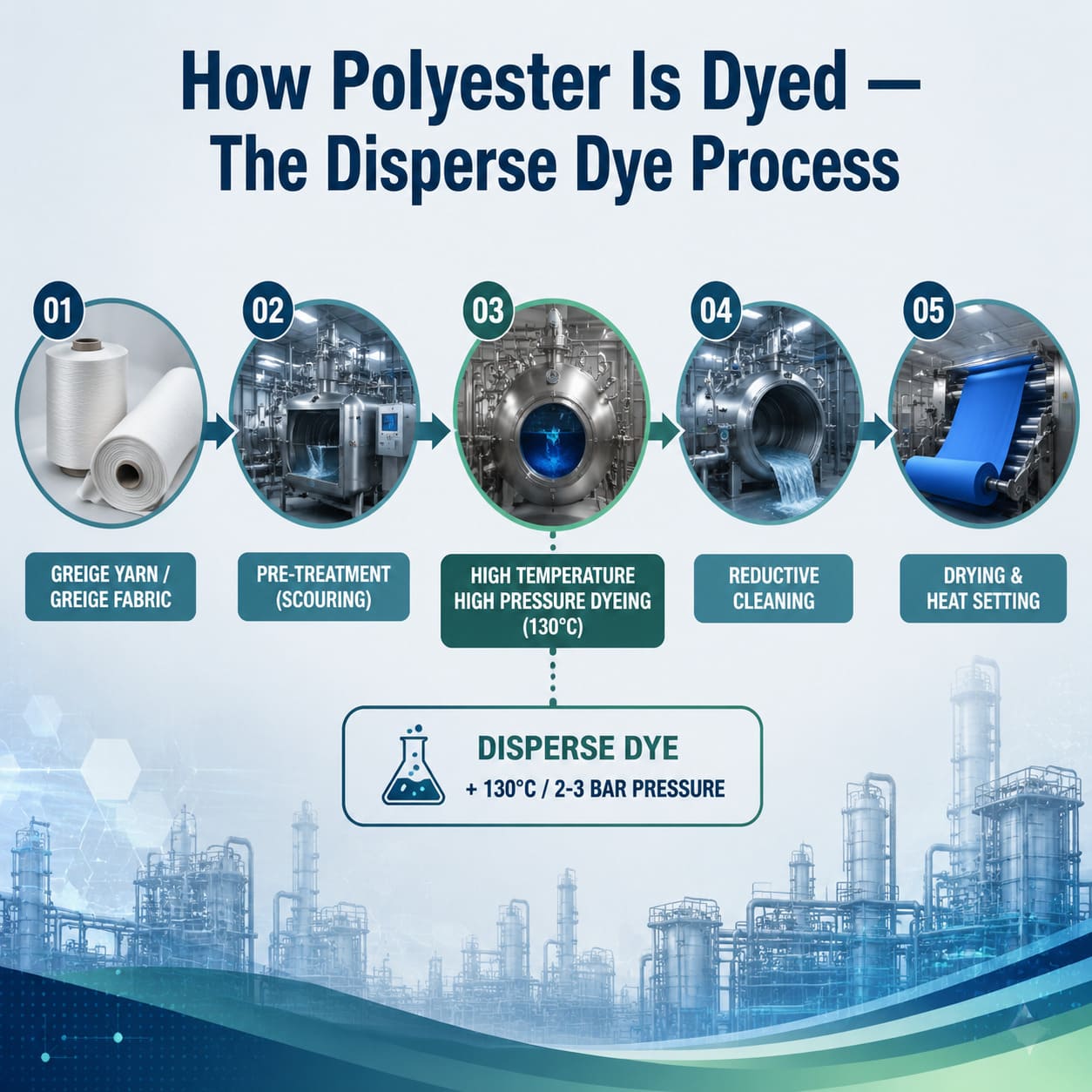
🌡️ The HT/HP Process — Step by Step
The standard method for dyeing polyester is the High Temperature / High Pressure (HT/HP) process — carried out in a sealed pressure vessel at around 130°C. Here's the full sequence: 🏭
Why Reduction Clearing Matters
After dyeing, reduction clearing (a wash with sodium hydrosulphite and caustic soda) removes loose, unfixed disperse dye from the fibre surface. Skipping or under-doing this step is the #1 cause of poor rubbing and washing fastness — the surface dye rubs off onto other fabric. For dark shades especially, thorough reduction clearing is essential. 🧽
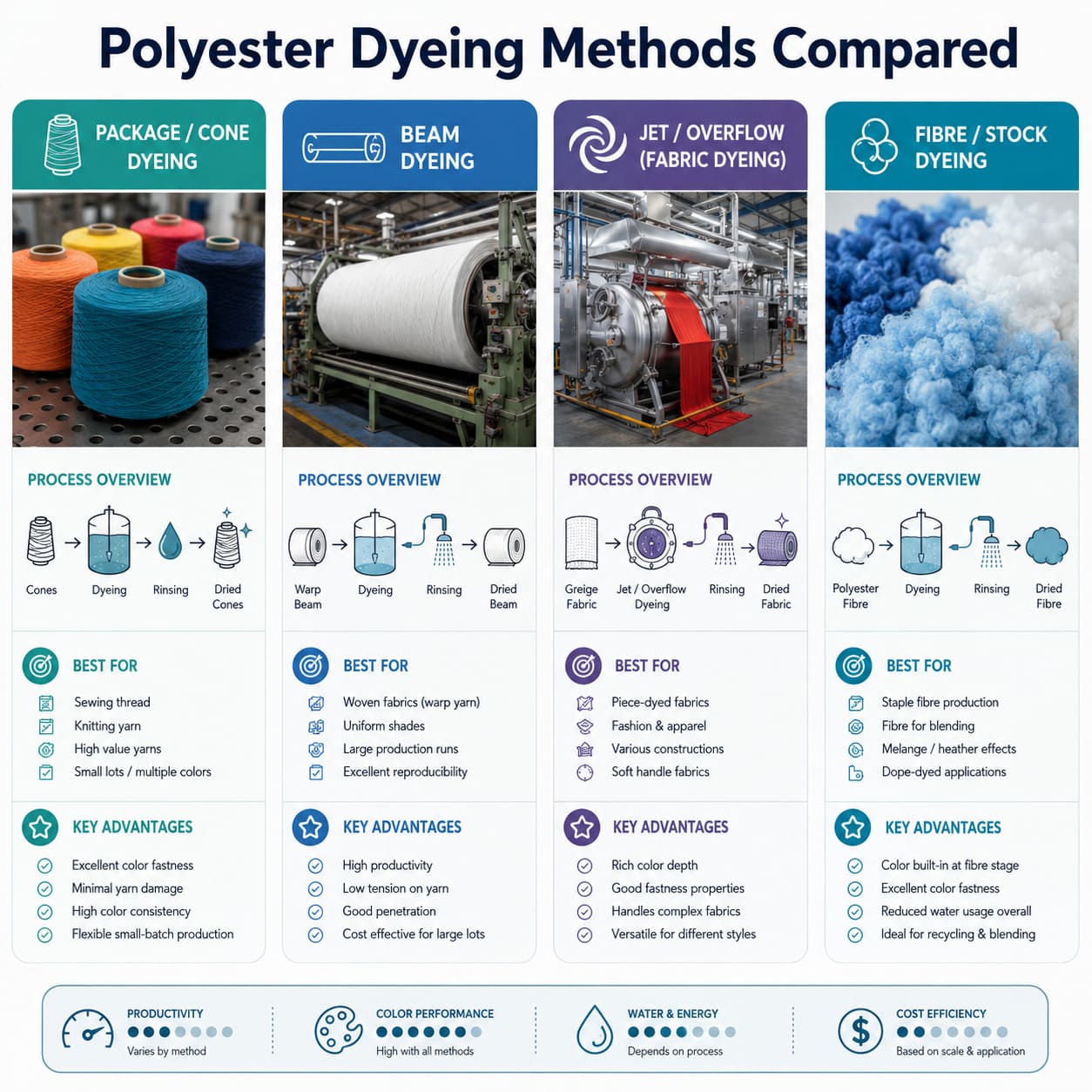
🏭 The Four Main Dyeing Methods
Polyester can be dyed at different stages — as loose fibre, as yarn, or as fabric. The method chosen depends on the product and the colour requirement: 🧵
The general rule: dye as late as possible for flexibility, as early as possible for colour depth. Piece-dyeing fabric (jet) is most flexible — you commit to colour last. Fibre dyeing gives the deepest, most even colour and enables melange effects, but you commit to colour earliest. Yarn (package) dyeing sits in between, and is essential for yarn-dyed stripes and patterns where different coloured yarns are woven together.
⚖️ Conventional Dyeing vs Dope Dyed — Quick Comparison
This article covers conventional dyeing — colour applied after the fibre is made. There's an alternative where colour is added to the molten polymer before spinning — dope dyed (solution dyed). Here's how they compare: 🎨
| Factor | Conventional Dyeing (this article) | Dope Dyed |
|---|---|---|
| When colour added | After fibre/fabric made | In molten polymer, before spinning |
| Colour flexibility | High — change colour anytime | Low — fixed at production |
| Colour fastness | Good (with proper process) | Excellent (built-in) |
| Water use | High (100–150 L/kg) | ~95% less |
| Small batches | Easy | High MOQ per colour |
| Best for | Fashion colours, flexibility | Black, navy, sustainability, UV applications |
For the full picture on dope dyed yarn, see our dedicated guide: Dope Dyed Polyester Yarn — Complete Guide. 📖
🎭 Special Case — Cationic Dyeable Polyester (CDP)
Standard polyester can only be dyed with disperse dyes. But a modified polyester — cationic dyeable polyester (CDP / CD) — is engineered with special sites that accept cationic (basic) dyes. This enables two-tone and cross-dye effects: when CD and standard polyester are knitted together and dyed in one bath, they take different dyes and produce two colours from a single dyeing. See our Cationic Series for more. 🎨
⚠️ Common Polyester Dyeing Defects & Causes
Most polyester colour complaints trace back to a handful of process problems. Here are the most common defects and what causes them: 🔍
Many "dyeing problems" are actually yarn problems. Variation in denier, oil content (finish %), intermingling or lustre between cones produces streaks, barré and shade variation that no dye house can fully fix. Starting with consistent, quality yarn — single lot, uniform specification — prevents most dyeing defects. This is why yarn consistency (low CV%) matters so much for dyed fabric.
📋 What Buyers Should Know & Specify
- 🎨 Specify colour properly: Provide a Pantone (PMS) reference or physical colour standard — not just "navy" or "red"
- 📊 Request fastness requirements: State the wash, light, rubbing fastness grades your market requires
- 📦 Single dye lot for large orders: Request all fabric/yarn dyed in one lot to avoid shade variation
- 🧵 Yarn consistency first: For dyed fabric, insist on consistent yarn (single lot, low CV%) — see our quality testing guide
- ⚫ Consider dope dyed for black/navy: If you need large volumes of black or navy with top fastness, dope dyed may be better than conventional dyeing
- ✅ Request lab dip approval: Always approve a lab dip (small colour sample) before bulk dyeing
📝 Summary
- 🤔 Polyester is hard to dye — hydrophobic, no dye sites, tight structure. Needs special dyes + heat + pressure.
- 🎨 Disperse dyes are the only dye class that works — they dissolve into the fibre as a "solid solution"
- 🌡️ HT/HP process at 130°C under pressure: pre-treat → heat → dye hold → cool → reduction clear → heat set
- 🧽 Reduction clearing is critical for rubbing/wash fastness — removes surface dye
- 🏭 Four methods: package (yarn), beam (warp/light fabric), jet (most fabric), fibre (melange/deepest)
- ⚠️ Most defects (streaks, shade variation, barré) trace back to yarn inconsistency — start with quality yarn
- ⚖️ Alternative: dope dyed for black/navy, sustainability and top fastness
Need consistent polyester yarn for dyed fabric? Contact Yaakan — we supply single-lot, low-CV% yarn ideal for even dyeing, plus dope dyed options for black and navy. Free samples available. 👇
Quality Yarn for Even Dyeing
Consistent single-lot yarn prevents most dyeing defects. Tell us your specification and colour requirement; we'll send a quote, quality certificate and free samples within 24 hours.