Virgin vs Recycled Polyester —
GRS Certification Buyer's Guide
Your brand buyer has just sent a new requirement: "All polyester yarn must be GRS-certified recycled content from 2025." Or perhaps a European retailer is asking for your supply chain's recycled polyester percentage. If you're not sure what GRS certification means, what recycled polyester actually is, or how much more it costs — this guide is for you. 🌱
We explain everything: what virgin and recycled polyester are, how rPET is made, what GRS certification involves, who needs it, and how to source it from China at competitive prices. ✅
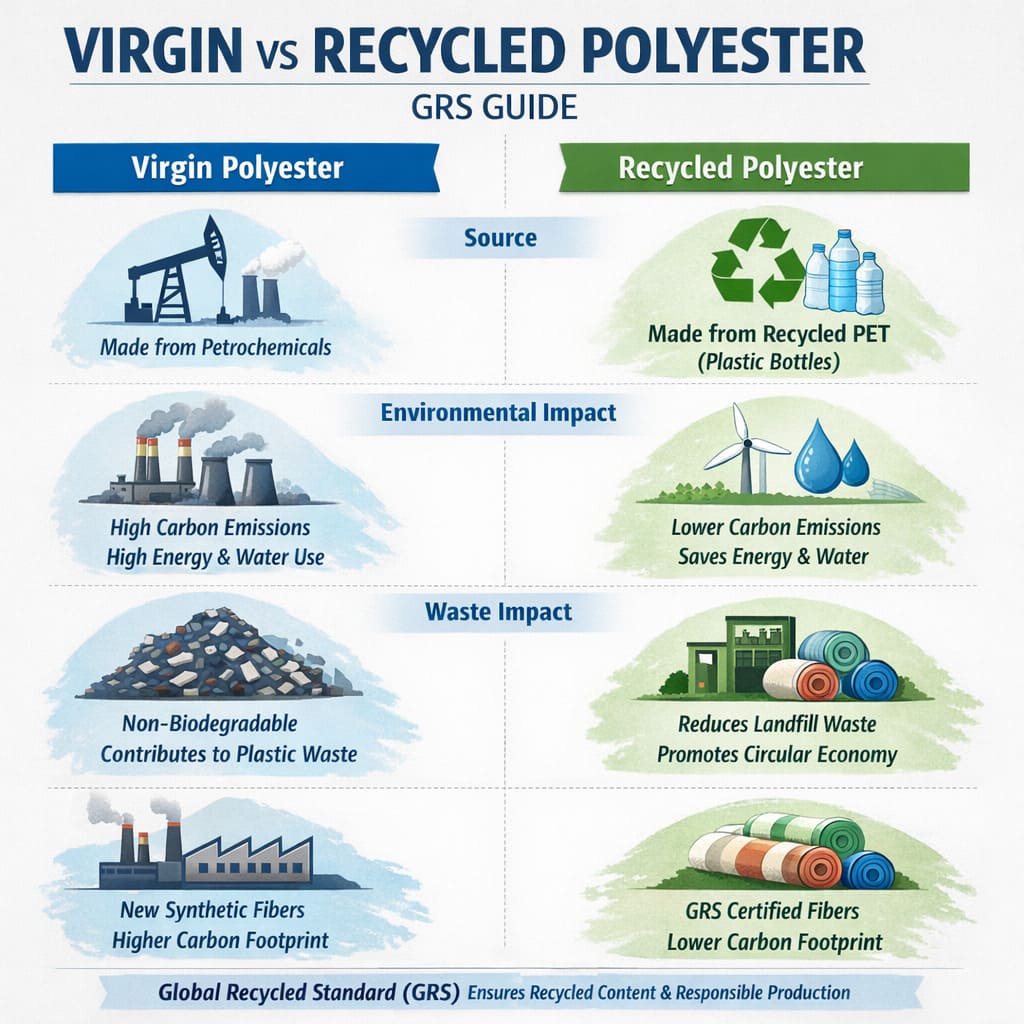
⚡ Virgin vs Recycled — Quick Overview
- Raw material: PTA + MEG from crude oil
- Consistent quality — tight spec control
- Lower price in most market conditions
- No certification required
- Standard for most applications
- Full range of deniers and types available
- No supply chain complexity
- Raw material: post-consumer PET bottles
- GRS certification available — chain of custody
- 5–15% price premium over virgin
- Required by EU/US sustainability programs
- Lower carbon footprint vs virgin
- Growing range — most major specs available
- Requires verified supply chain documentation
♻️ What is Recycled Polyester (rPET)?
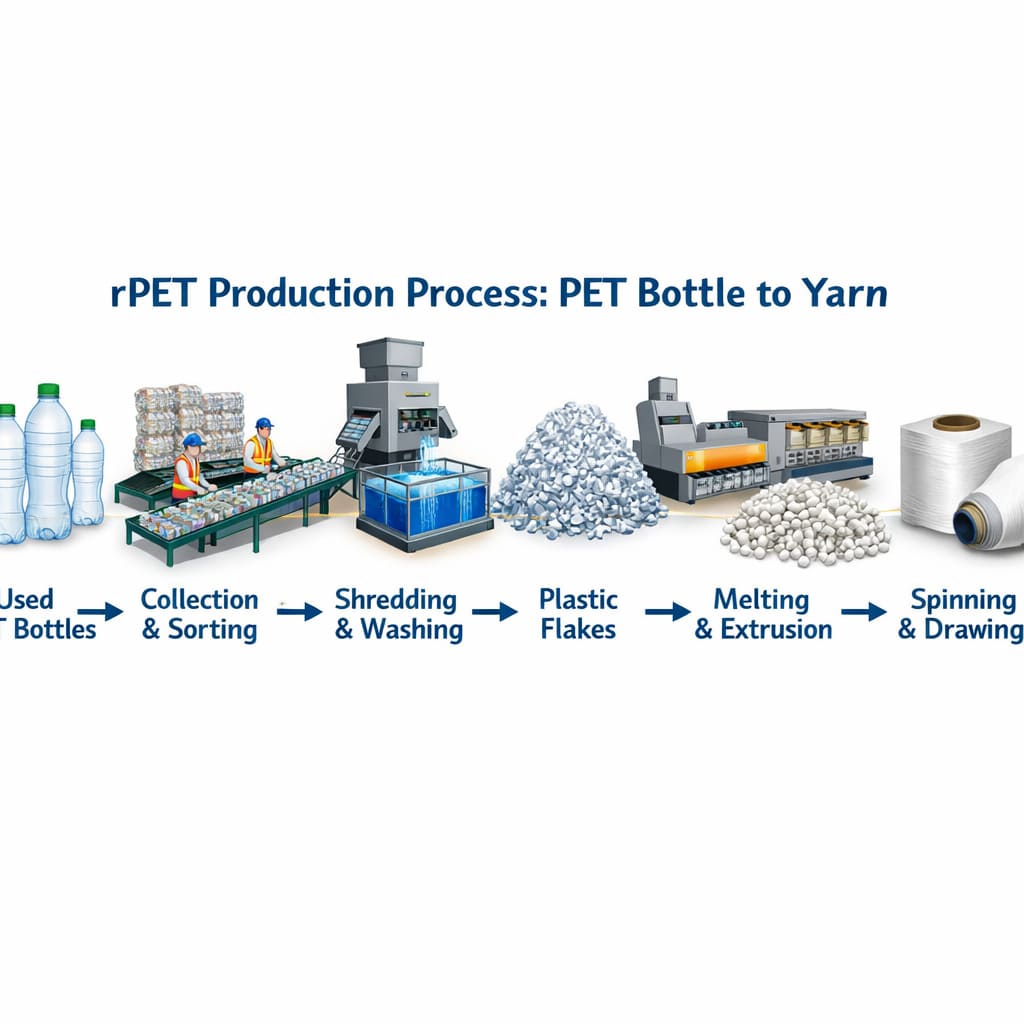
Recycled polyester — commonly called rPET — is polyester fiber produced from post-consumer recycled PET (polyethylene terephthalate) materials, primarily used plastic bottles. Instead of being made from virgin petroleum-based raw materials, rPET starts its life as a discarded plastic bottle, which is collected, sorted, cleaned, and processed back into polyester fiber. 🍶
The finished rPET yarn looks, feels, and performs almost identically to virgin polyester yarn. For most textile applications — fabric, filling, nonwoven — you cannot distinguish rPET from virgin by touch or appearance. The difference is entirely in the supply chain and the documentation that proves it. 📄
🏭 How rPET is Made — From Bottle to Yarn
🏅 What is GRS Certification?
GRS stands for Global Recycled Standard — an international, voluntary standard that sets requirements for third-party certification of recycled content, chain of custody, social and environmental practices, and chemical restrictions. It is administered by Textile Exchange. 🌍
GRS certification does two critical things:
- ✅ Verifies the recycled content claim — a third-party auditor confirms that the recycled material is genuinely post-consumer or post-industrial recycled content
- ✅ Tracks chain of custody — every step in the supply chain (from bottle collector to fiber producer to yarn manufacturer to fabric mill) must be GRS-certified for the final product to carry a GRS claim
When you buy GRS-certified rPET yarn from Yaakan, we issue a Transaction Certificate (TC) for each shipment. This document — issued by our GRS certification body — confirms the quantity, recycled content percentage, and product type of the certified shipment. You need this TC to pass the GRS claim to your customer or brand. Keep it with your other shipping documents. 📄
📋 Detailed Comparison
| Property | 🔵 Virgin Polyester | ♻️ Recycled rPET |
|---|---|---|
| Raw Material Source | Crude oil → PTA + MEG | Post-consumer PET bottles |
| Carbon Footprint | Higher CO₂ per kg | ✓ ~30–50% lower CO₂ vs virgin |
| Quality / Performance | ✓ Highly consistent, proven | Comparable — minor variation possible |
| Price | ✓ Lower — standard market price | 5–15% premium over virgin equivalent |
| Certification | None required | GRS (Global Recycled Standard) |
| Documentation | Standard mill certificate | Scope Certificate + Transaction Certificate |
| Availability | ✓ Full range, immediate stock | Growing — most major specs available |
| Brand Requirement | Standard | ✓ Required by major EU/US brands |
| Lead Time | 15–25 days | 20–30 days (longer certification process) |
| MOQ (Yaakan) | 1,000 kg filament / 500 kg spun | Same — 1,000 kg filament / 500 kg spun |
🎯 Who Needs GRS-Certified rPET?
Not every buyer needs GRS certification. Here's a clear breakdown of who does and who doesn't: 👇
| Buyer Type | Need GRS? | Reason |
|---|---|---|
| Supplying Nike, Adidas, H&M, Zara, Patagonia | ✓ Yes — required | All major brands have recycled content targets |
| Supplying EU retailers (EUDR, Green Deal) | ✓ Yes — increasingly required | EU sustainability regulations tightening |
| Supplying outdoor/sportswear brands | ✓ Yes — standard requirement | Sector has highest sustainability standards |
| Vietnam factories for brand export | ✓ Yes — growing requirement | Brand factories required to comply |
| Domestic market / local brands | Not required | No external sustainability requirement |
| Industrial / technical textile | Not required | Performance, not sustainability focus |
| Budget uniform / workwear | Not required | Cost is priority, no brand requirement |
| Wanting to market "eco" products | Recommended | GRS prevents greenwashing claims |
If your end customer is a global brand or a European retailer, ask them directly whether GRS-certified recycled content is required. Most major brands now have an official supplier sustainability guide that specifies this. If they say yes — you need GRS. If they don't ask — virgin polyester is almost always sufficient and more cost-effective. 🎯
🌍 Environmental Impact — The Real Numbers
The environmental case for recycled polyester is real, but it's important to understand the actual numbers rather than marketing claims. Here's what the data shows: 📊
| Environmental Metric | Virgin Polyester | Recycled rPET | Saving |
|---|---|---|---|
| CO₂ emissions (per kg fiber) | ~9.5 kg CO₂e | ~3.0–5.5 kg CO₂e | 40–70% reduction |
| Energy use (per kg fiber) | ~125 MJ | ~50–75 MJ | ~50% reduction |
| Water use | Low (vs cotton) | Similar to virgin | Minimal difference |
| PET bottles diverted per kg fiber | 0 | ~65–70 bottles/kg | Significant waste reduction |
| Fossil fuel dependency | High | Significantly reduced | Less petrochemical input |
Recycled polyester is significantly better than virgin on carbon and energy metrics, but it is not a complete solution. rPET still sheds microplastics during washing, and it can only be recycled a limited number of times before fiber quality degrades. The textile industry is working on closed-loop recycling systems, but these are not yet commercially scaled. rPET is a meaningful improvement — not a perfect answer. 🔬
🛒 How to Order GRS-Certified rPET from Yaakan
- Specify "GRS-certified recycled" in your inquiry. When you contact us, clearly state that you need GRS-certified rPET. Include: yarn type (DTY/FDY/PSF), denier/specification, recycled content % required (typically 100% recycled or 50%+ recycled), and quantity. 📧
- We confirm specification and price. We will confirm availability, the GRS-certified specification, and the price (typically 5–15% above equivalent virgin). We also confirm our current Scope Certificate validity. ✅
- Place order and pay deposit. Standard T/T 30%+70% payment terms. Production starts after deposit received. Lead time is typically 20–30 days. ⏱️
- We issue Transaction Certificate (TC) at shipment. Once goods are produced and loaded, we issue the GRS Transaction Certificate for your shipment. This TC is the key document you need to pass the GRS claim to your customer. 📄
- You verify on Textile Exchange platform. All GRS TCs can be verified on the Textile Exchange certificate platform. Your brand buyer can check the certificate number independently. 🔍
- ♻️ Recycled DTY — 75D–300D, SD/Bright, NIM/SIM, GRS certified
- ♻️ Recycled FDY — 50D–150D, SD/Bright/Trilobal, GRS certified
- ♻️ Recycled PSF — 1.4D–7D, solid/hollow, 38mm/64mm, GRS certified
- 📄 Transaction Certificate issued for every GRS shipment
- 🚢 FOB Xiamen | MOQ same as virgin specifications
📝 Summary
- 🔵 Virgin polyester — lower cost, consistent quality, no certification, suitable for most applications
- ♻️ Recycled rPET — 5–15% premium, GRS-certified, ~40–70% lower CO₂, required by major brands and EU retailers
- 🏅 GRS certification — third-party verified chain of custody; Transaction Certificate (TC) issued per shipment
- 🎯 Who needs it: suppliers to Nike/Adidas/H&M/Zara, EU-facing factories, sportswear manufacturers
- 🌱 rPET is a meaningful environmental improvement — but not required unless your buyer specifically asks
Need GRS-certified recycled polyester yarn? Contact Yaakan — we supply GRS-certified recycled DTY, FDY, and PSF FOB Xiamen with Transaction Certificates. Reply within 24 hours. 👇
Need GRS-Certified Recycled Polyester?
We supply GRS-certified rPET yarn (DTY, FDY, PSF) with Transaction Certificates — FOB Xiamen. Tell us your specification and we'll send pricing and certificate details within 24 hours.