Turkey, Egypt, India —
Three Emerging Markets for Polyester Yarn Buyers
Beyond the South Asian giants — Bangladesh, Pakistan and Vietnam — three markets are rapidly growing as significant importers of Chinese polyester yarn: Turkey, Egypt and India. Each has a distinct textile industry structure, different yarn needs, and different dynamics for Chinese suppliers. 🌍
This article is the second in our series on polyester yarn export markets. If you missed the first, see our guide on Bangladesh, Pakistan and Vietnam. Here we cover the next three markets in detail — what they produce, what yarn they need from China, and what makes each one unique. ✅
📊 Country Snapshot — At a Glance
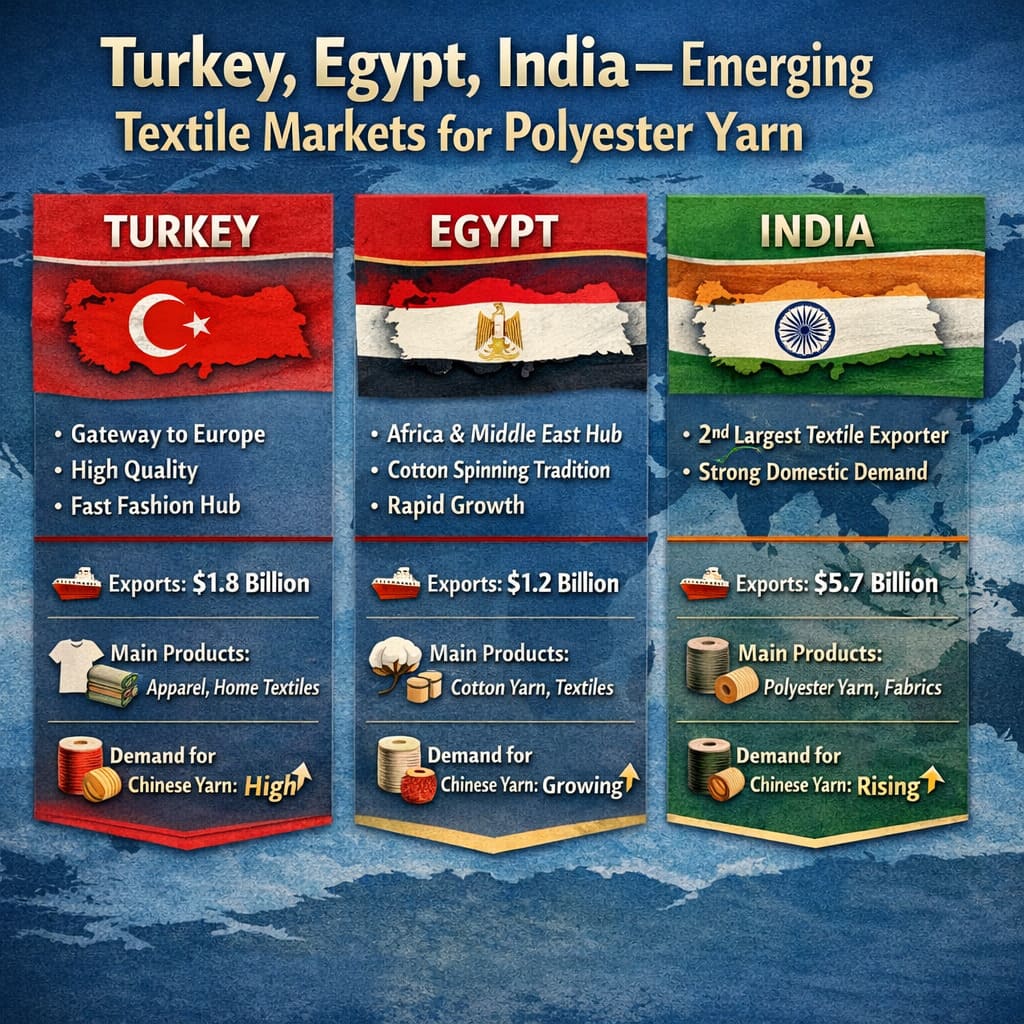
🇹🇷 Turkey — Europe's Nearest Textile Supplier
Turkey occupies a unique position in global textiles: it is a major manufacturer (one of the world's top five denim producers and a significant knitwear exporter) while simultaneously being geographically positioned as Europe's nearest large-scale textile supplier. Turkish factories can deliver to EU customers in 3–5 days — a significant advantage over Asian suppliers for fast fashion replenishment. 🚚
What Turkey Produces
- 👖 Denim fabric and garments — Turkey is among the top 5 global denim producers, supplying European fast fashion brands with quick-turn denim
- 🧥 Knitwear — T-shirts, sweatshirts, sportswear for EU and US buyers
- 🏠 Home textiles — towels, bathrobes, bed linen (significant export category, especially to the US and EU)
- 🧵 Technical and industrial textile — geotextile, automotive, filtration
What Yarn Turkey Needs from China
Turkey has a large domestic polyester production base but still imports significant volumes of speciality and functional polyester yarn from China — particularly types that its domestic industry does not produce competitively: 🧶
| Yarn Type | Application in Turkey | Demand Level |
|---|---|---|
| Polyester DTY | Knitwear fabric, sportswear, fleece | ⭐ High |
| Polyester FDY | Woven lining, taffeta, technical fabric | High |
| Cationic CD DTY | Two-tone fashion fabric for EU brands | High |
| Recycled rPET DTY/FDY | Sustainable fabric for EU brand supply chain | ⭐ Very High & Growing |
| Elastic Yarn (T400/PBT) | Stretch denim, sportswear, performance fabric | Medium-High |
| Functional DTY | Technical textile, antibacterial sportswear | Medium |
Turkish buyers are typically technically sophisticated and quality-focused — they supply demanding EU fashion brands and expect consistent quality with proper certifications. GRS-certified rPET is increasingly required as EU sustainability regulations tighten. Payment is commonly L/C or T/T with established suppliers. Transit from Xiamen to Istanbul or Mersin is approximately 18–24 days. Buyers often request SGS inspection and OEKO-TEX certification on yarn. 🏆
🇪🇬 Egypt — Africa's Textile Powerhouse, Rising Fast
Egypt is Africa's largest textile exporter and has been growing rapidly as a polyester yarn import market. The country benefits from significant trade preferences — it has free trade agreements with the EU (under the EU-Egypt Association Agreement) and the US (via QIZ — Qualified Industrial Zone agreements that allow tariff-free access), making Egyptian-made garments competitive in Western markets. 🌍
Egypt's traditional strength is in cotton — Egyptian cotton is world-renowned — but the industry is rapidly diversifying into polyester and blended yarn as buyers seek lower-cost alternatives to pure cotton. Egypt's large and growing domestic population also creates strong internal demand for home textiles and apparel. 🏠
What Egypt Produces
- 🛁 Home textiles — towels, bed linen, bathrobes — Egypt's single largest export category
- 👕 Knitwear and T-shirts — growing rapidly, especially for EU and US retail chains
- 🧵 Cotton and blended yarn — spun and exported to other markets
- 🏭 Denim — growing sector supplying EU fast fashion brands via QIZ zones
What Yarn Egypt Needs from China
| Yarn Type | Application in Egypt | Demand Level |
|---|---|---|
| Polyester DTY SD | Knit fabric for T-shirts, sportswear, casual wear | ⭐ High |
| Polyester Staple Fiber | Blending with domestic cotton in spinning mills | ⭐ High |
| Poly-Cotton TC/CVC | Shirting, uniform fabric, school wear | High |
| Polyester FDY | Woven fabric, lining for home textiles and apparel | Medium |
| Polyester Spun Yarn | Sewing thread, woven industrial fabric | Medium |
| Recycled rPET | EU-bound garments requiring GRS compliance | Growing |
Egyptian buyers are price-sensitive but increasingly quality-aware as they shift production toward EU and US brand supply chains. PSF for cotton blending is a large and consistent demand category. Payment terms are typically T/T or L/C, with some buyers preferring D/P. Transit from Xiamen to Alexandria or Port Said is approximately 18–22 days via Suez Canal. Since the Red Sea disruption, some shipments are routing around the Cape — check current shipping rates. 🚢
🇮🇳 India — The World's Largest Domestic Textile Market
India is the world's second-largest textile exporter by value and has the largest domestic textile consumption market globally — a population of 1.4 billion with rising incomes creates enormous internal demand that most other textile-producing countries cannot match. This dual role as both major exporter and massive domestic consumer makes India a uniquely complex and important market. 🌏
India has a highly developed domestic polyester industry — Reliance Industries is one of the world's largest polyester producers — which means India primarily imports from China the speciality, functional and value-segment yarn that its domestic industry doesn't produce competitively. Understanding this is key to successful yarn sales in India. 🏭
What India Produces and Exports
- 🥻 Saree and dress fabric — India is the world's dominant producer of saree, lehenga and traditional dress fabric, mostly in bright and trilobal polyester filament
- 🧵 Cotton yarn — India is the world's second-largest cotton yarn exporter
- 👕 Knitwear — growing rapidly in cities like Tirupur and Ludhiana
- 🏠 Home textiles — bedding, curtains, upholstery
- 🏗️ Technical textile — geotextile, medical, agri-textile (large and growing sector)
What Yarn India Needs from China
Despite strong domestic production, India imports significant volumes of Chinese polyester yarn — especially at the value and speciality ends of the market: 🧶
| Yarn Type | Application in India | Demand Level |
|---|---|---|
| Polyester FDY Bright / Trilobal | Saree fabric, dress material, lining — premium bright yarn | ⭐ Very High |
| Polyester DTY FD | Full dull matte fabric for fashion and suiting | High |
| Cationic DTY | Two-tone fashion fabric, saree with colour contrast | ⭐ High |
| Sea Island DTY/FDY | Premium microfibre suede fabric, luxury apparel | Medium |
| PBT / T400 Elastic | Stretch fabric for leggings, sportswear, ethnic stretch wear | Medium-High |
| Recycled rPET | Export garments for EU/US brands with sustainability requirements | Growing |
Indian buyers are highly price-sensitive and technically knowledgeable — they have domestic alternatives for most standard products and will only import from China when the price or specification offers a genuine advantage. Bright and trilobal FDY for saree fabric is the largest single import category from China. Buyers are experienced negotiators; multiple samples and competitive pricing are essential. Transit from Xiamen to JNPT Mumbai is approximately 10–14 days; to Chennai approximately 12–16 days. 🛳️
📋 Full Comparison — Turkey vs Egypt vs India
| Factor | 🇹🇷 Turkey | 🇪🇬 Egypt | 🇮🇳 India |
|---|---|---|---|
| Textile Export Value | ~$19B | ~$3.5B | ~$35B |
| Key Strength | EU proximity, fast fashion, denim | Cotton tradition, QIZ/EU trade access | Domestic scale, saree fabric, cotton yarn |
| Quality Level Expected | High — EU brand grade | Medium-High | Medium — varies by segment |
| Price Sensitivity | Medium | High | Very High |
| GRS rPET Demand | ⭐ High & mandatory | Growing | Growing (export-focused) |
| Top Yarn Need | rPET DTY + Cationic + Elastic | PSF + DTY + TC spun | Bright FDY + Cationic DTY |
| Domestic Competition | Strong (domestic polyester) | Moderate | Very strong (Reliance etc.) |
| Transit from Xiamen | 18–24 days | 18–22 days* | 10–16 days |
| Payment Terms | T/T or L/C | T/T or L/C / D/P | T/T (mostly advance or sight L/C) |
| Cert requirements | OEKO-TEX, GRS, SGS | SGS, basic cert | Basic mill cert (some OEKO-TEX) |
* Egypt transit times may vary due to Red Sea routing situation — check current sailings.
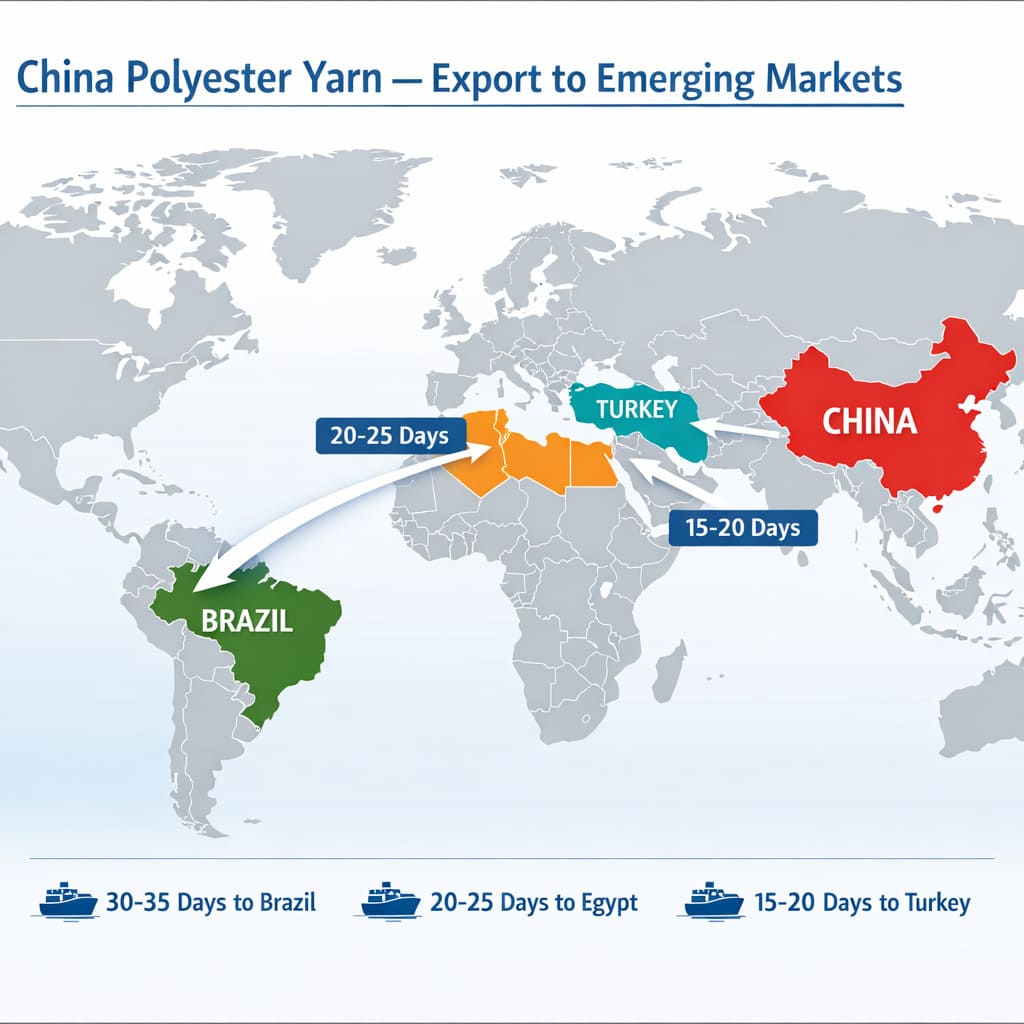
🚢 Yaakan's Experience in Turkey, Egypt and India
Yaakan has been exporting polyester yarn to all three markets for over 18 years. Here's what we typically supply to each: 📦
- 🇹🇷 Turkey — GRS-certified rPET DTY and FDY for sustainable fashion supply chains; Cationic CD+SD composite for two-tone fashion fabric; Elastic yarn (T400, PBT) for stretch denim and sportswear. Shipments to Istanbul (Ambarlı) and Mersin.
- 🇪🇬 Egypt — Polyester Staple Fiber (PSF) for cotton blending; DTY SD for knitwear; Poly-Cotton TC yarn for shirting and uniform fabric. Shipments to Alexandria and Port Said. Currently routing via Cape of Good Hope — please contact us for current rates.
- 🇮🇳 India — Trilobal Bright FDY for saree and dress fabric; Cationic DTY for colour-effect fashion fabric; Sea Island yarn for premium microfibre. Shipments to JNPT Mumbai, Chennai, and Mundra.
📝 Summary
- 🇹🇷 Turkey — EU-facing quality market; top need is rPET + Cationic + Elastic; sophisticated buyers with high certification requirements; 18–24 days from Xiamen
- 🇪🇬 Egypt — Africa's largest textile market; top need is PSF + DTY + TC spun; price-sensitive; 18–22 days from Xiamen (check current Red Sea routing)
- 🇮🇳 India — world's largest domestic textile market; top need is Bright/Trilobal FDY + Cationic DTY; very price-sensitive; strong domestic competition; 10–16 days from Xiamen
Are you a yarn buyer or trader in Turkey, Egypt or India? Contact Yaakan for current FOB Xiamen pricing — we respond within 24 hours. 👇
Sourcing Yarn for Turkey, Egypt or India?
Tell us your product, specification, quantity and destination port — we'll send competitive FOB Xiamen pricing with the right documentation for your market within 24 hours.