What Is Bamboo Fiber Yarn? —
Bamboo vs Cotton vs Viscose Explained
Bamboo fabric is marketed as one of the softest, most sustainable and most "naturally antibacterial" textiles available. But there's a lot of confusion — and some genuine misinformation — around bamboo fibre. Is it natural or processed? Is it really antibacterial? Is it the same as viscose? And how does it compare to cotton? 🎋
This guide gives you the honest, complete picture of bamboo fibre yarn — the two completely different types, how each is made, the truth about the antibacterial and sustainability claims, and how bamboo compares to cotton and viscose. If you're sourcing bamboo yarn or fielding buyer questions about it, this is your straight-talking reference. ✅
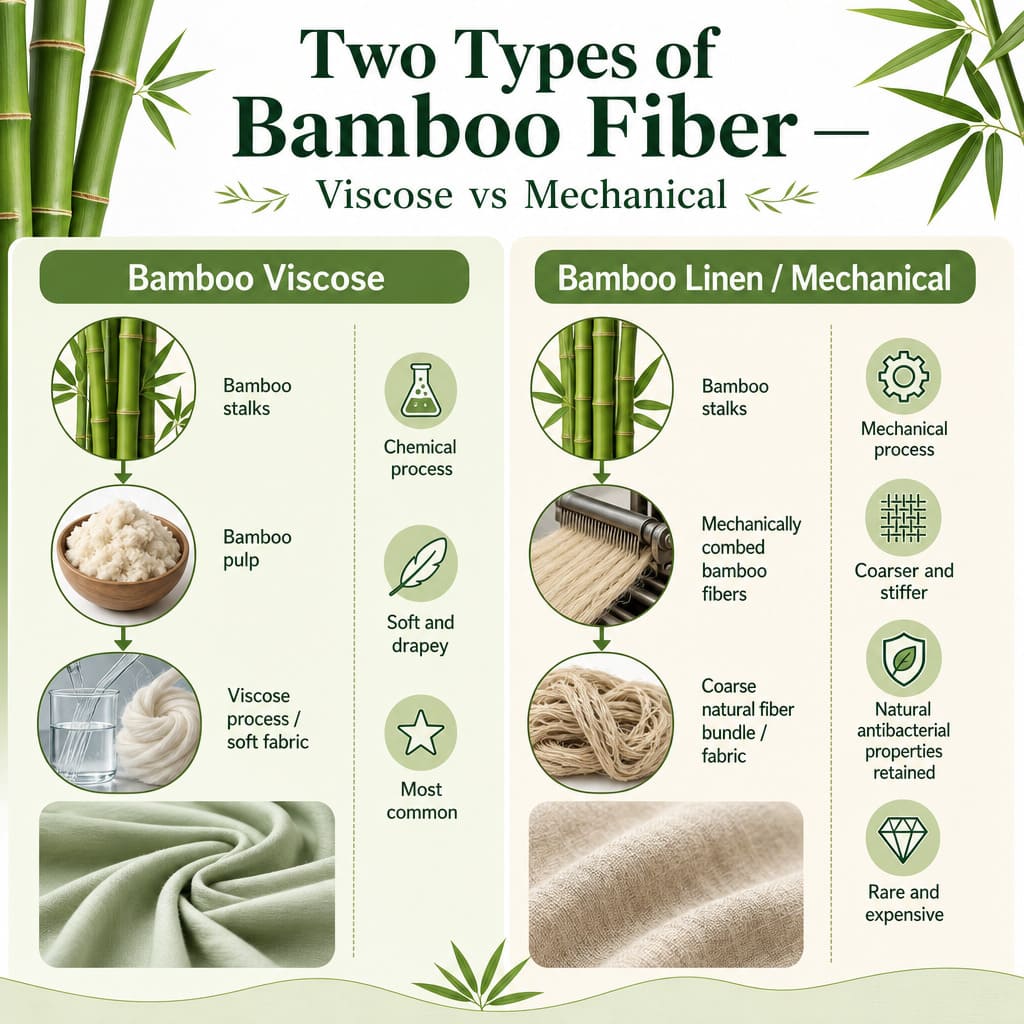
🎋 First — There Are Two Completely Different "Bamboo" Fibres
The single biggest source of confusion is that "bamboo fabric" can mean two completely different materials, made by completely different processes, with completely different properties. Understanding this distinction is essential: 🔍
When someone says "bamboo fabric" or "bamboo yarn", they almost always mean bamboo viscose (99% of the market). This is why many regulators — including the US FTC — require it to be labelled as "viscose made from bamboo" or "rayon from bamboo", not simply "bamboo". True mechanical bamboo (bamboo linen) is rare and costs significantly more. Always clarify which one you're sourcing.
🏭 How Bamboo Viscose Is Made
Since bamboo viscose dominates the market, here's how it's produced — note that it's the same viscose process described in our viscose fibre guide, just using bamboo as the cellulose source: 🔬
Modern producers can also make bamboo using the cleaner lyocell closed-loop process — this is sometimes marketed as "bamboo lyocell" or "monocel", which is more environmentally efficient than conventional bamboo viscose. 🌱
🦠 The Truth About "Antibacterial Bamboo"
The most common marketing claim about bamboo fabric is that it's "naturally antibacterial" thanks to a substance called bamboo kun. Here's the honest reality buyers need to understand: 🔬
The US FTC has fined multiple companies for falsely advertising bamboo viscose as "antibacterial" and "natural bamboo". If you sell into the US, EU or other regulated markets, do not make unsubstantiated antibacterial or "natural bamboo" claims on bamboo viscose products. Label it as "viscose made from bamboo" and only claim antibacterial function if you have test certification (e.g. from a built-in antibacterial additive). This protects you legally and commercially.
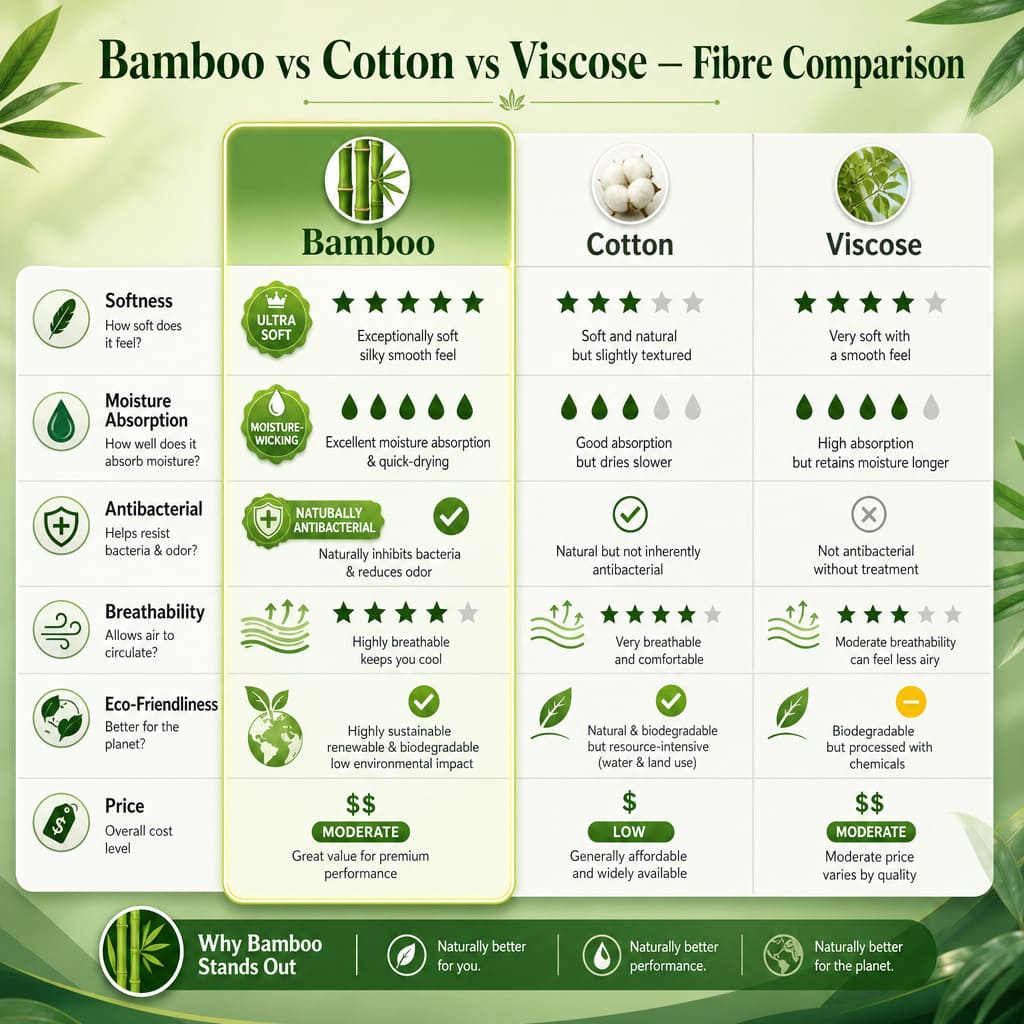
📊 Bamboo vs Cotton vs Viscose — Full Comparison
Here's how bamboo viscose (the common type) compares to cotton and standard wood-based viscose across the properties that matter: 📋
| Property | 🎋 Bamboo Viscose | 🌾 Cotton | 🌿 Wood Viscose |
|---|---|---|---|
| Fibre type | Regenerated cellulose | Natural | Regenerated cellulose |
| Softness | Exceptional — silky | Soft | Very soft |
| Drape | Excellent, fluid | Moderate | Excellent, fluid |
| Moisture absorption | Excellent | Good (8%) | Excellent (11–13%) |
| Breathability | Excellent | Excellent | Excellent |
| Cool-touch feel | Yes — cool, smooth | Neutral | Yes |
| Dry strength | Moderate | Good | Moderate |
| Wet strength | Weak (like viscose) | Increases wet | Weak |
| Wrinkle resistance | Poor — wrinkles | Moderate | Poor |
| Shrinkage | 2–4% | 3–5% | 2–4% |
| Antibacterial (inherent) | Minimal (process destroys it) | None | None |
| Raw material renewability | Excellent — bamboo grows fast | High water/pesticide use | Trees (slower) |
| Price (rel. to cotton) | ~100–120% | 100% (baseline) | ~80–90% |
🌱 Is Bamboo Sustainable? The Balanced View
Bamboo's sustainability story is genuinely mixed — the raw material is excellent, but the processing is the same as viscose. Here's the balanced picture: 🌍
✅ The Genuine Sustainability Advantages
- 🎋 Bamboo grows extremely fast — up to 1 metre per day for some species, the fastest-growing plant on earth
- 💧 Minimal water — bamboo needs far less water than cotton and no irrigation in most regions
- 🚫 No pesticides — bamboo grows without pesticides or fertilisers in most cases
- 🌳 Regenerates from roots — harvesting doesn't kill the plant; it regrows without replanting
- 💨 High CO₂ absorption — bamboo absorbs more CO₂ and releases more oxygen than equivalent trees
⚠️ The Processing Caveat
- 🧪 Bamboo viscose uses the same chemical process as wood viscose — carbon disulphide and caustic soda. The sustainable raw material is partly offset by chemical processing.
- ♻️ Closed-loop bamboo (bamboo lyocell) is far cleaner — if sustainability is the priority, specify bamboo lyocell over bamboo viscose
- 📜 Certifications matter — look for OEKO-TEX, FSC bamboo source, or closed-loop processing certification to substantiate eco claims
Bamboo as a raw material is genuinely one of the most sustainable fibre sources available. But bamboo viscose processing is no cleaner than wood viscose. The most sustainable bamboo option is bamboo lyocell (closed-loop). For honest marketing: praise bamboo's renewable raw material, but don't overstate the processed fibre's environmental credentials unless you use the closed-loop process.
🤝 Bamboo Blended Yarns
Like other regenerated cellulose fibres, bamboo blends well with polyester and cotton to balance its softness against its weaknesses (low wet strength, wrinkling): 🧵
- 🎋 Bamboo / Cotton — combines bamboo's silky softness with cotton's strength and structure; popular for premium T-shirts and baby wear
- 🧪 Bamboo / Polyester — polyester adds durability, wrinkle resistance and lower cost; good for activewear and easy-care fabric
- 🌿 Bamboo / Spandex — adds stretch for fitted garments, leggings and underwear
- 🌳 Tri-blends — bamboo/cotton/polyester or bamboo/cotton/spandex for balanced comfort, durability and fit
Yaakan supplies 100% bamboo yarn (bamboo viscose, Ne 16/1 to 60/1) and bamboo blended spun yarn — bamboo/cotton, bamboo/polyester and tri-blends — produced by Ring Spun, Vortex or Siro Compact methods. We provide honest product descriptions and certification so you can market your fabric correctly and legally.
🎯 Who Should Use Bamboo Yarn?
| Application | Bamboo a Good Fit? | Notes |
|---|---|---|
| Premium soft T-shirts | ✓ Excellent | Silky softness is bamboo's strength; blend with cotton for durability |
| Baby & children's wear | ✓ Excellent | Soft, smooth, cool — but verify safety certification |
| Underwear & loungewear | ✓ Excellent | Soft, breathable, moisture-managing |
| Bed sheets & bedding | ✓ Very good | Cool, smooth, silky — premium bedding category |
| Summer apparel | ✓ Good | Cool-touch and breathable |
| Towels | ~ Moderate | Absorbent but lower wet strength; usually blended with cotton |
| Activewear | ~ With polyester | Blend with polyester for strength and quick-dry |
| Structured / tailored garments | ✗ Poor alone | Wrinkles and lacks structure; needs blending |
| Heavy-duty workwear | ✗ Not suitable | Insufficient strength; use polyester or cotton |
📝 Summary
- 🎋 Two types: Bamboo viscose (chemical, 99% of market) vs mechanical bamboo / bamboo linen (physical, rare, premium)
- 🧪 Bamboo viscose is essentially viscose made from bamboo — regenerated cellulose, must be labelled "viscose made from bamboo" in many markets
- 🦠 Antibacterial claim: mostly destroyed in chemical processing — don't make inherent claims; use a tested built-in additive if needed
- 🪶 Strengths: exceptional softness, drape, moisture absorption, cool-touch
- ⚠️ Weaknesses: weak when wet, wrinkles, moderate strength (same as viscose)
- 🌱 Sustainability: excellent raw material; viscose processing is the caveat — bamboo lyocell is the cleanest option
- 🤝 Blends well with cotton (strength), polyester (durability), spandex (stretch)
Sourcing bamboo or bamboo-blend yarn? Contact Yaakan — we supply 100% bamboo and bamboo blends with honest descriptions and certification, so you can market your fabric accurately. Free samples available. 👇
Source Bamboo & Bamboo-Blend Yarn
100% bamboo viscose, bamboo/cotton, bamboo/polyester and tri-blends — in Ring Spun, Vortex or Siro Compact. Honest descriptions, full certification, free samples within 24 hours.