Ring Spun vs Vortex vs Siro Compact —
The Three Spinning Technologies Explained
You're sourcing polyester spun yarn. The quotation comes back with three different prices for the same count: Ring Spun T30S, Vortex T30S, and Siro Compact T30S. Same denier, same fibre composition — but different prices, and the fabric will look and feel different from each. Why? 🤔
The difference lies in how the yarn is spun. Three completely different machine technologies are used to turn polyester staple fibre (or cotton, viscose, blends) into yarn — and each produces yarn with distinct surface, strength, hairiness and fabric character. This guide explains the three dominant spinning technologies, how to recognise each in finished yarn, and which to choose for your application. ✅
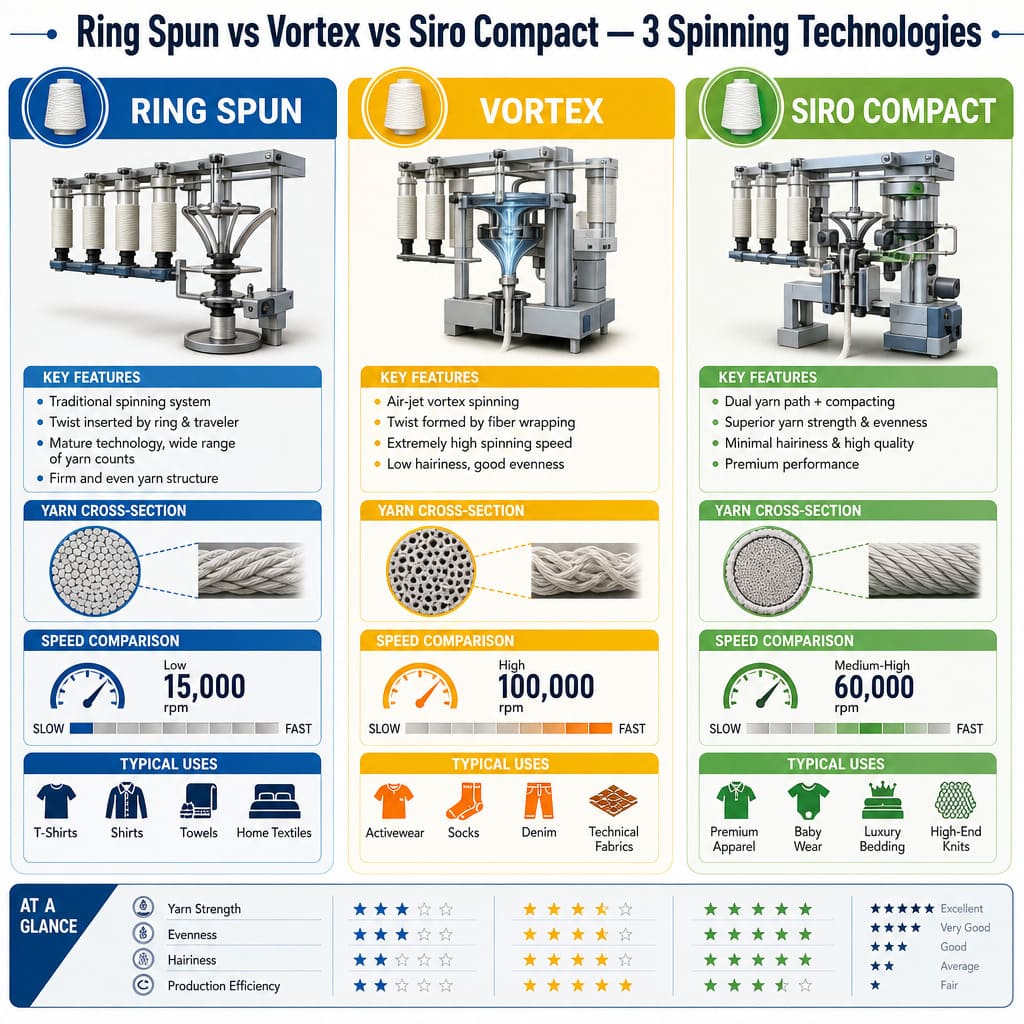
🧵 The Three Spinning Technologies — At a Glance
⚙️ Ring Spun (环锭纺) — The Traditional Standard
Ring spinning is the oldest still-dominant yarn manufacturing method. Invented by John Thorp in 1828 and refined continuously since then, it remains the choice for premium-quality yarn and any application requiring maximum yarn strength or fine count capability. 🏛️
How It Works
Loose fibre roving is drawn through drafting rollers that pull the fibres to the required thinness. The thinned strand passes through a tiny "traveller" that orbits around a rotating ring — each revolution adds one twist to the yarn. The twisted yarn winds onto a high-speed spindle below. Simple in concept, mechanically refined over two centuries. ⚙️
Why Ring Spun Yarn Feels Different
In ring spinning, fibres are gathered into a triangular formation as they twist together. This spinning triangle creates the classic ring spun structure: outer fibres wrap helically around the yarn axis while inner fibres run more straight. The result is yarn with more loose surface fibres (hairiness) giving the soft, natural hand feel — but more pilling tendency. 🪶
Strengths: Highest tensile strength (around 18–25 cN/tex for polyester), softest hand feel, capable of finest counts (Ne 100+), most uniform yarn structure. Universally accepted for premium fabric.
Limitations: Slowest method — 15–25 m/min vs vortex at 350+. Higher hairiness leads to more pilling on knitwear. Each spindle is a separate spinning point — large floor space, higher labour requirement.
🌀 Vortex Spinning (MVS / 涡流纺) — The Speed Revolution
Murata Vortex Spinning (MVS) was commercialised by Japanese textile machinery maker Murata in 1997. It is the modern high-speed alternative to ring spinning — using compressed air instead of mechanical twisting to create yarn at unprecedented speed. 🚀
How It Works — No Ring, No Traveller
Drafted fibre stream enters a tiny nozzle where compressed-air jets create a high-speed vortex. The vortex grabs the outer fibres and wraps them tightly around the inner fibre core — creating a unique "wrapper-and-core" yarn structure in milliseconds. No mechanical contact, no ring, no traveller. Yarn exits the nozzle ready to wind directly onto a finished package. 💨
The Unique Vortex Yarn Structure
Vortex yarn looks fundamentally different from ring spun under a microscope. It has two distinct fibre groups: a parallel-aligned inner core (untwisted) wrapped by an outer helical sheath of wrapping fibres. This wrapped structure gives vortex its signature properties — exceptional pilling resistance (no loose surface fibres to pill), low hairiness, and slightly stiffer hand feel. 🧬
Strengths: 20× faster than ring spinning (350–500 m/min). Excellent pilling resistance — best of the three. Very low hairiness. Lower energy per kg of yarn. Cleaner surface for printing. Best fabric appearance retention after washing.
Limitations: Strength 10–20% lower than ring spun. Slightly stiffer hand feel — less suitable for next-to-skin softness applications. Limited to medium counts (Ne 20–60s typical, not for fine counts). Requires consistent high-quality fibre input.
💎 Siro Compact Spinning (赛络紧密纺) — Premium Refined Ring
Siro Compact is not a new technology — it is the premium refinement of ring spinning. It combines two improvements onto traditional ring spinning machinery: Siro spinning (twin-strand technique developed in Australia in the 1970s) and Compact spinning (fibre condensation, developed in Switzerland in the 1990s). Together they produce the highest-quality ring-family yarn available. ✨
Siro — The Twin-Strand Innovation
Traditional ring spinning feeds one roving into one spinning point. Siro spinning feeds two parallel rovings through the drafting zone, which then come together at the spinning triangle and twist around each other. The result is yarn with a 2-ply-like structure produced in a single spinning step — naturally stronger, more uniform, and with reduced hairiness. 🧬
Compact — Condensing the Fibre Bundle
In standard ring spinning, fibres emerge from the drafting rollers in a slightly fanned-out triangle. Compact spinning uses suction (negative pressure through a perforated drum or apron) to condense the fanned fibres into a narrow, parallel bundle before they enter the spinning triangle. This eliminates loose edge fibres — dramatically reducing hairiness and increasing the percentage of fibres contributing to yarn strength. 🌬️
Siro Compact spinning runs both technologies on the same machine: twin-roving feed (Siro) + suction condensation (Compact). The result is the cleanest, strongest, most uniform ring-family yarn possible — typically priced 10–25% above standard ring spun, justified by premium fabric performance.
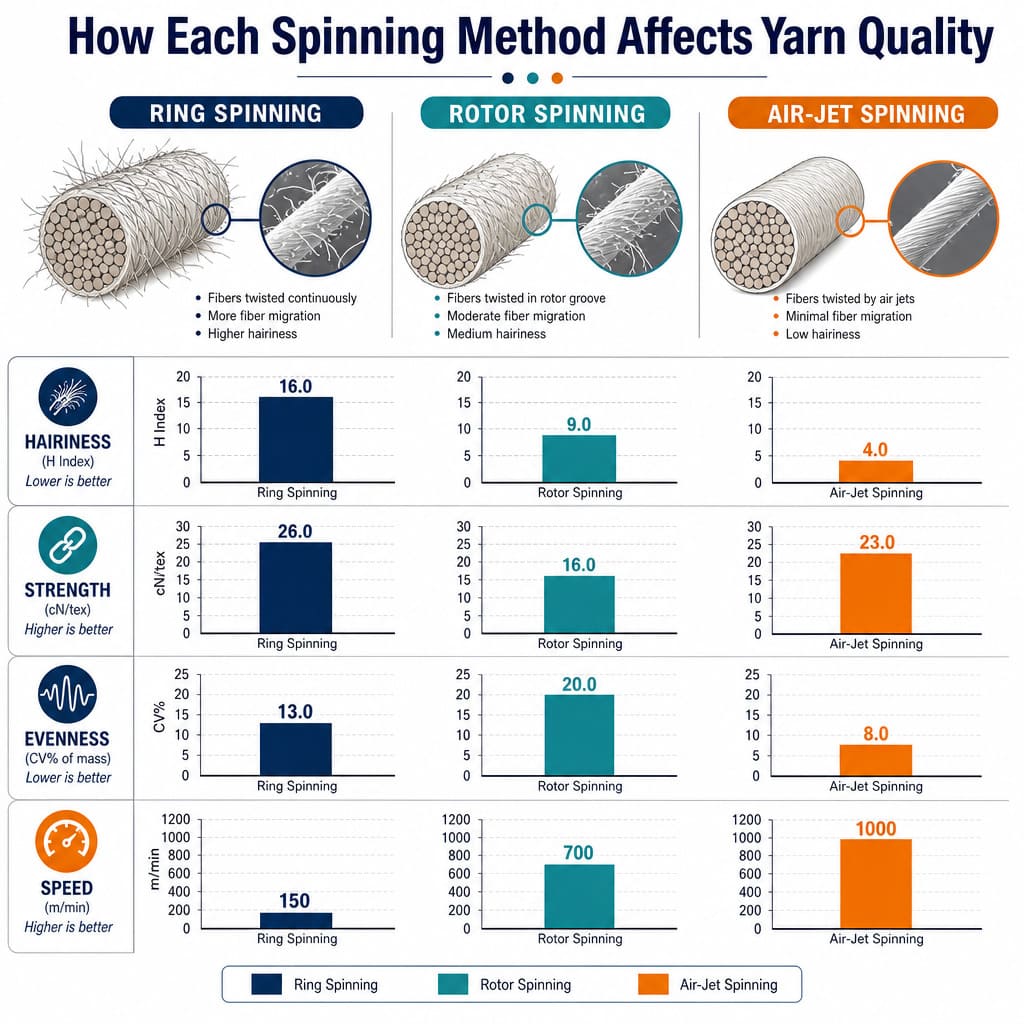
🔬 The Yarn Structure — Side by Side
Under microscopy, the three yarn structures look completely different. Here's a simplified visual of each: 🔍
⚡ Speed Comparison — Why Vortex Disrupted the Industry
Spinning speed determines production cost. Here's a visual comparison of typical delivery speeds (note: rotor/open-end spinning included for reference): 📊
Despite vortex's massive speed advantage, ring spun still dominates premium and fine-count markets. The reason is simple: fabric performance matters more than yarn cost. Premium shirting, fine knitwear and luxury fabric command prices that justify ring spinning's higher cost. Vortex wins in commodity T-shirts, low-pilling fabric, and applications where speed-to-cost matters more than ultimate hand feel.
📋 Head-to-Head Comparison Table
| Property | 🔵 Ring Spun | 🟠 Vortex (MVS) | 🟢 Siro Compact |
|---|---|---|---|
| Spinning speed | 15–25 m/min | 350–500 m/min | 15–22 m/min |
| Yarn tenacity | High (baseline) | 10–20% lower | 5–10% higher than ring |
| Hairiness (H value) | 5.0–7.0 | 2.5–4.0 (lowest) | 3.0–4.5 |
| Pilling resistance | Moderate (3–3.5) | Excellent (4–4.5) | Good (4) |
| Hand feel | Softest, natural | Slightly stiff, "drier" | Smooth, clean, refined |
| Count range | Ne 6–120 (very wide) | Ne 20–60 typical | Ne 20–100 |
| Suitable fibres | All — cotton, polyester, viscose, blends | Polyester, cotton, viscose, blends (not wool) | All — esp. cotton, polyester, blends |
| Twist style | S or Z twist | Wrapper-core structure | S or Z twist (2-ply look) |
| Yarn evenness (CV%) | 11–13% | 13–15% | 10–12% (best) |
| Energy use per kg yarn | Higher | ~30% lower | Similar to ring |
| Price (rel. to ring) | 100% (baseline) | ~85–95% | ~110–125% |
| Best fabric | Premium knit/woven, fine count | T-shirts, sportswear, anti-pill | Premium shirting, suiting, fine knit |
🎯 Which Spinning Method to Choose?
Choosing the right spinning method depends on what fabric you're producing and what fabric performance matters most. Here's a decision guide: 📋
| Your Priority | Recommended Method | Why |
|---|---|---|
| Maximum softness against skin | Ring Spun | Surface hairiness creates the softest feel |
| Minimum pilling on finished garment | Vortex (MVS) | Wrapper structure has no loose surface fibres |
| Premium shirting or fine business shirt | Siro Compact | Cleanest appearance + strongest yarn |
| Lowest cost for commodity T-shirts | Vortex | Lower production cost, anti-pill performance |
| Premium knit dress fabric | Ring Spun or Siro Compact | Soft hand and drape essential |
| Sportswear with frequent washing | Vortex | Best appearance retention after wash cycles |
| Fine count (Ne 80+) premium fabric | Siro Compact | Ring spun also possible but Siro Compact stronger |
| Coarse count (Ne 6–16) workwear | Ring Spun | Strength essential for heavy fabric |
| Print-receptive smooth fabric | Vortex | Low hairiness gives cleaner print surface |
| Suiting / formal fabric | Siro Compact | Premium hand + crease recovery |
| Yarn for embroidery thread | Siro Compact | Highest strength + smooth surface essential |
🏭 Yaakan's Spinning Range
Yaakan supplies polyester spun yarn and blended spun yarn produced by all three spinning methods. Common specifications by count and method: 📦
| Product | Available Counts | Spinning Methods Available |
|---|---|---|
| 100% Polyester Yarn | T10S, T16S, T21S, T26S, T30S, T32S, T40S, T45S, T30S/2, T32S/2 | Ring Spun / Vortex / Siro Compact |
| Polyester / Cotton (T/C) | T65/C35 in 21S, 26S, 32S; T85/C15 in 21S, 32S; T75/C25 in 26S, 32S | Ring Spun / Vortex / Siro Compact |
| Cotton / Polyester (CVC) | C60/T40 in 21S, 26S, 32S, 40S | Ring Spun / Vortex / Siro Compact |
| 100% Viscose Yarn | R30S, R40S | Ring Spun / Siro Compact / Vortex |
| Blended Spun Yarn | Polyester/Viscose/Tencel/Cotton/Bamboo/Modal blends — Ne 16/1 to 80/1 | All three methods |
When ordering spun yarn, always specify the spinning method — "T30S Ring Spun" or "T30S Vortex" or "T30S Siro Compact". Without this specification, you may receive yarn that technically matches the count but produces fabric with wrong hand feel for your application. The count alone is not a complete specification.
📝 Summary
- ⚙️ Ring Spun (环锭纺) — Traditional, slowest, strongest, softest hand. Premium fabric, fine counts, knit comfort. The benchmark.
- 🌀 Vortex (涡流纺 / MVS) — Modern air-jet, 20× faster, lowest hairiness, anti-pill. T-shirts, sportswear, washing durability. Wrapper-core structure.
- 💎 Siro Compact (赛络紧密纺) — Premium refined ring spinning with twin-roving + compact suction. Highest quality, premium shirting and suiting. 10–25% premium price.
- 📊 Trade-offs — Ring = soft + strong but slow + hairy. Vortex = fast + clean but slightly stiff. Siro Compact = best ring quality but at premium price.
- 📋 Always specify spinning method when ordering — count alone is incomplete
Need to compare spinning methods for your fabric? Contact Yaakan — we can send samples of the same yarn count produced by Ring Spun, Vortex and Siro Compact methods so you can compare hand feel directly. Free samples for all three. 👇
Compare All Three Spinning Methods
Send us your count and fibre composition — we'll dispatch samples in Ring Spun, Vortex and Siro Compact so you can choose the right yarn for your fabric.