Polyester Yarn Packaging, Shipping & Claims —
What Every Buyer Should Know
You've placed your order, the yarn is on its way — but what arrives in the carton, and what happens if something isn't right? A weight shortage, a shade that doesn't match the sample, a few damaged cones from rough handling. These post-delivery issues are where buyer-supplier relationships are really tested. 📦
This guide covers what happens after you order: how polyester yarn is packaged for export, what to check on arrival, and — most importantly — how to handle weight shortages, colour variation and quality claims professionally so they get resolved fairly. Knowing the process protects you and signals to suppliers that you're a serious buyer. ✅
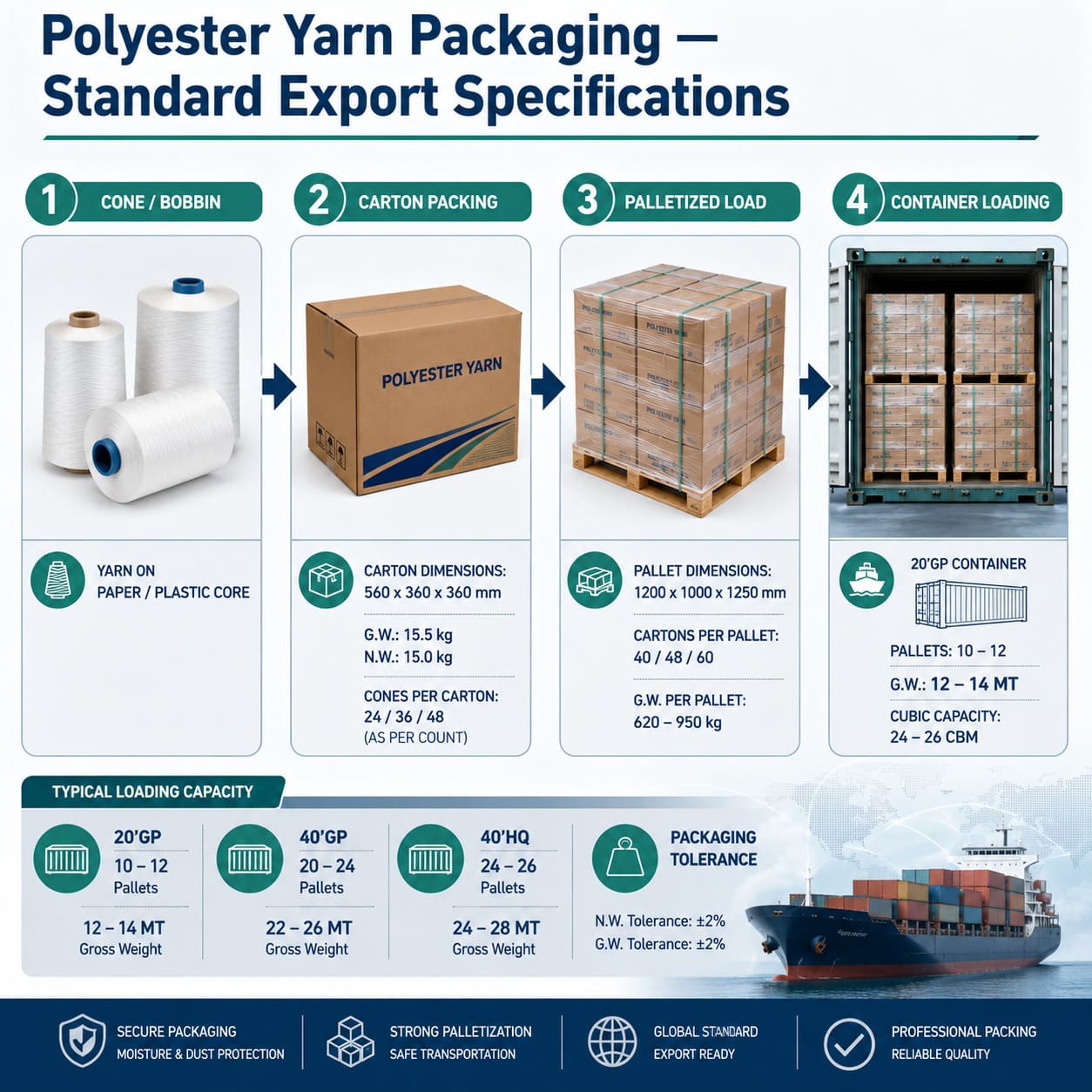
📦 How Polyester Yarn Is Packaged for Export
Export yarn packaging is built in layers, each protecting the yarn and carrying the information you need to verify your shipment: 🧵
Layer 1 — The Cone / Bobbin
Yarn is wound onto a paper or plastic tube (cone). Filament yarn (DTY/FDY) typically winds ~1.5–4 kg net per cone; spun yarn cones are usually ~1.0–1.89 kg net. Each cone should be uniform, cleanly wound and free of damage.
Layer 2 — The Carton
Cones are packed into cartons, usually with an inner plastic liner to keep out moisture and dust. A typical carton holds ~20–48 kg net depending on yarn type. The carton is marked with net weight, gross weight, count/denier, colour, lot number and carton number.
Layer 3 — The Pallet (optional)
Cartons are often stacked and shrink-wrapped onto wooden or plastic pallets for easier handling and to protect against floor moisture and forklift damage. Palletised loads are faster to unload and reduce handling damage.
Layer 4 — The Container
Pallets or loose cartons are loaded into shipping containers. A 20ft container holds roughly 10–12 tonnes of yarn; a 40ft HQ holds roughly 20–25 tonnes, depending on yarn density and packaging. Loading should be tight and braced to prevent shifting.
Net weight = the weight of the yarn only. Gross weight = yarn + cone + carton + packaging. Yarn is bought and priced on net weight. When checking a shipment, always weigh against net weight figures — confusing net and gross is one of the most common causes of "weight shortage" disputes that turn out to be misunderstandings. The packing list states both; check which one you're comparing.
✅ What to Check the Moment Your Shipment Arrives
The actions you take in the first 24–48 hours after delivery are critical — they determine whether you can make a successful claim if something is wrong. Here's your arrival checklist: 📋
📋 Arrival Inspection Checklist
If you suspect a problem (wrong colour, quality defect), stop before knitting or weaving. Once yarn is processed into fabric, most suppliers will reject the claim — you can no longer prove the yarn was the cause, and the value of any settlement drops dramatically. Inspect first, process second. Knitting up suspect yarn "to see if it's OK" is the single most common reason valid claims fail.
🔍 The Three Most Common Post-Delivery Issues
Common Causes
Net vs gross confusion; moisture regain differences (polyester is stable, but spun blends with cotton/viscose vary with humidity); genuine under-filling; scale calibration differences between origin and destination.
How to Handle
Weigh a representative sample of cartons on a calibrated scale, compare to net weight markings, document with photos. A small variance (±1–2%) is normal trade tolerance; larger consistent shortfalls warrant a claim.
Common Causes
Different dye lots mixed in one order; viewing under wrong lighting (metamerism); comparing to an outdated sample; yarn-property variation affecting dye uptake. See our dyeing guide for why shade varies.
How to Handle
Compare against your approved lab dip / sealed sample under standard D65 lighting, not office light. Keep cones from each lot separate. For large orders, specify single-dye-lot up front to prevent this entirely.
Common Causes
Excessive yarn breaks/joins, oil stains, uneven count (CV%), tension variation, contamination. Often shows up as fabric defects (streaks, barré) during processing.
How to Handle
Test against agreed specs before processing — see our quality testing guide. Document defects with photos and the affected lot numbers. Independent lab testing strengthens a claim.
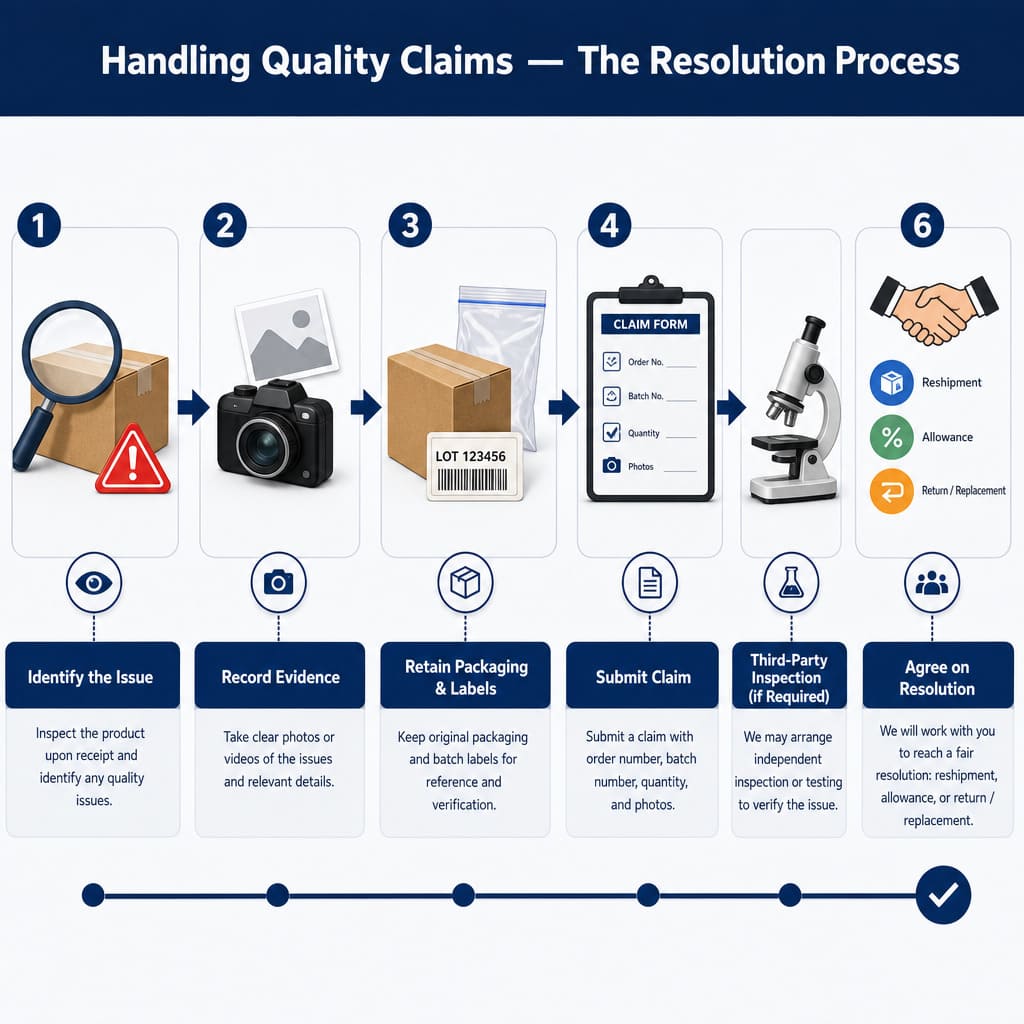
📋 The Claim Process — Step by Step
When you do have a genuine issue, handling the claim professionally gets it resolved faster and more fairly. Follow this sequence: 🤝
- Order & lot details: PO number, invoice number, affected lot/batch numbers
- Quantity affected: exact cartons/cones/kg involved, not the whole order if only part is affected
- Clear evidence: dated photos, weight records, test reports, retained original samples/labels
- The standard breached: reference to the agreed spec, approved sample, or contract term
- Requested remedy: be specific — replacement, credit note, price reduction, etc.
🤝 Common Resolution Outcomes
| Issue Severity | Typical Resolution | When It Applies |
|---|---|---|
| Minor (within tolerance) | No action / goodwill note | Variance within agreed trade tolerance (e.g. ±1–2% weight) |
| Moderate, yarn usable | Price discount / credit | Defect reduces value but yarn still usable; partial credit on affected lots |
| Significant, partial | Replace affected lots | Specific lots defective; supplier replaces those cartons |
| Major, unusable | Full replacement / refund | Yarn unfit for purpose; full remedy for affected quantity |
| Disputed cause | Third-party arbitration | SGS/Intertek test or trade body mediation determines outcome |
🛡️ Preventing Problems Before They Happen
The best claim is the one you never need to make. These steps prevent most post-delivery issues: 🎯
- 📝 Approve a sealed sample / lab dip before bulk production — your reference for any colour dispute
- 📋 Agree specs in writing — count, denier, colour standard, fastness, tolerance, packaging — in the contract or PI
- 📦 Specify single dye lot for large colour orders to prevent shade variation
- 🔬 Consider pre-shipment inspection (PSI) — a third-party check before the goods leave China; see our import guide
- ⏱️ Know your claim window — agree the claim notification period in the contract (commonly 14–30 days after arrival)
- 🤝 Work with established suppliers — reputable suppliers stand behind their goods; see our reliable supplier guide
Yaakan packs to international export standards with clear net/gross weight, count, colour and lot marking on every carton. We provide packing lists, retain dye-lot records, and approve sealed samples before bulk. If an issue arises, we work with buyers transparently — documentation, third-party testing where needed, and fair resolution. 18 years of repeat business across 50+ countries is built on standing behind what we ship.
📝 Summary
- 📦 Packaging layers: cone → carton (with net/gross/lot marking) → pallet → container
- 🏷️ Net vs gross: yarn is priced on net weight — never confuse the two when checking shipments
- ✅ On arrival: photograph, count cartons, weigh samples, check colour vs sealed sample, keep lot labels — within 24–48 hrs
- ⚠️ Golden rule: don't process suspect yarn — inspect before knitting/weaving or the claim fails
- 🔍 Three common issues: weight shortage, colour variation, quality defects — each with specific causes & handling
- 📋 Strong claim: order/lot details, affected quantity, dated evidence, standard breached, requested remedy
- 🛡️ Prevention: sealed sample approval, written specs, single dye lot, pre-shipment inspection, established suppliers
Want a supplier who packs properly and stands behind every shipment? Contact Yaakan — clear packaging, full documentation, sealed-sample approval and transparent after-sales support. 👇
Order with Confidence
Professional export packaging, full documentation, and transparent after-sales support. Tell us what you need; we'll send a quote, packing details and free samples within 24 hours.