Stretch Yarn Guide —
PTT vs PBT vs T400 vs T800 Elastic Polyester
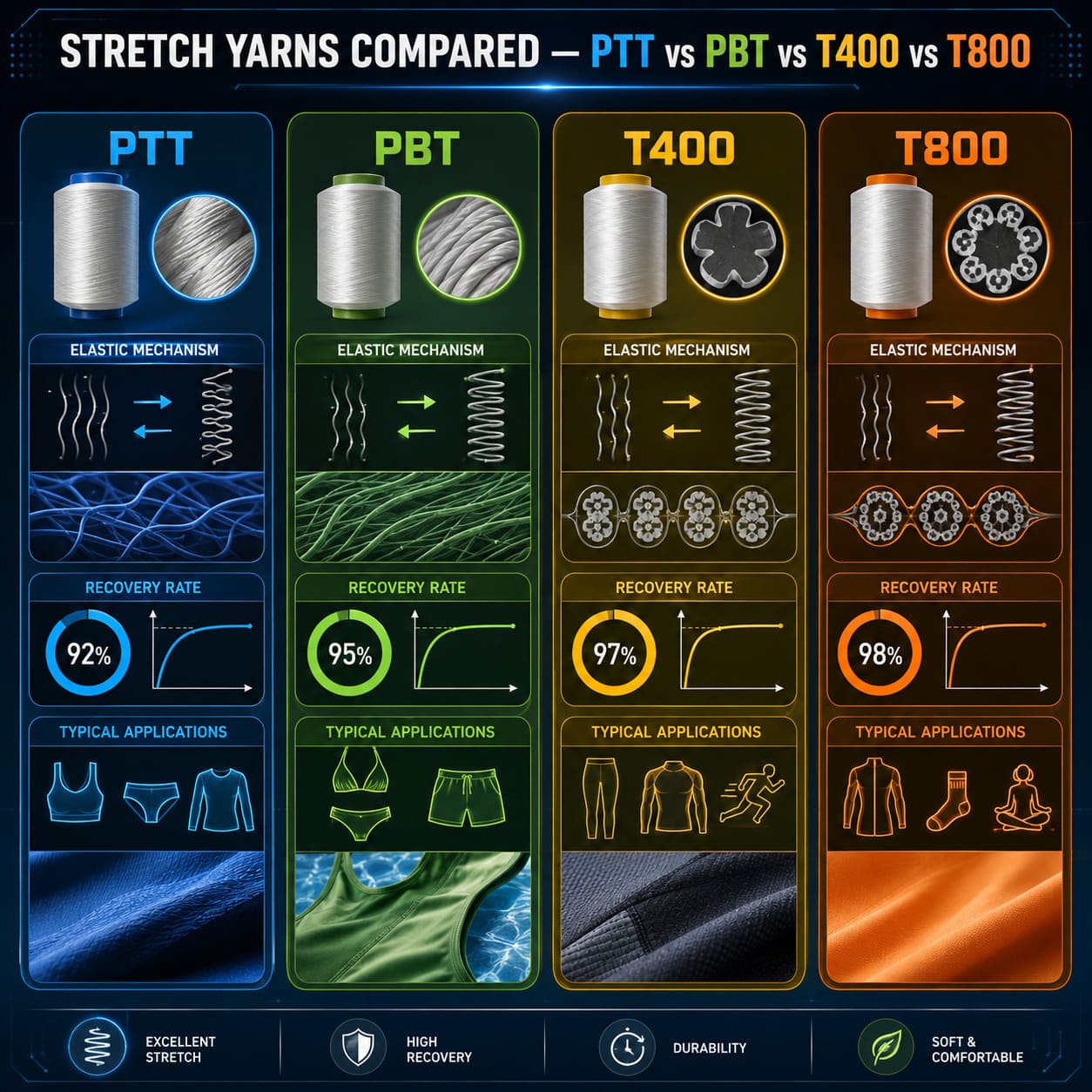
Stretch is everywhere in modern fabric — jeans that move with you, sportswear that flexes, comfortable shirts that don't restrict. Most people assume all stretch comes from spandex (elastane). But there's a whole family of elastic polyester yarns — PTT, PBT, T400 and T800 — that deliver stretch without any spandex at all. 🧬
These polyester-based stretch yarns offer significant advantages over spandex: better durability, no rubber-band ageing, easier dyeing, and recyclability. But they each work differently and suit different applications. This guide explains how each stretch yarn works, how they compare, and which to choose for your fabric. ✅
⚙️ Two Ways Polyester Can Stretch — The Foundation
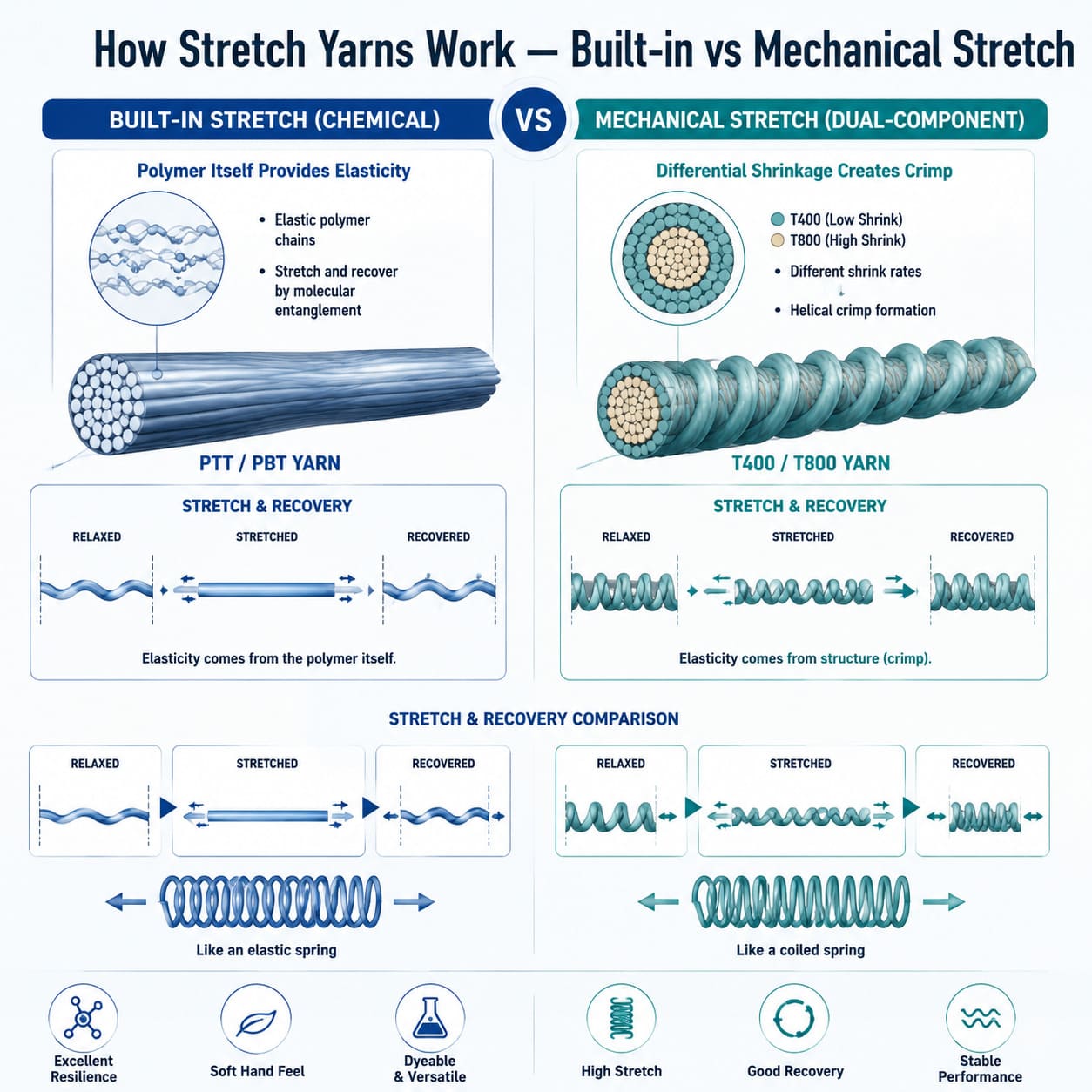
Before looking at the individual yarns, it's essential to understand the two fundamentally different ways polyester yarn can have stretch. This is the key to understanding the whole category: 🔬
🧵 The Four Stretch Yarns — In Detail
📊 Stretch Level Comparison
Here's how the typical stretch (elongation) of each yarn compares — with spandex shown for reference (note: spandex has far higher stretch but the trade-offs are explained below): 📏
Spandex stretches 400–700% — far more than these polyester yarns. But for most apparel, you don't want that much stretch — you want comfortable "give" (20–45%) that recovers well and lasts. Polyester stretch yarns provide exactly this moderate, durable, comfortable stretch — without spandex's downsides. The lower stretch number is a feature, not a limitation, for everyday stretch fabric.
🆚 Polyester Stretch Yarn vs Spandex (Elastane)
Why choose PTT/PBT/T400/T800 over traditional spandex? Here are the real advantages — and the honest trade-offs: ⚖️
| Factor | Polyester Stretch (PTT/PBT/T400/T800) | Spandex (Elastane/Lycra) |
|---|---|---|
| Stretch amount | Moderate (20–45%) | Very high (400–700%) |
| Durability / ageing | Excellent — no rubber ageing | Degrades over time, loses elasticity |
| Chlorine resistance | Excellent (esp. PBT) | Poor — pool water destroys it |
| Heat resistance | Good — survives dyeing/finishing | Limited — heat sensitive |
| Dyeing | Dyes with polyester in one bath | Needs separate handling |
| Recyclability | Yes — all polyester | Complicates recycling |
| Recovery (shape retention) | Excellent, durable | Excellent when new |
| Cost | Competitive | Higher per stretch unit |
| Best for | Comfort stretch, denim, easy-care, durable | High-compression, swimwear, shapewear |
The biggest advantage of polyester stretch yarn is durability. Spandex is a polyurethane rubber that ages and degrades — it loses elasticity, goes "baggy", and breaks down with heat, chlorine, body oils and UV over time. This is why old spandex garments lose their shape. Polyester stretch yarns (PTT/PBT/T400/T800) don't have this problem — the stretch is permanent for the fabric's life. For garments that need to last, this matters enormously.
📋 PTT vs PBT vs T400 vs T800 — Full Comparison
| Property | 🔵 PTT | 🟢 PBT | 🟡 T400 | 🟣 T800 |
|---|---|---|---|---|
| Stretch type | Polymer | Polymer | Bi-component | Bi-component |
| Stretch % | 20–30% | 30–40% | 25–35% | 35–45% |
| Hand feel | Soft, natural | Springy | Crisp | Soft, premium |
| Recovery | Excellent | Excellent | Excellent | Excellent |
| Chlorine resistance | Good | Excellent | Good | Good |
| Forms available | FDY / DTY | DTY | FDY / DTY | DTY |
| Denier range | 50D–300D | 30D–150D | 50D–300D | 30D–300D |
| Best application | Soft stretch apparel, sportswear | Swimwear, high-stretch knit | Stretch denim, woven | Premium stretch, performance |
🎯 Which Stretch Yarn to Choose?
| Your Application | Recommended Yarn | Why |
|---|---|---|
| Stretch denim / jeans | T400 | Durable mechanical stretch ideal for woven denim |
| Swimwear & beachwear | PBT | Chlorine resistance + high stretch essential |
| Soft comfort sportswear | PTT | Natural soft stretch + moisture management |
| Premium stretch fashion | T800 | Softest hand + fine fabric appearance |
| Easy-care stretch shirts | PTT | Stretch + polyester easy-care + recovery |
| High-stretch activewear knit | PBT | High stretch + heat/chemical resistance |
| Stretch woven trousers | T400 | Durable stretch holds shape in woven fabric |
| Premium performance wear | T800 | High stretch + soft premium feel |
| Eco / bio-based stretch | PTT (Sorona) | Partly bio-based, sustainable stretch option |
| Bra & intimate stretch fabric | PBT | High recovery + chlorine/wash resistance |
👕 Bonus — Cotton-Like Elastic Yarn
Beyond the four core stretch yarns, Yaakan also produces Polyester Cotton-Like Elastic Yarn — a spun-effect stretch yarn (available in 25S/35S/40S/50S/60S counts) that combines the matte, soft, cotton-like appearance of spun yarn with built-in elastic stretch. This is ideal for buyers who want the natural look and feel of cotton with the comfort of stretch and the durability of polyester. 🧶
Yaakan supplies the complete elastic polyester yarn range: PTT, PBT, T400, T800 (in FDY/DTY, 30D–300D), plus Mechanical Stretch, Dope Dyed Mechanical Stretch, and Polyester Cotton-Like Elastic (25S–60S). See our Elastic Yarn Series and Cotton-Like Elastic Yarn for the full range. Free samples available for stretch testing.
📝 Summary
- 🧬 Two stretch mechanisms: Polymer stretch (PTT/PBT — coiled molecules) vs mechanical stretch (T400/T800 — bi-component spiral crimp)
- 🔵 PTT — soft natural stretch, partly bio-based (Sorona); soft sportswear, easy-care apparel
- 🟢 PBT — high stretch + chlorine resistance; swimwear, high-stretch knit
- 🟡 T400 — durable bi-component stretch; stretch denim, woven fabric
- 🟣 T800 — premium soft bi-component stretch; premium fashion, performance wear
- 🆚 vs Spandex: less stretch (20–45% vs 400%+) but far more durable, no ageing, chlorine/heat resistant, recyclable, easy dyeing
- 👕 Plus: Cotton-Like Elastic yarn for matte cotton appearance with stretch
Need elastic polyester yarn for stretch fabric? Contact Yaakan — we supply PTT, PBT, T400, T800 and cotton-like elastic with free samples so you can test the stretch and recovery yourself. 👇
Source Elastic Polyester Yarn
PTT, PBT, T400, T800 and cotton-like elastic — spandex-free stretch with durability. Tell us your application and stretch requirement; we'll send a quote and free samples within 24 hours.