Tencel, Lyocell, Modal & Viscose —
The Regenerated Cellulose Fibres Explained
Tencel. Lyocell. Modal. Viscose. Rayon. These names appear on garment labels and yarn specifications constantly — often used interchangeably, often incorrectly. Buyers ask: is Tencel the same as Lyocell? Is Modal better than viscose? Which is the most sustainable? 🌿
All four are regenerated cellulose fibres — made from wood pulp through different processes. But they differ significantly in strength, softness, wet performance, environmental impact and price. This guide explains each one clearly, shows how they compare, and helps you choose the right fibre for your fabric. If you've read our viscose fibre guide, this is the natural next step. ✅
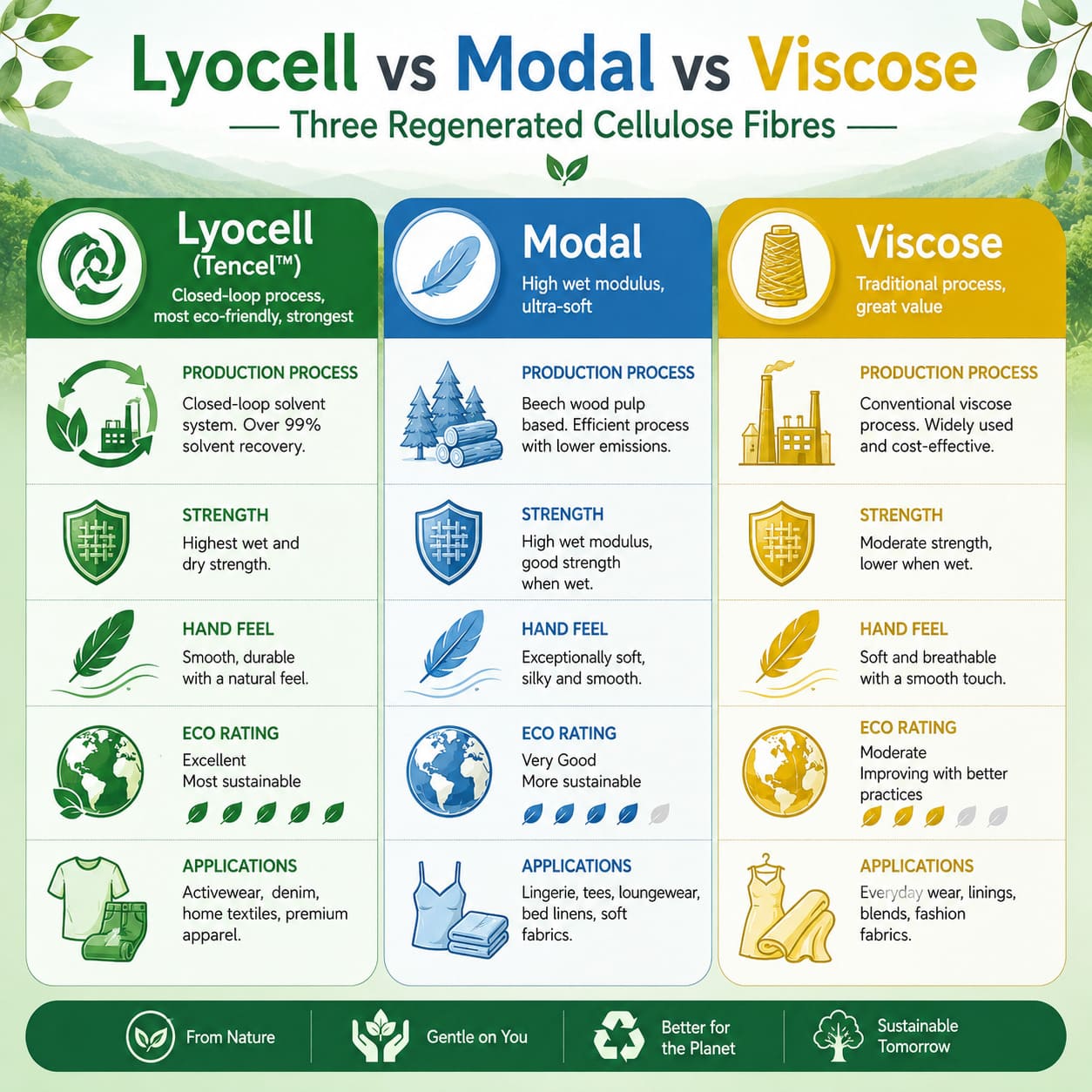
🏷️ First — Clearing Up the Names
The biggest source of confusion is brand names versus generic fibre names. Let's settle this immediately: 📋
🌿 Lyocell = Generic Fibre Name
"Lyocell" is the generic name for a regenerated cellulose fibre made by the closed-loop NMMO solvent process. Any manufacturer can produce and sell "lyocell".
™️ Tencel = Brand Name
"Tencel" is a registered brand owned by Lenzing AG (Austria). Tencel Lyocell is Lenzing's branded lyocell. All Tencel is lyocell, but not all lyocell is Tencel.
🔵 Modal = Generic Fibre Name
"Modal" is a generic name for high-wet-modulus regenerated cellulose. Lenzing also brands its version as "Modal" / "TENCEL Modal".
🟡 Viscose = Rayon = Generic
"Viscose" and "Rayon" are the same thing — the original (and cheapest) regenerated cellulose fibre, made by the traditional viscose process.
Think of it as three generations of the same fibre family: Viscose (1st generation, 1890s, traditional process) → Modal (2nd generation, 1950s, stronger when wet) → Lyocell/Tencel (3rd generation, 1990s, closed-loop eco process, strongest). All are cellulose from wood — the difference is in how they're processed.
🌱 The Three Fibres — At a Glance
🏭 How Lyocell Is Made — The Closed-Loop Revolution
The key reason lyocell is considered the most sustainable regenerated cellulose fibre is its closed-loop manufacturing process. Unlike the traditional viscose process — which uses carbon disulphide and generates chemical waste — lyocell uses a non-toxic organic solvent (NMMO, N-Methylmorpholine N-oxide) that is recovered and reused. 🔄
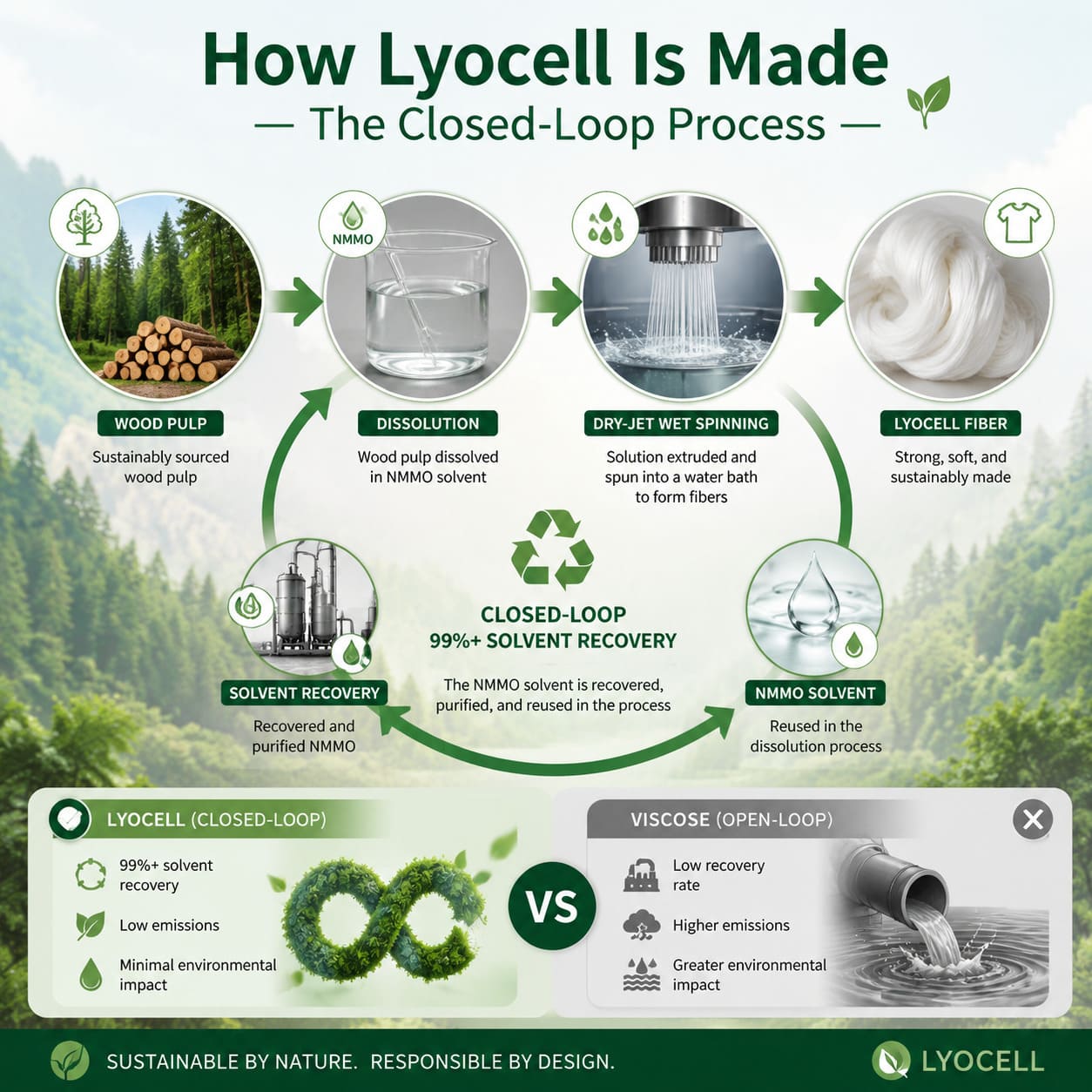
⚗️ The Process Difference — Why It Matters
The three fibres differ fundamentally in how cellulose is dissolved and re-formed. This processing difference drives all the performance and sustainability differences: 🔬
| Aspect | 🌿 Lyocell | 💧 Modal | 🌾 Viscose |
|---|---|---|---|
| Process type | Closed-loop solvent | Modified viscose | Traditional viscose |
| Solvent / chemical | NMMO (non-toxic) | Carbon disulphide (modified) | Carbon disulphide |
| Solvent recovery | 99%+ recycled | Partial | Limited (open loop) |
| Spinning method | Dry-jet wet spinning | Wet spinning (modified) | Wet spinning |
| Year introduced | 1990s | 1950s | 1890s |
| Environmental rating | ⭐ Highest | Medium-High | Medium (improving) |
📊 Performance Comparison — Lyocell vs Modal vs Viscose
| Property | 🌿 Lyocell | 💧 Modal | 🌾 Viscose |
|---|---|---|---|
| Dry strength | Highest (40–45 cN/tex) | High (34–36) | Moderate (22–26) |
| Wet strength | Excellent (retains ~85%) | Good (retains ~75%) | Poor (retains ~50%) |
| Softness | Smooth, crisp-soft | Softest, silkiest | Soft, fluid |
| Drape | Good, structured | Excellent, fluid | Excellent, fluid |
| Moisture absorption | Excellent | Excellent | Excellent (11–13%) |
| Wrinkle resistance | Best of the three | Moderate | Poor |
| Shrinkage control | Best | Good | Moderate (2–4%) |
| Pilling resistance | Good | Good | Lower |
| Colour vibrancy | Excellent | Excellent | Excellent |
| Fibrillation tendency | Yes (can be controlled) | Low | Low |
| Price (rel. to viscose) | ~150–200% | ~120–140% | 100% (baseline) |
| Best for | Premium sustainable fabric, denim, activewear | Underwear, loungewear, soft knits | Fashion fabric, drape, vivid colours |
Lyocell has one quirk: fibrillation — under wet abrasion, tiny fibrils peel from the fibre surface. This can be a defect (fuzzy surface) or a feature (engineered "peach skin" effect). Standard lyocell is treated to control fibrillation; some fabric finishes deliberately use it for texture. Modal and viscose don't fibrillate. This is worth knowing when planning fabric finishing.
🎯 Which Fibre to Choose?
| Your Priority / Application | Recommended Fibre | Why |
|---|---|---|
| Sustainability is top priority | Lyocell (Tencel) | Closed-loop, 99%+ solvent recovery, top eco ratings |
| Softest possible underwear / loungewear | Modal | Silkiest hand feel of all three |
| Lowest cost fashion fabric | Viscose | Best value, excellent drape and colour |
| Premium activewear / sportswear | Lyocell | Strongest, best moisture management, durable |
| Eco-denim | Lyocell | Strength for denim + sustainability story |
| T-shirts with soft feel + durability | Modal | Soft + better shape retention than viscose |
| Bedding & sheets (premium) | Lyocell or Modal | Cool, smooth, moisture-managing |
| Drape dresses, blouses (fashion) | Viscose | Best fluid drape at low cost |
| Frequent washing durability | Lyocell | Highest wet strength — survives wash cycles |
| Blended with polyester for performance | Lyocell / Modal | Stronger blend partner than viscose |
🤝 Blending with Polyester — Best of Both Worlds
Like viscose, both lyocell and modal blend beautifully with polyester. The cellulose fibre contributes softness, breathability and moisture management; the polyester adds strength, wrinkle resistance and cost efficiency. Common blends include: 🧵
- 🌿 Polyester / Lyocell — premium sustainable activewear and shirting; the lyocell brings strength and eco-credentials, polyester adds durability and lower cost
- 💧 Polyester / Modal — soft premium knits with shape retention; modal's softness + polyester's structure
- 🌾 Polyester / Viscose (PV) — the classic, most economical blend; see our Polyester Viscose Yarn and PV vs PC guide
- 🌳 Tri-blends — Polyester / Cotton / Lyocell or Modal for fabric needing comfort, durability and a premium hand
Yaakan supplies spun yarn in 100% Viscose (R30S, R40S), 100% Modal, 100% Lyocell/Tencel, and blends of polyester with viscose, modal, lyocell, cotton and bamboo — in counts from Ne 16/1 to 80/1, produced by Ring Spun, Vortex or Siro Compact methods. See our spinning methods guide for how each affects the finished yarn.
🌍 The Sustainability Picture
All regenerated cellulose fibres start from a renewable resource (wood), which is a sustainability advantage over petroleum-based synthetics. But the processing differs significantly: 🌱
- 🌿 Lyocell — the clear sustainability leader. Closed-loop NMMO process, 99%+ solvent recovery, low water use, FSC/PEFC certified wood common. Tencel branded lyocell carries strong eco-certifications.
- 💧 Modal — better than viscose but uses a modified version of the traditional process. Lenzing's branded modal uses cleaner production than generic modal.
- 🌾 Viscose — historically the least clean process (carbon disulphide, open loop), but modern responsible producers have dramatically improved. Look for EU Ecolabel or responsible-viscose certification.
For buyers who need to substantiate eco claims to brands, look for recognised certifications: FSC / PEFC (sustainable forestry), EU Ecolabel, OEKO-TEX Standard 100, and for Tencel, Lenzing's certificates of origin. Always request supporting documentation from your yarn supplier — credible suppliers provide it readily.
📝 Summary
- 🏷️ Names: Lyocell & Modal & Viscose are generic fibre names; Tencel is Lenzing's brand of lyocell. All are regenerated cellulose from wood.
- 🌿 Lyocell (Tencel) — 3rd gen, closed-loop eco process (99%+ solvent recovery), strongest wet & dry, most sustainable, highest price
- 💧 Modal — 2nd gen, softest/silkiest, good wet strength & shape retention, mid-price
- 🌾 Viscose (Rayon) — 1st gen, best drape & vivid colour, lowest cost, weakest wet, widest availability
- 🤝 All blend well with polyester — cellulose adds comfort, polyester adds strength & durability
- 🌍 Sustainability order: Lyocell > Modal > Viscose (but all improving with responsible production)
Sourcing Lyocell, Modal, Viscose or blended spun yarn? Contact Yaakan — we supply all three in pure and blended forms, with certification documentation and free samples. 👇
Source Lyocell, Modal & Viscose Yarn
Pure or blended with polyester — in Ring Spun, Vortex or Siro Compact. Tell us your fibre, count and application; we'll send a quote, certification and free samples within 24 hours.