What Polyester Yarn Is Used to Make Fire Hoses? —
Industrial Yarn Specifications & Manufacturing Guide
When firefighters connect a hose to a hydrant, what stops it from bursting under hundreds of pounds of water pressure? When the same hose is dragged across hot concrete, sharp debris and burning timber, what gives it the abrasion resistance to survive? The answer in both cases is the same: high-tenacity polyester filament yarn, woven into a tightly braided jacket around a rubber or polyurethane lining. 🔥
Fire hose is one of the most demanding applications for industrial polyester yarn — combining high pressure resistance, abrasion resistance, flexibility, heat resistance and consistent year-after-year reliability. This guide explains exactly what yarn specifications are used, why polyester is the dominant fibre choice, and how the yarn-to-hose manufacturing process works. ✅
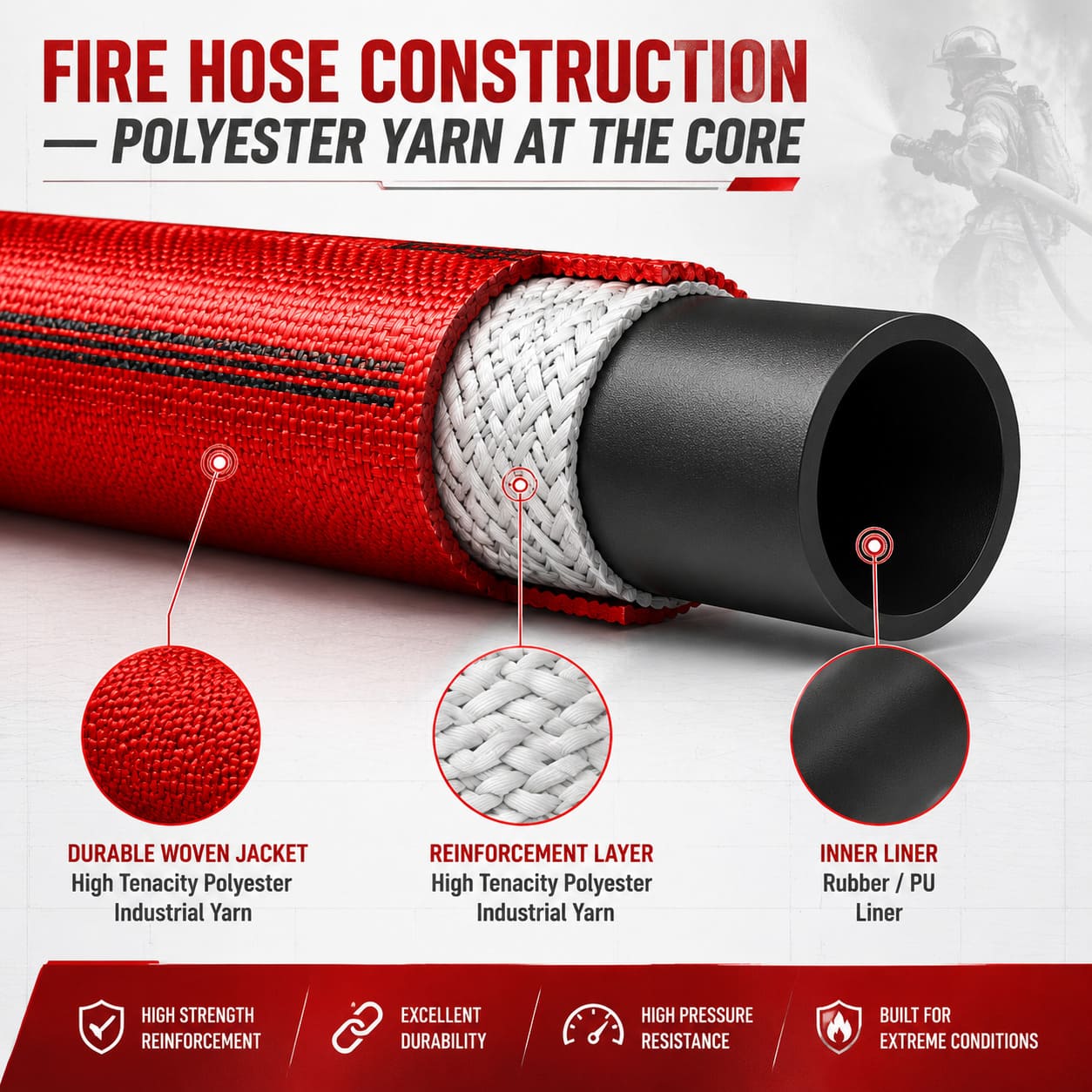
🧱 Fire Hose Construction — Three Layers, One Critical Yarn
A modern fire hose is a multi-layer composite structure. Each layer has a specific function, but the structural strength comes from one layer in particular — the outer woven jacket, which is almost always made from high-tenacity polyester filament yarn. 🧶
The rubber lining keeps water in. But the strength to contain that water under pressure — typically 200–400 PSI working pressure, 600–1200 PSI burst pressure — comes entirely from the woven polyester yarn jacket. Choose the wrong yarn specification and the hose fails. This is why fire hose manufacturers care intensely about yarn quality, consistency and certification.
🏭 Why Polyester? Why Not Cotton, Nylon or Aramid?
Fire hose has been made from many materials over the past 150 years. Modern manufacturing has settled on high-tenacity polyester as the dominant choice for the woven jacket. Here's why polyester beats the alternatives: 🔬
| Fibre | Pressure Strength | Abrasion Resistance | Water Resistance | UV Resistance | Cost | Verdict |
|---|---|---|---|---|---|---|
| Cotton (historical) | Low | Medium | Absorbs water — rots | Moderate | Cheap | Obsolete |
| Nylon (Polyamide) | High | Excellent | Absorbs some water | Poor — UV degrades | Higher | Limited use |
| High-Tenacity Polyester | High | Excellent | Hydrophobic — no rot | Excellent | Moderate | ✓ Industry Standard |
| Aramid (Kevlar/Nomex) | Very High | Very High | Excellent | Moderate | 5–10× more expensive | Specialty use only |
The Five Reasons Polyester Won
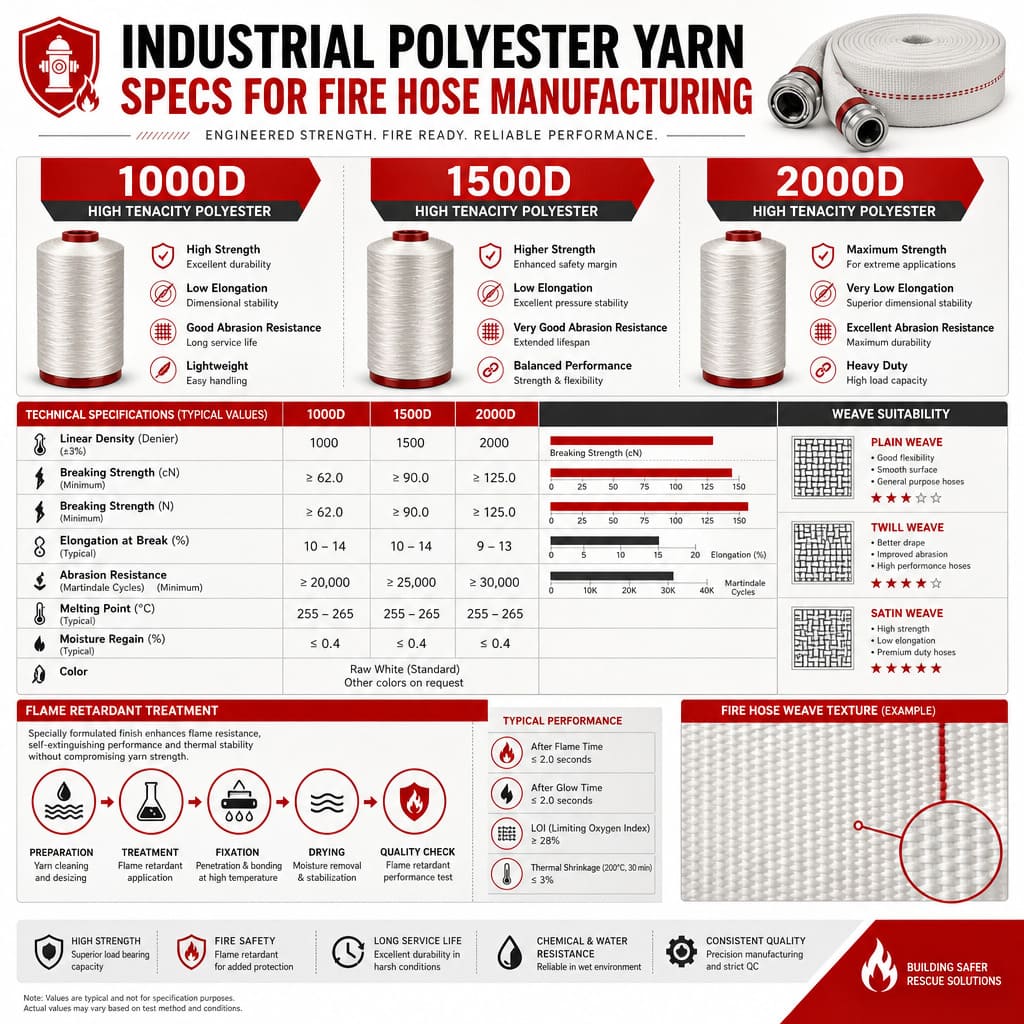
📏 Typical Polyester Yarn Specifications for Fire Hose
Fire hose yarn is not the same as apparel DTY or standard FDY. It is a specialty industrial grade with specific characteristics. Here are the common specifications used in fire hose jackets: 📋
| Hose Type | Yarn Denier | Filaments | Tenacity | Elongation | Working Pressure |
|---|---|---|---|---|---|
| Light-duty / Forestry | 500D – 900D | 72F – 144F | 7.5 g/d min | 15–20% | ~200 PSI |
| Standard attack hose | 900D – 1500D | 144F – 192F | 8.0 g/d min | 12–18% | 250–300 PSI |
| High-pressure attack | 1500D – 2000D | 192F – 288F | 8.5 g/d min | 10–15% | 400 PSI |
| Industrial / supply line | 2000D – 3000D | 288F – 480F | 8.5 g/d min | 10–15% | 200–300 PSI |
| Suction hose reinforcement | 1500D – 2500D | 192F – 384F | 8.0 g/d min | 10–15% | Vacuum capable |
Tenacity (strength per unit weight, measured in grams per denier, g/d) is the single most important specification for fire hose yarn. Apparel-grade polyester DTY has tenacity around 3.5–4.5 g/d. Fire-hose industrial yarn requires 7.0–8.5+ g/d — roughly double the strength of regular polyester. This is achieved through higher polymerisation, optimised drawing ratios, and specific molecular orientation during spinning.
🏗️ From Yarn to Fire Hose — The Manufacturing Process
Converting industrial polyester yarn into a finished fire hose involves a precision weaving and lining process. Here's the typical sequence: 🛠️
📜 Certifications Fire Hose Yarn Must Meet
Polyester yarn for fire hose manufacturing typically must meet several international standards. Buyers should verify these with their yarn supplier: 🏅
| Standard | Region | Key Requirement |
|---|---|---|
| EN 14540 | EU | Non-percolating delivery hose for fire services — burst, abrasion, kink tests |
| BS 6391 Type 1/2/3 | UK | Performance specification for fire hoses for fire-service use |
| NFPA 1961 | USA | Standard on fire hose — burst pressure, kink, abrasion, ozone resistance |
| UL 19 | USA | Lined fire hose and hose assemblies for fire service |
| GB 6246 | China | Lined fire hose national standard — burst pressure ≥ 3× working pressure |
| ISO 14557 | International | Fire-fighting hose — rubber and plastics suction hoses and assemblies |
| FM Approval | Insurance | FM Global approval for industrial fire-protection hose |
🤝 From Yarn to Finished Fire Hose — Manufacturing Partnership
Industrial yarn and finished fire hose are produced by different companies in different parts of the world — yarn from large polyester mills, fire hose from specialised hose manufacturers. The two industries work together closely on yarn specification, quality and supply chain coordination. ⛓️
❓ Common Questions About Fire Hose Yarn
Q: Can I use regular polyester DTY for fire hose?
No. Standard apparel-grade DTY tenacity (3.5–4.5 g/d) is roughly half what fire hose requires (7.0–8.5+ g/d). The yarn would fail catastrophically under hose operating pressure. Fire hose requires industrial high-tenacity polyester — a different polymer grade and manufacturing process.
Q: What about polyester FDY?
Standard FDY is closer but still not industrial-grade. Apparel FDY typically reaches 4.5–5.5 g/d tenacity. Fire hose yarn is a specialty FDY produced with higher draw ratios and specific molecular orientation to reach 7+ g/d. Yaakan's sister mills can supply both — contact us for industrial specifications.
Q: Is there any flame-retardant treatment on the yarn?
Some specifications require flame-retardant (FR) treatment on the outer jacket yarn. This can be achieved through inherently FR polyester (phosphorus-modified — see our Differential Yarn Series) or topical FR finishes applied after weaving. For most fire hose applications, the inherent heat resistance of high-tenacity polyester is sufficient — FR treatment is specified separately when needed.
Q: How long does a fire hose last?
Quality fire hoses typically last 15–20 years in service when properly stored and maintained. The polyester yarn jacket retains 80%+ of its original strength even after 10+ years of use. End-of-life is usually determined by inner lining failure or coupling wear, not yarn degradation. This longevity is why high-quality polyester yarn is critical — saving cost on cheap yarn shortens hose lifespan dramatically.
🌱 Sustainability — Recycled Polyester in Fire Hose?
Sustainability is increasingly important even in industrial textile applications. The question of whether recycled polyester (rPET) can replace virgin polyester in fire hose is sometimes asked. The honest answer: partially, with caveats. 🌍
- Light-duty hose: Recycled polyester (rPET) industrial-grade yarn is being trialled for forestry and light-duty hose applications where pressure requirements are lower
- Standard fire hose: Currently, virgin high-tenacity polyester dominates because of stricter quality consistency requirements — recycled material has slightly more variable properties
- Hybrid approach: Some manufacturers use 30–50% recycled content with the rest as virgin to balance sustainability and consistency
- Future direction: As rPET industrial-grade quality improves, expect wider adoption — Yaakan's Recycle Series includes industrial-grade options
📝 Summary
- 🧱 Fire hose structure — outer woven polyester jacket (strength) + inner rubber/PU lining (watertight). Yarn provides ALL pressure resistance.
- 🏭 Why polyester — high tenacity (7–8.5 g/d), hydrophobic (no rot), UV stable, heat resistant, abrasion resistant, cost effective
- 📏 Typical specs — 900D–2000D high-tenacity polyester, 144F–288F, tenacity 7.5–8.5 g/d minimum
- 🏗️ Manufacturing — circular weaving → lining → vulcanisation → pressure test. Specialised equipment, not standard textile machinery
- 📜 Standards — EN 14540, BS 6391, NFPA 1961, GB 6246, UL 19 — fire hose yarn must enable hose to pass these tests
- ♻️ rPET — limited current use, growing for light-duty applications, virgin still dominant for life-safety hose
Looking for industrial high-tenacity polyester yarn for fire hose manufacturing? Contact Yaakan for industrial-grade specifications. Looking for finished fire hose? Visit our partner CA-Fire for a complete range of certified fire hoses. 🚒
Industrial Polyester Yarn from Yaakan
For fire hose, lifting slings, ratchet straps, geotextile and other industrial applications. High-tenacity specifications available — contact us with your tenacity and denier requirements.