Low F vs Mid F vs High F —
The Polyester Yarn Filament Count Guide
You see "150D/48F" and "150D/144F" on a yarn quotation. The denier is the same — but the prices may be different and the fabric these two yarns produce will look and feel completely different. The reason is the F number — the filament count. 🧵
Filament count is one of the most underrated yarn specifications. Two yarns with the same denier can produce fabric ranging from stiff and shiny to ultra-soft and matte just by changing the F number. This guide explains what low F, mid F and high F mean, how to calculate denier per filament (dpf), and which F count to choose for your fabric. ✅
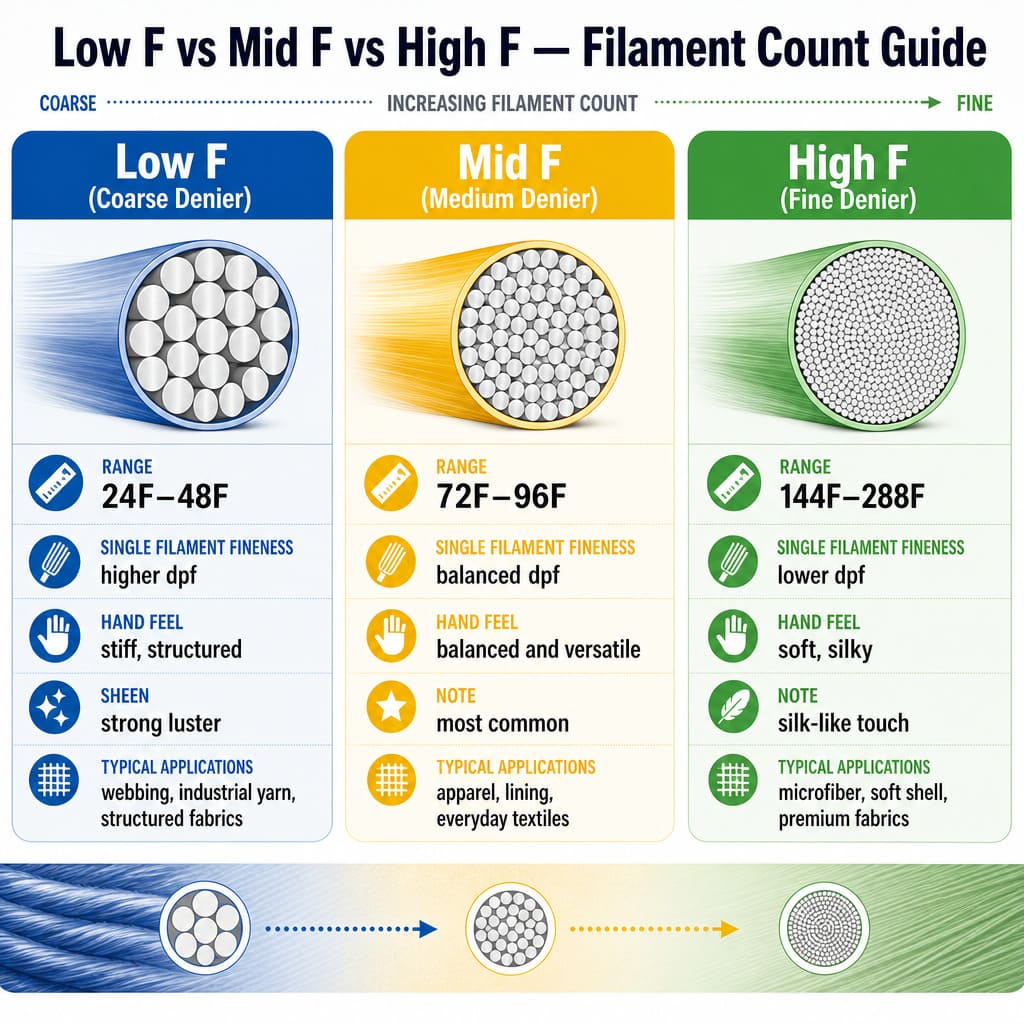
🧵 What Is the F Number?
In polyester yarn specifications, F (filament count) is the number of individual filaments that make up the yarn bundle. A yarn marked 150D/48F contains 150 denier total weight divided among 48 individual filaments. A yarn marked 150D/144F contains the same 150 denier total — but split into 144 much finer filaments. 🔍
The same total denier can be produced as a few thick filaments or many fine filaments. The choice has nothing to do with strength or yarn weight — it's about fabric character. Each filament still contributes the same proportion of strength, but the resulting fabric texture, drape and lustre are dramatically different.
📏 Denier per Filament (dpf) — The Key Metric
The single most important number derived from F count is dpf — denier per filament. This tells you how thick each individual filament is, regardless of the total yarn weight. 🔢
Two yarns with identical total denier but very different dpf will produce fabric with dramatically different feel and appearance. Here are typical dpf ranges for the three categories: 📊
🎯 Low F / Mid F / High F — In Detail
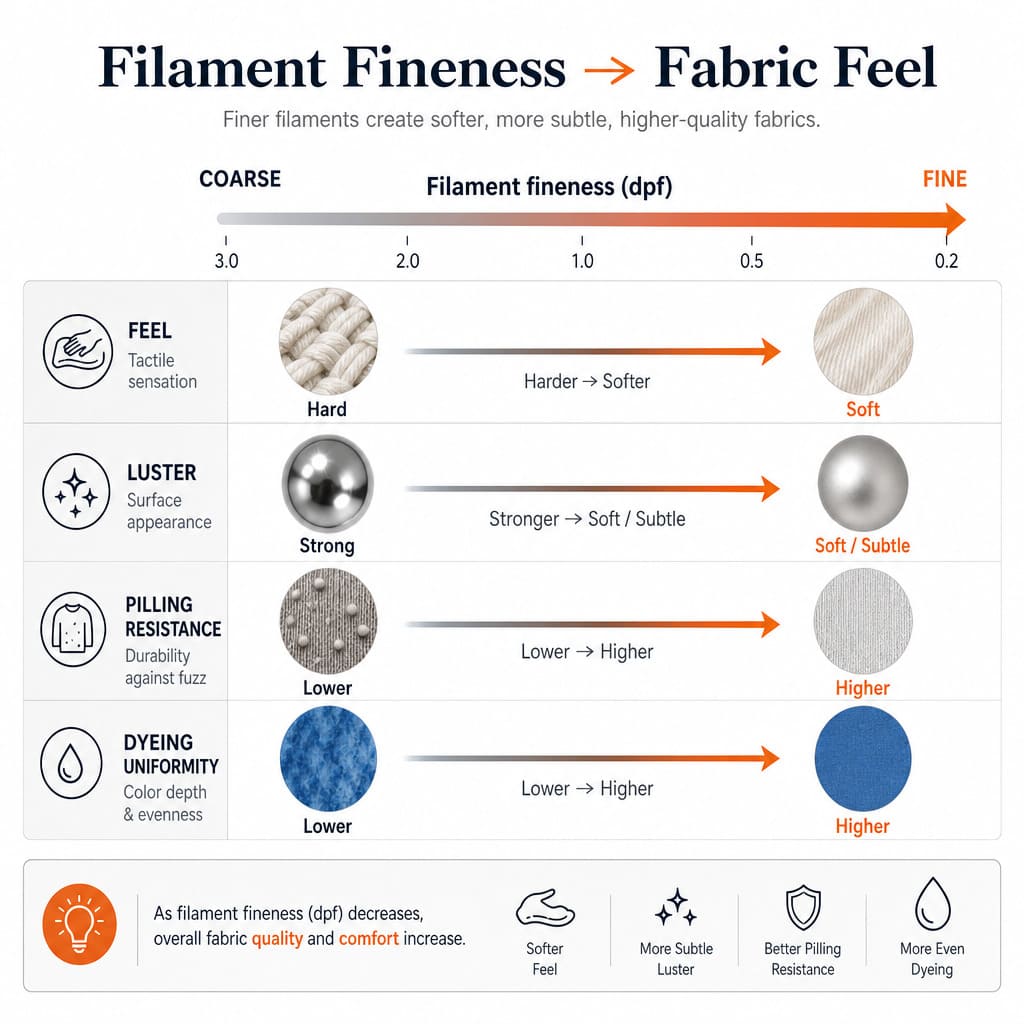
📊 Why dpf Matters More Than Total Denier
If a buyer asks for "soft polyester DTY for premium activewear" and you ship them 150D/48F yarn, the fabric will feel stiff and shiny — not soft at all. If instead you ship 150D/144F or 150D/288F, the same total denier produces dramatically softer fabric. The total denier didn't change. The dpf did. 💡
Here's how dpf controls the most important fabric characteristics: 📋
| Fabric Property | 🔵 Low F (high dpf) | 🟡 Mid F | 🟢 High F (low dpf) |
|---|---|---|---|
| Hand feel | Crisp, structured | Balanced | Ultra-soft, silky |
| Lustre / Shine | Strong, glossy | Moderate | Subdued, natural |
| Drape | Stiffer, more body | Balanced | Fluid, flowing |
| Colour depth (after dyeing) | Standard | Good | Deepest, richest |
| Moisture wicking | Lower surface area | Standard | Superior — more surface |
| Abrasion resistance | Better per-filament | Good | Per-filament weaker |
| Snag resistance | Higher | Standard | Lower — fine filaments |
| Air permeability | Higher | Moderate | Lower — dense surface |
| Price per kg | Standard | Standard | ~5–15% premium |
Most yarn discussions focus on denier (size) and ignore F count. But when fabric samples come back wrong, the issue is usually F count, not denier. A spec like "150D DTY SD" gives no guidance on F count — the supplier defaults to their standard (usually 48F or 72F) which may not match the fabric your buyer wants. Always specify F count. It costs nothing to specify and prevents most fabric quality complaints.
📋 Common Denier/F Combinations and Their Applications
| Specification | dpf | Category | Typical Application |
|---|---|---|---|
| 50D / 24F | 2.08 | Mid | Lining, lightweight fabric |
| 75D / 36F | 2.08 | Mid | Sportswear knit, casual wear |
| 75D / 72F | 1.04 | High | Premium soft activewear, peach skin |
| 100D / 36F | 2.78 | Low-Mid | Taffeta lining, jacket lining |
| 100D / 96F | 1.04 | High | Premium knit, soft drape fabric |
| 150D / 48F | 3.13 | Low | Crisp shirting, taffeta, heavy lining |
| 150D / 96F | 1.56 | Mid | Standard knit, T-shirt fabric |
| 150D / 144F | 1.04 | High | Soft drape, premium casual |
| 150D / 288F | 0.52 | Very High | Microfibre, peach skin, ultra-soft |
| 300D / 96F | 3.13 | Low | Outerwear, workwear, structured fabric |
| 300D / 192F | 1.56 | Mid | Soft heavy knit, plush fabric |
| 600D / 192F | 3.13 | Low | Workwear, bags, technical fabric |
🎯 Which F Count for Which Application?
| Fabric / Application | Recommended F Range | Reason |
|---|---|---|
| Woven lining (taffeta) | Low F (24–48F) | Crisp body, strong lustre, no need for drape |
| Embroidery thread | Low F | Low filament count gives clean visual lines |
| Ribbon & trim fabric | Low F | Structure and surface shine essential |
| Industrial / technical fabric | Low F | Per-filament strength preferred |
| T-shirts & casual knit | Mid F (72–96F) | Balanced soft feel without extra cost |
| Standard sportswear | Mid F | Sufficient softness, good machine runnability |
| Home textiles (bedding, curtains) | Mid F | Balanced appearance for daily use |
| Premium sportswear & activewear | High F (144F+) | Soft against skin, superior moisture wicking |
| Peach skin fabric | High F (144F+) | Soft surface essential for peach skin effect |
| Premium woven dresses & blouses | High F | Fluid drape and luxurious hand feel |
| Microfibre cleaning cloth | High F (288F+) | Ultra-fine filaments for cleaning performance |
| Velvet & pile fabric | High F | Fine pile structure requires fine filaments |
🎨 How F Count Affects Dyeing
Filament fineness directly affects how dye interacts with the yarn. The total surface area of fine filaments is much larger than the equivalent in coarse filaments — and this changes dyeing behaviour: 🎨
- 🎨 Colour depth: High F yarn requires more dye to reach the same colour depth — but produces richer, more saturated final colours due to greater light absorption on the larger surface area.
- ⚡ Dye absorption rate: High F yarn absorbs dye faster than low F. This requires careful dye process control to prevent uneven dyeing or stripping.
- 🌈 Pastels and light shades: Easier to achieve subtle pastel shades on high F yarn — the fine filaments take up light colours more uniformly.
- ⚫ Deep blacks and navies: High F yarn produces deeper, more luxurious blacks. This is one reason premium black fabric uses high F yarn.
- 💧 Dye bath ratio: Higher liquor ratios (more water per kg of yarn) are typically used for high F yarn to ensure even dye distribution.
🔬 High F vs True Microfibre — Are They the Same?
This is a common confusion. High F yarn and true microfibre are related but not identical: 🤔
- 📏 High F yarn — fine filaments produced by conventional spinning. dpf typically 0.5–1.5. Achievable by spinning more filaments through a standard spinneret.
- 🔬 True microfibre — typically defined as dpf ≤ 1.0 (or sometimes ≤ 0.5). Includes high F conventional yarn and bicomponent yarn like sea island.
- 🏝️ Ultra-microfibre (sea island) — uses bicomponent technology to achieve dpf as low as 0.05. Cannot be produced by conventional spinning alone.
If you need softness beyond what 288F yarn can deliver — for example, ultra-premium suede effect or true silk-replacement fabric — high F conventional yarn cannot reach the necessary dpf. The answer is sea island yarn, where bicomponent spinning produces dpf of 0.05–0.1. See our Sea Island Series for more on ultra-fine microfibre yarn.
📝 How to Specify F Count Correctly
When placing an order, always include the F count as part of the denier specification. Here are correct and incorrect ways to specify: 📋
- "150D/48F SD DTY SIM" — explicitly states denier, F count, lustre, type and intermingling
- "75D/72F SD DTY for soft knit fabric" — F count specified + intended use stated
- "150D/144F FD DTY for peach skin fabric" — full specification with application context
- "150D DTY" — no F count specified; supplier ships standard (usually 48F or 96F)
- "Soft DTY 150D" — softness depends on F count; without F specified, you may get the wrong yarn
- "Polyester DTY for activewear" — no denier or F count; vague specification leads to mismatched samples
📝 Summary
- 🧵 F = filament count. In "150D/48F", the yarn is 150 denier total made of 48 filaments.
- 📏 dpf (denier per filament) = Denier ÷ F. This is the single most important number derived from F count.
- 🔵 Low F (24–48F, dpf 2.5+) — crisp, lustrous, structured. For lining, taffeta, ribbon, industrial fabric.
- 🟡 Mid F (72–96F, dpf 1.5–2.5) — balanced. For sportswear, casual knit, home textiles. Universal default.
- 🟢 High F (144F+, dpf <1.5) — ultra-soft, fluid drape, rich colour. For premium activewear, peach skin, luxury fabric.
- 📋 Always specify F count when ordering — don't leave it as the supplier's default
- 🏝️ For ultra-soft beyond 288F, use sea island yarn with dpf 0.05–0.1
Need help choosing the right F count for your fabric? Contact Yaakan — we stock the full range from low F (24F) to high F (288F+) in DTY and FDY. Free samples available so you can compare hand feel in person. 👇
Request Samples in Multiple F Counts
Send us your fabric application and we'll dispatch samples in 2–3 different F counts (e.g. 150D/48F, 150D/96F, 150D/144F) so you can compare hand feel before bulk ordering.