Polyester Yarn Oil Content & Fudan Index —
What They Mean and Why They Matter
You receive a mill quality certificate for your DTY yarn. It lists denier, tenacity, elongation — and then two numbers you may not fully understand: "Finish: 0.42%" and "Fudan: 0.28/0.32". What do these mean? Are they within acceptable range? And what happens to your fabric or machine if they're wrong? 🤔
This guide explains both parameters in plain language — what they measure, what the standard ranges are, and what happens when they fall outside specification. Once you understand these two values, you can read any polyester yarn quality certificate with confidence. ✅
🛢️ What Is Yarn Oil (上油剂)?
During the production of polyester filament yarn, a spin finish oil (also called spinning oil, lubricant, or 上油剂) is applied to the yarn surface immediately after extrusion and drawing. This is a carefully formulated mixture of lubricants, antistatic agents, emulsifiers and cohesion agents. 🏭
The spin finish serves several critical functions:
- 🔧 Lubrication — reduces friction between yarn and machine guides, rollers and needles during processing
- ⚡ Antistatic protection — prevents static charge build-up that causes filaments to splay, snag and cling
- 🧵 Cohesion — helps hold the multifilament bundle together during high-speed winding and unwinding
- 🏗️ Process stability — ensures consistent tension and reduces broken ends on knitting and weaving machines
Without spin finish, polyester yarn would be almost impossible to process — the filaments would separate, generate static, break on guides, and produce fabric with severe defects. 🚫
📊 The Two Parameters — Finish % and Fudan Index
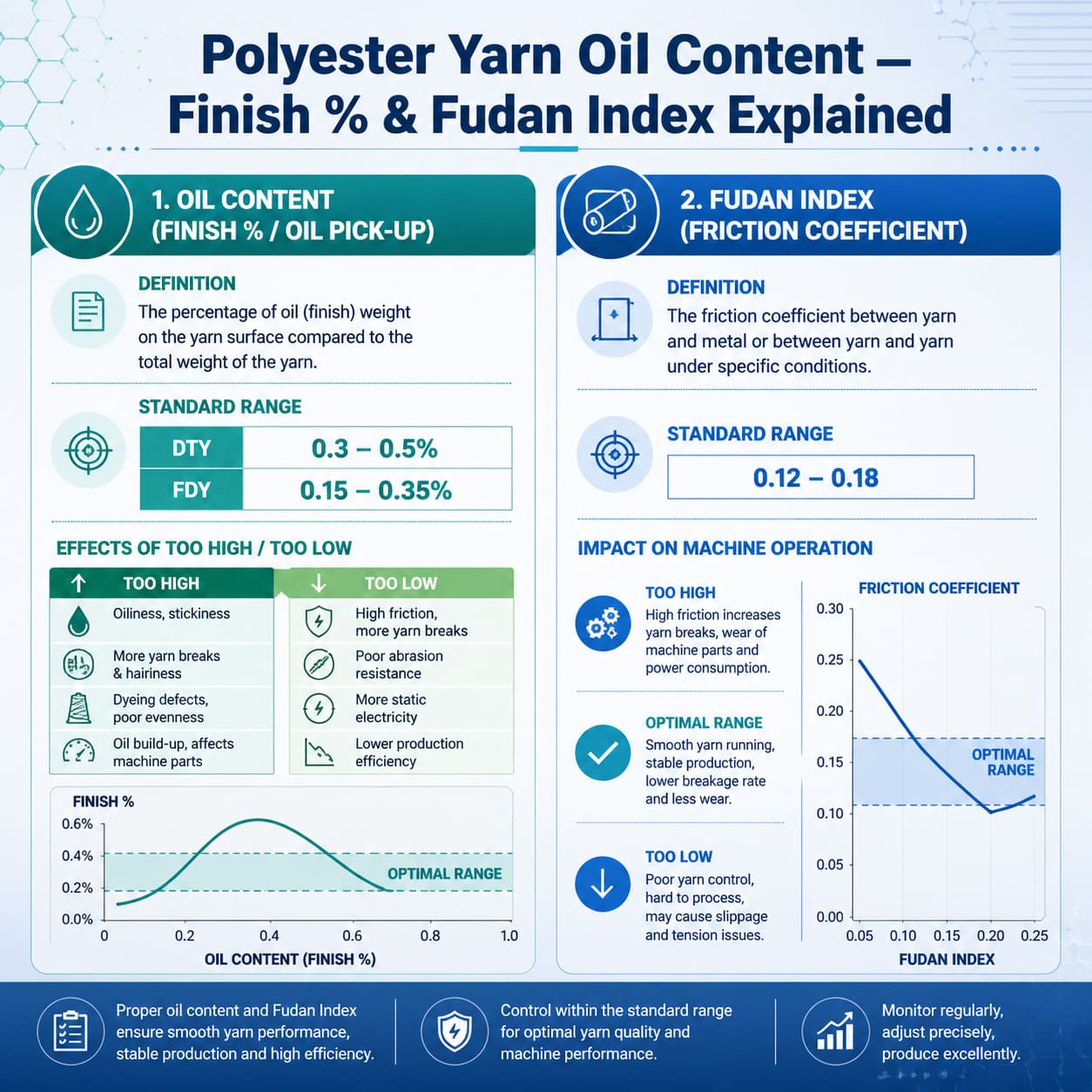
Definition: The weight of spin finish oil as a percentage of the total yarn weight. Also called "oil content", "oil pick-up" or "finish percentage".
Formula: Finish % = (Oil weight ÷ Total yarn weight) × 100
How measured: Soxhlet extraction using petroleum ether solvent — the oil is extracted from a yarn sample and weighed. Standard: GB/T 6504 or ASTM D2259.
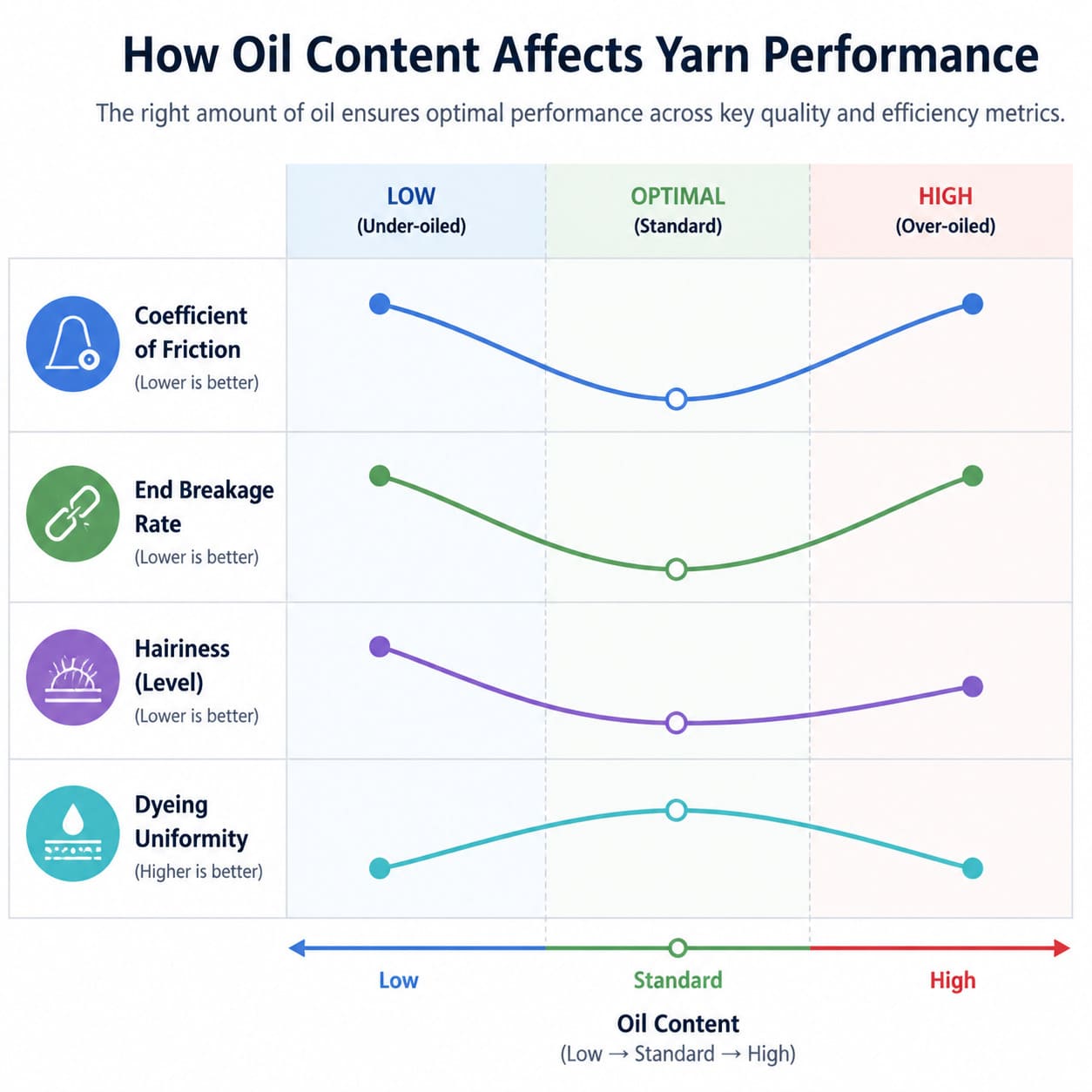
What it tells you: Whether the yarn has the right amount of lubricant for your processing conditions. Too little → friction/static problems. Too much → oil contamination on machines and uneven dyeing.
Definition: A measure of the friction coefficient between yarn and a metal pin (yarn-to-metal, Y/M) and between yarn and yarn (yarn-to-yarn, Y/Y). Named after the Fudan University method used in China.
Format: Reported as two values — e.g. 0.28/0.32 where the first is Y/M friction and the second is Y/Y friction.
How measured: Yarn is drawn over a metal capstan at constant speed and tension difference is measured to calculate friction coefficient. Standard: GB/T 14344.
What it tells you: How easily the yarn will slide over machine guides and itself. Low friction → better machine runnability. High friction → more tension variation, potential breaks.
📏 Standard Ranges — What Numbers to Expect
| Yarn Type | Finish % — Standard Range | Finish % — Acceptable | Fudan Y/M | Fudan Y/Y |
|---|---|---|---|---|
| DTY (standard) | 0.35 – 0.50% | 0.30 – 0.55% | 0.25 – 0.32 | 0.28 – 0.36 |
| DTY (high-speed knitting) | 0.40 – 0.55% | 0.38 – 0.60% | 0.22 – 0.30 | 0.26 – 0.34 |
| FDY (standard) | 0.15 – 0.30% | 0.12 – 0.35% | 0.20 – 0.28 | 0.24 – 0.32 |
| FDY (warp knitting) | 0.20 – 0.35% | 0.18 – 0.40% | 0.20 – 0.28 | 0.24 – 0.32 |
| POY | 0.25 – 0.40% | 0.20 – 0.45% | 0.22 – 0.30 | 0.26 – 0.34 |
| Spun yarn (PSF-based) | 0.10 – 0.20% | 0.08 – 0.25% | N/A | N/A |
⚠️ What Happens When Oil Content Is Wrong
- 🔥 High friction on guides and needles — more heat generation
- ⚡ Static electricity build-up — filaments splay and cling
- ✂️ More frequent yarn breaks (ends down) on knitting/weaving machines
- 🧶 Filament separation and flyaway fibres in fabric
- 📉 Reduced production efficiency and more machine stops
- ✓ Smooth running on all machine types
- ✓ Consistent tension and minimal breaks
- ✓ Good filament cohesion throughout processing
- ✓ Even dye absorption — uniform colour in fabric
- ✓ Machine guides and needles stay clean
- 🟫 Oil deposits on machine guides, rollers and needles — builds up over time
- 🎨 Uneven dye absorption — oil repels dye in patches → streaks in fabric
- 🧴 Oily feel on fabric — may not fully wash out
- 💨 Smoke and odour during high-temperature processing
- 🧺 Fabric may feel greasy after knitting — dye pre-treatment needed
📐 Fudan Index — Reading the Two Numbers
The Fudan Index is reported as two numbers separated by a slash — for example 0.28 / 0.32: 🔢
- 🔵 First number (0.28) = Yarn-to-Metal (Y/M) friction coefficient — how much friction exists between the yarn and the metal guides, rollers and needles on your machine. Lower = more slippery on metal = better machine runnability.
- 🟡 Second number (0.32) = Yarn-to-Yarn (Y/Y) friction coefficient — friction between adjacent yarn filaments. Affects cohesion, pilling tendency and yarn-on-yarn abrasion during processing.
For standard DTY yarn, a typical good Fudan Index is 0.25–0.30 / 0.28–0.34. For FDY, slightly lower: 0.20–0.26 / 0.24–0.30. If either number is significantly higher than these ranges, the yarn will have more friction on your machine — expect more tension variation, more breaks, and more guide wear. If both numbers are very low (below 0.18), the yarn may be too slippery to maintain consistent tension.
📄 How to Read Oil Data on a Quality Certificate
Here's a typical section from a polyester yarn mill quality certificate and how to interpret it: 🗂️
| Certificate Line | What It Means | Standard Range (DTY) | Status |
|---|---|---|---|
| Finish: 0.42% | Oil pick-up = 0.42% of yarn weight | 0.35–0.50% | ✓ Pass |
| Finish: 0.28% | Oil content low | 0.35–0.50% | ⚠️ Low — friction risk |
| Finish: 0.61% | Oil content high | 0.35–0.50% | ✗ High — dyeing risk |
| Fudan: 0.27/0.31 | Y/M = 0.27, Y/Y = 0.31 | 0.25–0.32 / 0.28–0.36 | ✓ Pass |
| Fudan: 0.38/0.42 | Both friction values elevated | 0.25–0.32 / 0.28–0.36 | ✗ High friction — machine wear risk |
| Fudan: 0.16/0.20 | Very low friction | 0.25–0.32 / 0.28–0.36 | ⚠️ Too slippery — tension issues |
🎯 Different Machines, Different Requirements
The optimal oil content varies depending on what machine and process the yarn will go through. Here's a practical guide: 🏭
| Machine / Process | Yarn Type | Optimal Finish % | Fudan Y/M Target | Notes |
|---|---|---|---|---|
| Circular knitting (standard) | DTY | 0.35–0.45% | 0.25–0.30 | Standard — most common application |
| High-speed circular knitting | DTY | 0.42–0.55% | 0.22–0.28 | More oil needed for higher needle speed |
| Warp knitting (tricot/raschel) | FDY | 0.20–0.35% | 0.20–0.26 | FDY standard — lower oil than DTY |
| Weaving (rapier/air-jet) | FDY / DTY | 0.15–0.30% | 0.20–0.28 | Lower oil preferred for clean shed |
| Package dyeing after purchase | DTY / FDY | 0.30–0.45% | Any in range | Not too high — oil must not block dye |
| Sewing thread production | FDY | 0.15–0.25% | 0.18–0.24 | Low oil for clean sewing needle passage |
Many fabric mills troubleshoot knitting machine breaks, tension problems and dye streaks for weeks without identifying the cause — only to discover the yarn's oil content or Fudan index is out of specification. Before changing machine settings, replacing guides or adjusting tension, always request and check the mill quality certificate for Finish % and Fudan Index. It's a 2-minute check that can save days of troubleshooting. 🔧
📝 Summary
- 🛢️ Finish % = weight of oil on yarn as % of total weight. Standard DTY: 0.35–0.50%. Standard FDY: 0.15–0.30%.
- 📐 Fudan Index = two friction coefficients — Y/M (yarn-metal) and Y/Y (yarn-yarn). Standard DTY: ~0.25–0.32 / 0.28–0.36.
- ⚠️ Too low oil → static, friction, breaks, filament separation
- 🚫 Too high oil → machine contamination, uneven dyeing, oily fabric
- 📄 Both values should appear on every mill quality certificate — always request them and check against standard ranges for your yarn type
- 🔧 Machine problems? Check Finish % and Fudan Index before adjusting machine settings
All Yaakan yarn shipments include a full mill quality certificate with Finish % and Fudan Index values. Contact us to request sample certificates or current FOB pricing on DTY, FDY or any other specification. 👇
Request a Sample Quality Certificate
Want to see exactly what a Yaakan quality certificate looks like before ordering? Contact us — we'll send a sample cert for your required specification within 24 hours.