Polyester Viscose (PV) vs Poly-Cotton (PC) —
Which Yarn Is Right for Your Suiting Fabric?
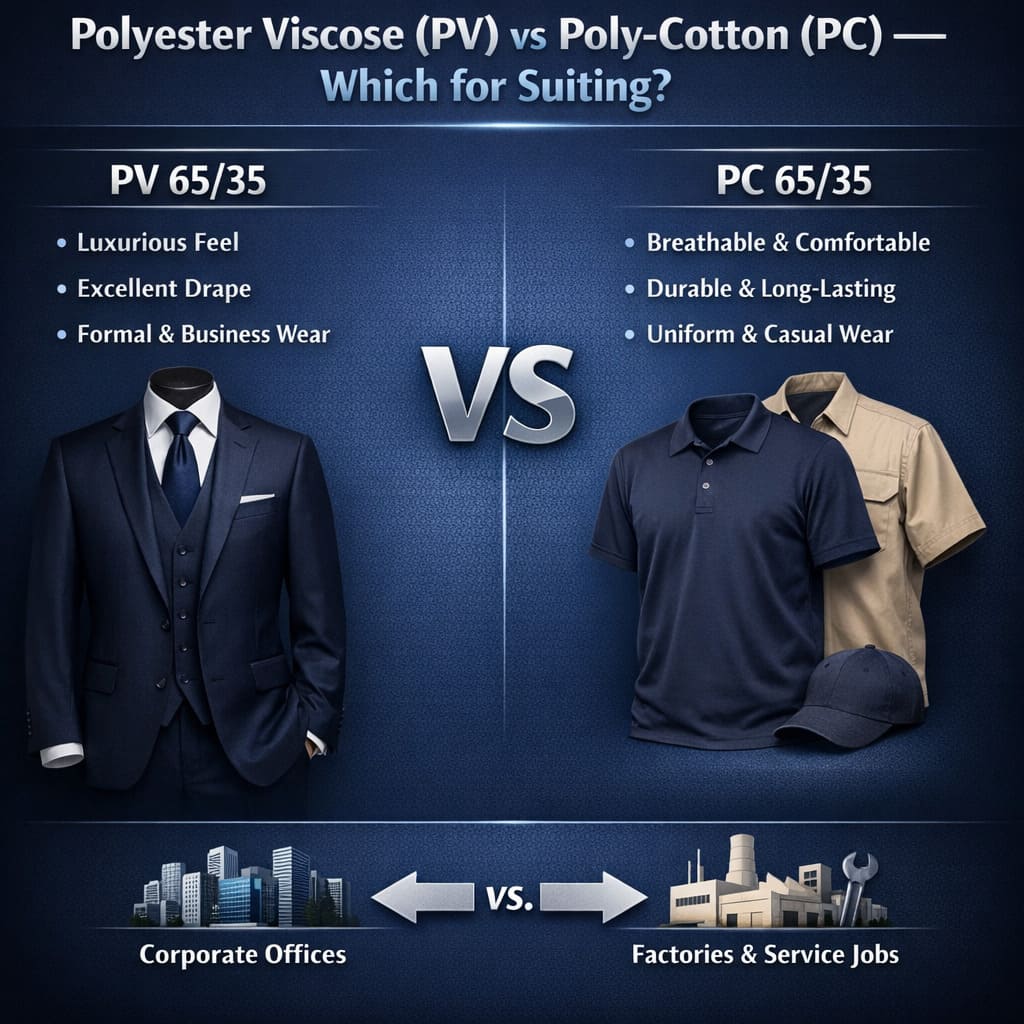
If you're sourcing fabric for suits, formal uniforms, or dress trousers, you've almost certainly come across two blended yarn options: PV 65/35 (Polyester Viscose) and PC 65/35 (Poly-Cotton). Both are blended yarns. Both are widely used in suiting and uniform fabric. But the fabrics they produce feel completely different — and choosing the wrong one can mean disappointing your customer or losing margin on unnecessary cost. 🤔
This guide explains the fundamental difference between PV and PC yarn, what each one does in fabric, and how to choose the right blend for every application. ✅
⚡ Quick Overview
- Silky smooth surface — premium feel
- Excellent drape — falls gracefully
- Slight lustre, formal appearance
- Lightweight for its construction
- Wrinkle-prone (viscose characteristic)
- Higher cost (viscose more expensive)
- Measured in Nm (Metric Count)
- Natural matte surface — practical feel
- More structured, less drape
- Breathable — cotton allows airflow
- Durable and easy to maintain
- Better wrinkle resistance than PV
- More economical — cotton cheaper than viscose
- Measured in Ne (English Count)
🟣 What Makes PV Yarn Special — Understanding Viscose
PV yarn is a blend of polyester staple fiber and viscose (rayon) staple fiber. Viscose is a semi-synthetic fiber made from wood pulp cellulose — it is technically a natural-based fiber, which gives it properties that polyester alone cannot replicate.
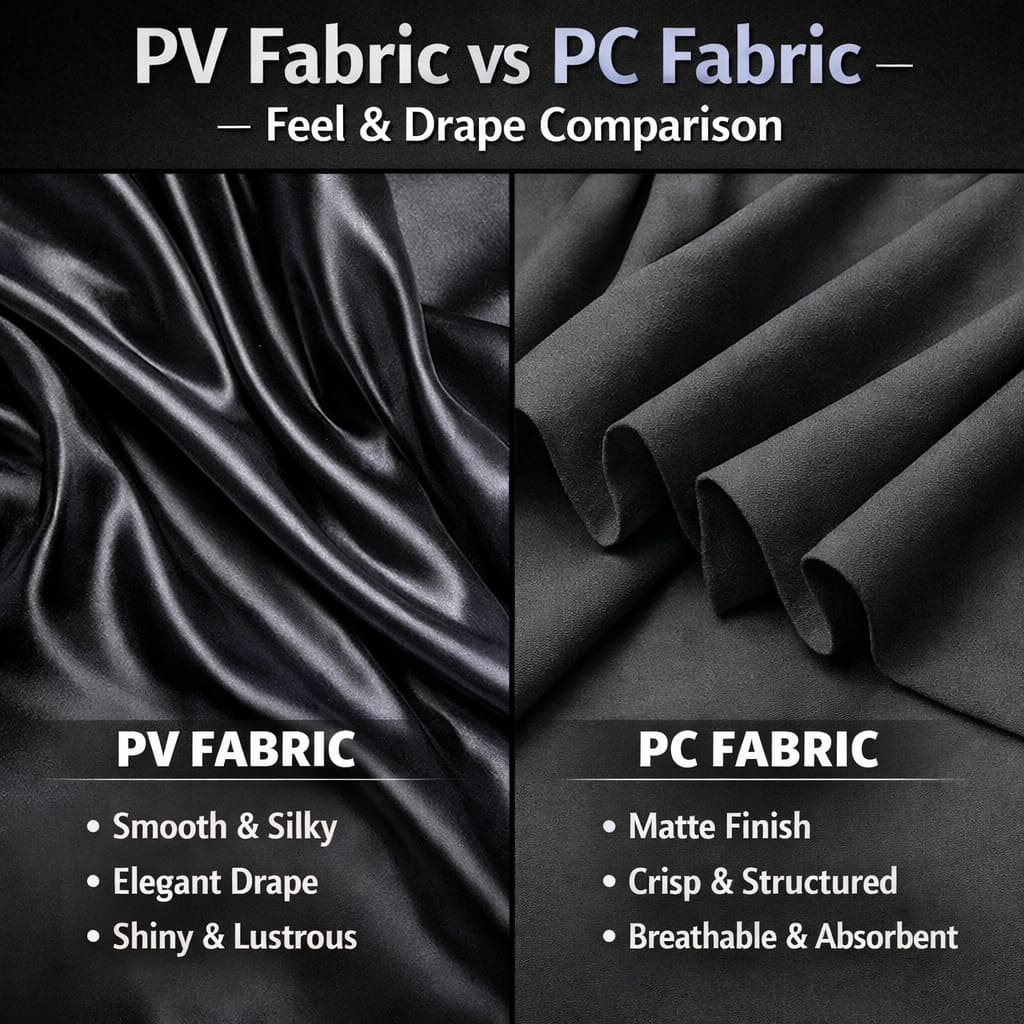
The viscose component is what defines PV fabric's character. Viscose fibers are naturally smooth and silky, with a subtle lustre that mimics natural silk. When blended with polyester (which adds durability and shape retention), the result is a fabric that feels premium, drapes beautifully, and has a formal, tailored appearance. 👔
Viscose has a much lower stiffness modulus than cotton — meaning viscose fibers bend and flow more easily under gravity. This is what creates PV fabric's characteristic drape. A suit jacket or dress trouser made from PV fabric hangs in clean, flowing lines. The same garment in PC fabric will be slightly stiffer and more structured. For formal suiting, drape is everything. 🎯
🟠 PC Yarn in Suiting — When Cotton Wins
We covered poly-cotton yarn in detail in a previous article, but in the context of suiting and formal uniform fabric, PC 65/35 has a specific role. The cotton component gives the fabric a natural, matte appearance and better breathability — important for uniforms worn in hot climates all day. 🌡️
PC suiting fabric is particularly popular in South Asia, Africa, and the Middle East, where the combination of durability, easy care, and breathability makes it the preferred choice for school uniforms, corporate uniforms, and workwear with a semi-formal appearance.
In hot and humid climates (Bangladesh, Nigeria, Pakistan, Indonesia), buyers often prefer PC 65/35 for uniform suiting because cotton absorbs moisture and feels cooler against the skin. In temperate or air-conditioned environments (offices in Turkey, formal events in the Middle East), PV 65/35 is preferred for its premium appearance and drape. Climate is often the deciding factor. 🌍
📊 Head-to-Head: 6 Key Dimensions
📋 Detailed Comparison
| Property | 🟣 PV 65/35 | 🟠 PC 65/35 |
|---|---|---|
| Fiber Blend | 65% Polyester + 35% Viscose | 65% Polyester + 35% Cotton |
| Surface Feel | ✓ Silky, smooth, premium | Natural, matte, practical |
| Drape | ✓ Excellent — falls gracefully | Moderate — more structured |
| Lustre | ✓ Subtle sheen — formal look | Matte — casual/practical look |
| Breathability | Moderate | ✓ Better — cotton absorbs moisture |
| Wrinkle Resistance | Poor — viscose wrinkles easily | ✓ Better wrinkle resistance |
| Wash Care | Dry clean recommended | ✓ Machine washable |
| Price | Higher (viscose cost) | ✓ More economical |
| Count System | Nm (Metric Count) e.g. Nm 48/2 | Ne (English Count) e.g. Ne 30/2 |
| Spinning System | Worsted / wool system | Cotton system |
| MOQ (Yaakan) | 500 kg per spec | 500 kg per spec |
🎯 Which Applications Suit Each Yarn?
- Business suits and blazers
- Formal dress trousers
- Ceremonial and military dress uniform
- Hotel and airline staff uniforms
- Premium corporate uniform (suits)
- Dress fabric for formal occasions
- Any garment where drape and elegance matter
- Markets valuing premium appearance over price
- School uniforms (shirts and trousers)
- Corporate casual and semi-formal uniform
- Police and security uniforms
- Healthcare and hospital staff uniform
- Workwear with a smart appearance
- Uniform fabric for hot-climate countries
- Budget-conscious uniform procurement
- High-wash-frequency garments
If the garment needs to look like a business suit → PV 65/35. If the garment needs to be durable, breathable, easy to wash, and cost-effective → PC 65/35. The price difference between the two can be significant — PV is typically 15–25% more expensive than the equivalent PC spec — so don't over-specify when PC will do the job. 💰
📐 Common Specifications for Each Yarn
PV Yarn — Typical Specifications
PV yarn is spun on the worsted system and measured in Nm (Metric Count). Common PV specifications for suiting fabric:
| Specification | Fabric Weight | Application |
|---|---|---|
| PV 65/35 Nm 32/2 | 280–320 g/m² | Heavy suiting, winter fabric |
| PV 65/35 Nm 48/2 | 220–260 g/m² ⭐ | Standard suiting — most popular globally |
| PV 65/35 Nm 60/2 | 180–220 g/m² | Light suiting, tropical suiting fabric |
| PV 65/35 Nm 80/2 | 140–180 g/m² | Fine suiting, premium dress fabric |
PC Yarn — Typical Specifications for Suiting/Uniform
PC yarn is spun on the cotton system and measured in Ne (English Count). Common PC specifications for suiting and uniform fabric:
| Specification | Fabric Weight | Application |
|---|---|---|
| TC 65/35 Ne 20/2 | 280–320 g/m² | Heavy uniform fabric, winter weight |
| TC 65/35 Ne 30/2 | 220–260 g/m² ⭐ | Standard uniform suiting — most ordered |
| TC 65/35 Ne 40/2 | 170–210 g/m² | Light uniform fabric, tropical weight |
| CVC 60/40 Ne 40/2 | 160–200 g/m² | Premium uniform — softer cotton-dominant feel |
Both PV and PC suiting yarn are typically 2-ply (Nm 48/2 or Ne 30/2). The two strands twisted together give suiting fabric better dimensional stability, less pilling, and a more even, professional surface. Single-ply yarn is used for knit fabric (T-shirts) — for woven suiting, always specify /2. 🔀
🧾 Real Buying Example
A uniform supplier in Turkey is producing three types of garments for a corporate hotel group: 🏨
- Management staff suits (front desk, concierge — formal, customer-facing) → PV 65/35 Nm 48/2 — premium drape and elegant appearance for guest-facing roles
- Housekeeping uniforms (physical work, frequent washing, hot environment) → TC 65/35 Ne 30/2 — durable, breathable, easy to wash, cost-effective
- Restaurant staff waistcoats (semi-formal, moderate movement) → PV 65/35 Nm 60/2 — lighter weight PV for comfortable but elegant food service uniform
Three garment types, three different specifications — all ordered from Yaakan in a single shipment FOB Xiamen. 🚢
📝 Summary
- 🟣 PV 65/35 = silky, elegant drape, premium appearance → formal suits, dress trousers, hotel/airline uniform. View PV Yarn →
- 🟠 PC 65/35 = breathable, durable, easy-care → school/corporate/workwear uniform, hot-climate countries. View PC Yarn →
- 📐 PV uses Nm count (Nm 48/2 most common); PC uses Ne count (Ne 30/2 most common)
- 💰 PV is typically 15–25% more expensive than equivalent PC — choose based on the garment's appearance requirements, not habit
- 🌡️ For hot climates: prefer PC. For formal/temperate: prefer PV
Not sure which yarn to specify for your fabric? Send us your garment application and target GSM — we'll recommend the right PV or PC specification and send you FOB Xiamen pricing within 24 hours. 👇
Need PV or PC Yarn for Your Suiting Fabric?
Tell us your garment type, target fabric weight (GSM), and monthly quantity. We'll recommend the right specification and send competitive FOB Xiamen pricing within 24 hours. MOQ 500 kg.