Poly-Cotton vs 100% Polyester Yarn — Which Is Right for Your Fabric?
One of the most common questions we receive from new buyers is: "Should I order poly-cotton yarn or 100% polyester spun yarn?" Both are spun yarns. Both are widely used in garment fabric. Both are available from China at competitive prices. 🤔
But they are fundamentally different in feel, performance, and cost — and choosing the wrong one can mean fabric that doesn't meet your customer's expectations, or unnecessary cost that eats into your margin. This guide explains everything you need to know to make the right choice every time. ✅
⚡ Quick Comparison
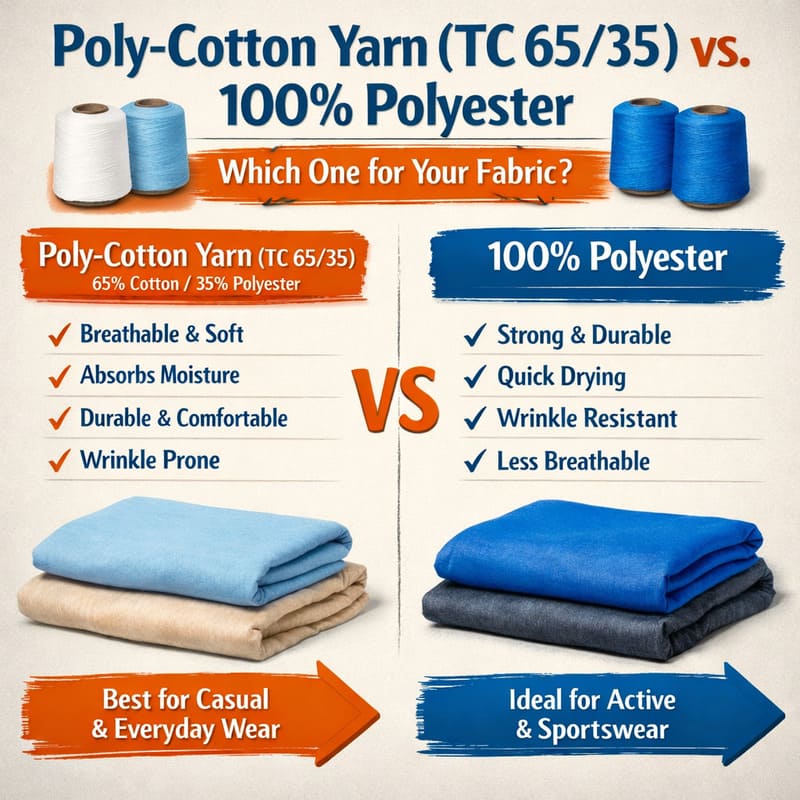
- Soft, natural cotton feel
- Breathable & comfortable
- Absorbs moisture well
- Good for skin-contact garments
- Prone to wrinkling
- Higher cost (cotton content)
- Strong & highly durable
- Quick drying
- Excellent wrinkle resistance
- Low moisture absorption
- Slightly synthetic feel
- Most economical option
🟠 What is Poly-Cotton Yarn?
Poly-Cotton yarn (also called TC yarn or blended yarn) is made by spinning polyester staple fiber and cotton fiber together into a single yarn. The most common blend is TC 65/35 — 65% polyester and 35% cotton. There is also CVC 60/40 — which has more cotton (60% cotton, 40% polyester) for a softer, more premium feel.
The cotton component is what makes poly-cotton special. Cotton fibers absorb moisture, feel natural against the skin, and give fabric a soft, lived-in drape that pure polyester can never replicate. The polyester component adds strength, wrinkle resistance, and dimensional stability — making it far more practical than 100% cotton. 🌾
School and corporate uniforms · Casual shirts and blouses · Workwear shirting · Medical scrubs · T-shirts for everyday wear · Any garment where comfort and breathability matter, but 100% cotton would be too expensive or impractical.
🔵 What is 100% Polyester Spun Yarn?
100% Polyester Spun Yarn is made entirely from polyester staple fiber — short-cut polyester fibers that are carded and ring spun or open-end spun into continuous yarn. It has no cotton content at all, which gives it maximum durability and the lowest cost among all spun yarn types.
Don't confuse polyester spun yarn with polyester filament yarn (DTY/FDY). Polyester spun yarn has a soft, cotton-like texture with a slightly hairy surface — it's the industrial workhorse of the spun yarn world. ⚙️
Industrial workwear and coveralls · Heavy-duty uniform fabric · Sewing thread (twisted multi-ply) · Industrial cloth and canvas · Mosquito net fabric · Applications where maximum durability and minimum cost matter more than comfort.
📊 Head-to-Head: 5 Key Dimensions
📋 Detailed Comparison Table
| Property | 🟠 TC 65/35 Poly-Cotton | 🔵 100% Polyester Spun |
|---|---|---|
| Composition | 65% Polyester + 35% Cotton | 100% Polyester PSF |
| Hand Feel | ✓ Soft, natural, cotton-like | Moderate — softer than filament |
| Breathability | ✓ Good — cotton allows airflow | Poor — polyester traps heat |
| Moisture Absorption | ✓ Moderate (cotton absorbs) | Very low (~0.4%) |
| Durability | Very good | ✓ Excellent — highest durability |
| Wrinkle Resistance | Good (polyester helps) | ✓ Excellent |
| Quick Drying | Moderate | ✓ Fast drying |
| Price | Mid-range (cotton adds cost) | ✓ Lowest among spun yarns |
| Dyeing | Requires 2-step dyeing process | ✓ Simple single-step dyeing |
| Count Range | Ne 10 – Ne 60 | Ne 10 – Ne 60 |
| MOQ (Yaakan) | 500 kg per spec | 500 kg per spec |
| HS Code | 5205 / 5206 | 5509.11 |
🎯 Which Applications Suit Each Yarn?
- School and corporate uniform shirts
- Medical and hospital scrubs
- Casual everyday T-shirts
- Chef and hospitality uniforms
- Lightweight workwear shirting
- Children's clothing fabric
- Bed sheets and pillowcases
- Any garment worn against skin all day
- Industrial coveralls and heavy workwear
- Sewing thread (multi-ply twisted)
- Canvas, tarpaulin, industrial cloth
- Sofa and upholstery fabric
- Mosquito net fabric
- Safety and protective clothing
- Budget uniform fabric (non-skin contact)
- Technical textile applications
If the fabric touches skin all day and comfort matters → Poly-Cotton. If the fabric needs to be as durable and cost-effective as possible and comfort is secondary → 100% Polyester Spun. When in doubt, think about your end customer: a factory worker in a coverall needs durability; a school student in a uniform shirt needs comfort. 🏭🎒
🟠 TC 65/35 vs CVC 60/40 — What's the Difference?
Within poly-cotton yarn, there are two main blend options you'll encounter. Understanding the difference helps you choose the right one for your market. 👇
| Property | TC 65/35 | CVC 60/40 |
|---|---|---|
| Composition | 65% Polyester / 35% Cotton | 60% Cotton / 40% Polyester |
| Dominant Fiber | Polyester dominant | Cotton dominant |
| Feel | Good — balanced | ✓ Softer, more natural |
| Durability | ✓ Slightly stronger | Good |
| Price | ✓ More economical | Higher (more cotton) |
| Breathability | Good | ✓ Better (more cotton) |
| Best For | Standard uniforms, budget workwear | Premium uniforms, quality shirts |
| Most Popular In | South Asia, Africa, Middle East | Markets requiring premium feel |
TC 65/35 is the global standard — the most ordered, most available, and most cost-effective poly-cotton blend. It's what most uniform and workwear fabric mills use worldwide. CVC 60/40 is for buyers who specifically need a softer, more premium feel and are willing to pay a small price premium for more cotton content.
🧾 Real Buying Example
A uniform supplier in Egypt is producing two garments for a corporate client:
- Office shirts (worn all day, direct skin contact, formal appearance required)
- Warehouse coveralls (heavy use, durability priority, worn over other clothing)
The right yarn choice:
- Office shirts → TC 65/35 Ne 40/1 ring spun, carded — soft enough for daily skin contact, wrinkle-resistant enough to look professional all day 👔
- Warehouse coveralls → 100% Polyester Ne 20/1 ring spun — maximum durability, easy care, lowest cost for a high-wear industrial garment 🏭
Two different products, two different yarns — both sourced from Yaakan, both FOB Xiamen, both delivered within 30 days. 🚢
📝 Summary
- 🟠 Poly-Cotton TC 65/35 = soft, breathable, comfortable → uniforms, casual wear, skin-contact garments. View Poly-Cotton Yarn →
- 🔵 100% Polyester Spun = durable, wrinkle-resistant, lowest cost → industrial workwear, sewing thread, technical fabric. View Polyester Spun Yarn →
- 🟠 CVC 60/40 = softer than TC 65/35, more cotton, slightly higher price → premium uniforms and quality shirting.
Not sure which yarn is right for your specific fabric? Send us your application details and we'll recommend the right specification and send you a FOB Xiamen price within 24 hours. 👇
Need a Quote for Poly-Cotton or Polyester Yarn?
Tell us your fabric type, Ne count, and monthly quantity. We'll respond with competitive FOB Xiamen pricing within 24 hours. MOQ 500 kg.