DTY, FDY, POY —
What's the Difference?
If you've received a polyester yarn price list and found yourself staring at "DTY 150D/48F" or "FDY 75D/36F SD" without knowing what any of it means — this article is for you. 🙋
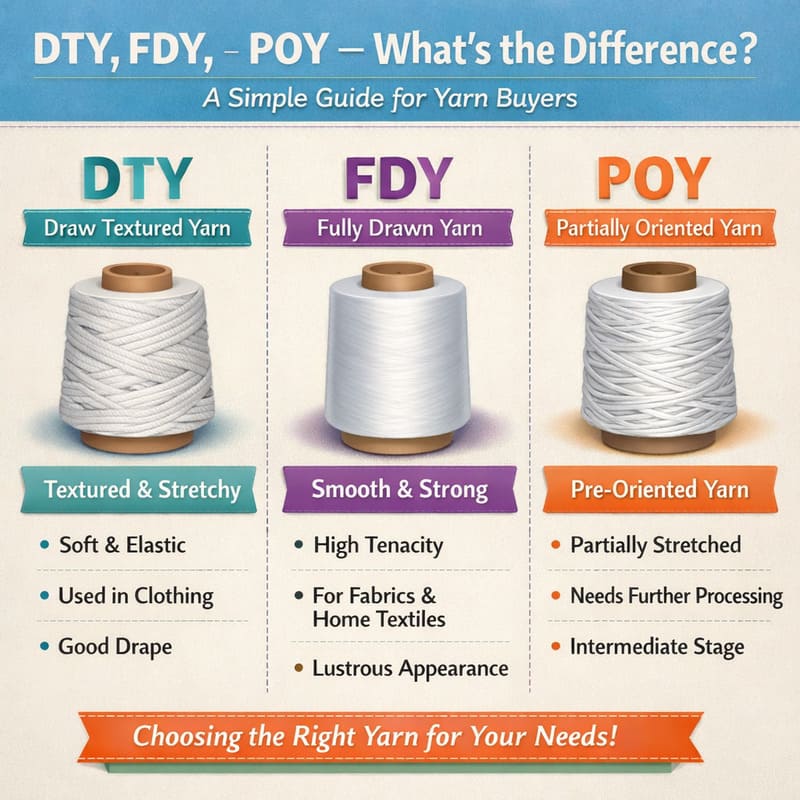
DTY, FDY, and POY are the three main types of polyester filament yarn. They look similar. They come on the same kind of cones. But they are made differently, behave differently in fabric, and are used for completely different applications.
Here is everything you need to know — explained simply, no technical background required. ✅
⚡ The Quick Answer
| Property | DTY | FDY | POY |
|---|---|---|---|
| Full Name | Draw Textured Yarn | Fully Drawn Yarn | Pre-Oriented Yarn |
| Texture | Soft, stretchy, fluffy | Smooth, flat, silky | Semi-raw, slightly stretchy |
| Feel | Like cotton — soft & warm | Like silk — smooth & crisp | Unstable — not for fabric |
| Main Use | Knit fabric, sportswear, fleece | Woven fabric, lining, embroidery | Raw material for DTY factories |
| Who Buys It | Fabric mills, garment factories | Woven fabric mills, lining factories | DTY manufacturers only |
- Soft & stretchy
- Ideal for knitwear
- Sportswear & fleece
- Comfortable against skin
- Smooth & silky
- Ideal for woven fabric
- Lining & embroidery
- Clean, flat surface
- Semi-processed
- Not for end fabric
- Raw material only
- Bought by DTY factories
🟢 What is DTY Yarn?
DTY stands for Draw Textured Yarn. It is made by taking POY yarn and running it through a texturing machine — a process that adds a permanent crimp, curl, or wave to the filaments. This texturing gives the yarn stretch, bulk, and softness.
Think of DTY as the polyester yarn that feels most like natural fibre. It has a slightly fluffy, textured surface. When knitted into fabric, it creates materials that are soft to touch, stretchy, and comfortable to wear — very similar in feel to cotton jersey or fleece.
T-shirts and sportswear fabric · Fleece and polar fleece · Swimwear and activewear · Soft lining fabric · Knitted upholstery and sofa fabric · Elastic woven fabric for bags and outdoor gear
Common DTY specifications you'll see:
- 75D/36F — fine DTY, used in light sportswear and thin jersey
- 150D/48F or 150D/96F — standard, the most ordered globally 🌍
- 300D/96F — heavier, for outdoor fabric, bags, and upholstery
- "SD" = Semi-Dull (matte finish) | "Bright" = Fully Bright (shiny)
- "NIM/SIM/HIM" = level of interlacing (affects how the yarn holds together and how much it stretches)
👉 See our full Polyester DTY Yarn specifications and pricing →
🔵 What is FDY Yarn?
FDY stands for Fully Drawn Yarn. Unlike DTY, FDY filaments are not textured — they are straight, smooth, and parallel. This gives FDY a flat, silky surface with very little stretch.
Because FDY is smooth and uniform, it produces fabrics with a clean, crisp surface — ideal for weaving, printing, and applications where you want a flat, defined textile structure. If you've ever felt the lining inside a suit jacket, that smooth slippery fabric is almost certainly made from FDY. 👔
Woven fabric (taffeta, chiffon, satin, georgette) · Lining fabric for suits and jackets · Embroidery thread · Warp yarn in weaving · High-lustre fabric where a shiny surface is desired · Label fabric and ribbon
Common FDY specifications:
- 50D/24F or 75D/36F — fine FDY for chiffon and light woven fabric
- 100D/36F or 150D/48F — medium weight for taffeta and lining
- "Trilobal Bright" — a special cross-section shape that gives extra shine, used in satin and high-lustre fabric ✨
- "SD" vs "Bright" — same as DTY: SD is matte, Bright is shiny
Not sure if a yarn sample is DTY or FDY? Scratch it between your fingers. If it feels textured and slightly rough, it's DTY. If it feels slippery and silky, it's FDY. That's it.
👉 See our full Polyester FDY Yarn specifications and pricing →
🟡 What is POY Yarn?
POY stands for Pre-Oriented Yarn. This is where things get different — POY is not a finished yarn for making fabric. It is a semi-processed intermediate product with one primary purpose: to be fed into a texturing machine to make DTY.
POY is stretchy and dimensionally unstable on its own. If you tried to make fabric from raw POY, it would shrink and distort badly after the first wash. This is why POY is almost never used directly by garment or fabric factories.
POY is bought by DTY manufacturers — factories that own texturing machines and convert POY into DTY. If you are a fabric mill, garment importer, or textile trader, you almost certainly do not need to buy POY directly. What you need is DTY or FDY.
The polyester filament production process happens in two stages. Some manufacturers produce the raw yarn (POY) in stage one, then sell it to separate texturing factories. POY is simply the "work in progress" between stage one and two.
👉 Learn more about Polyester POY Yarn — who it's for and pricing →
🤷 DTY vs FDY: How to Choose
This is the most common question from buyers. The answer depends entirely on your fabric type. Here is the simplest decision guide:
| Your fabric is… | Use this yarn | Why |
|---|---|---|
| Knitted (T-shirt, jersey, fleece) | ✅ DTY | Needs stretch and soft feel |
| Woven (taffeta, satin, lining) | ✅ FDY | Needs smooth flat surface |
| Sportswear, activewear | ✅ DTY | Elasticity and comfort |
| Suit lining or dress lining | ✅ FDY | Smooth drape, no stretch |
| Embroidery thread | ✅ FDY | Strong and doesn't stretch under tension |
| Sofa fabric, upholstery | ✅ DTY | Soft, durable knit structure |
Knit fabric = DTY. Woven fabric = FDY. When in doubt, ask your fabric supplier which yarn they use — they will tell you immediately, and you can then send us that exact specification for a quote.
📏 Does the Denier Number Matter?
Yes. Denier (D) measures yarn thickness — the higher the number, the thicker (and heavier) the yarn.
- 50D–75D — fine, lightweight fabric (chiffon, light sportswear, thin lining)
- 100D–150D — standard weight, the most widely used range for most fabric types 🌐
- 200D–300D — medium-heavy, for outdoor fabric, workwear, and bags
- 400D and above — heavy industrial, for luggage, tarpaulin, and heavy-duty cloth
The filament count (the number after the slash, e.g. 150D/48F) tells you how many individual filaments make up the yarn. More filaments = softer and finer fabric. Fewer filaments = coarser but stronger.
According to the Textile Exchange Global Fiber Report, polyester remains the world's most produced fibre — and the vast majority of that is filament yarn (DTY and FDY). Understanding denier is the first step to buying it confidently. 📊
🧾 A Real Buying Example
Suppose you are sourcing fabric for women's sportswear. You contact a fabric mill and they tell you they need:
- 150D/48F DTY SD NIM for the knit fabric body panels
- 75D/36F FDY Bright for the smooth woven trim
Now you know exactly what to order:
- 150D/48F DTY, Semi-Dull, Non-Interlaced → for the soft stretchy body fabric
- 75D/36F FDY, Bright (shiny) → for the smooth woven trim panels
You can send this specification directly to Yaakan and receive a FOB Xiamen price within 24 hours. 🚢
📝 Summary
- 🟢 DTY = textured, soft, stretchy → knit fabric, sportswear, fleece. View DTY Yarn →
- 🔵 FDY = smooth, flat, silky → woven fabric, lining, embroidery. View FDY Yarn →
- 🟡 POY = semi-raw intermediate product → for DTY factories only, not for fabric mills or importers. View POY Yarn →
If you are a fabric importer or garment manufacturer and still not sure which type you need, the fastest solution is to ask your fabric supplier for their yarn specification, then send it to us. We confirm stock and pricing the same day. 👇
Ready to Request a Quote?
Send us your yarn specification — DTY, FDY, or POY — and we'll reply with a competitive FOB Xiamen price within 24 hours. MOQ 1,000 kg.