How to Test Polyester Yarn Quality —
5 Practical Methods Every Buyer Should Know
You've received a yarn sample from a new supplier. It looks fine. The price is good. But how do you know if the quality is actually what was promised — before committing to a full container order? 🤔
Poor-quality polyester yarn causes real problems downstream: fabric defects, broken ends on knitting machines, inconsistent dyeing, and customer complaints. Catching quality issues at the sample stage saves weeks of headaches and thousands of dollars. This guide gives you 5 practical tests you can perform on any polyester yarn sample — no laboratory required for most of them. ✅
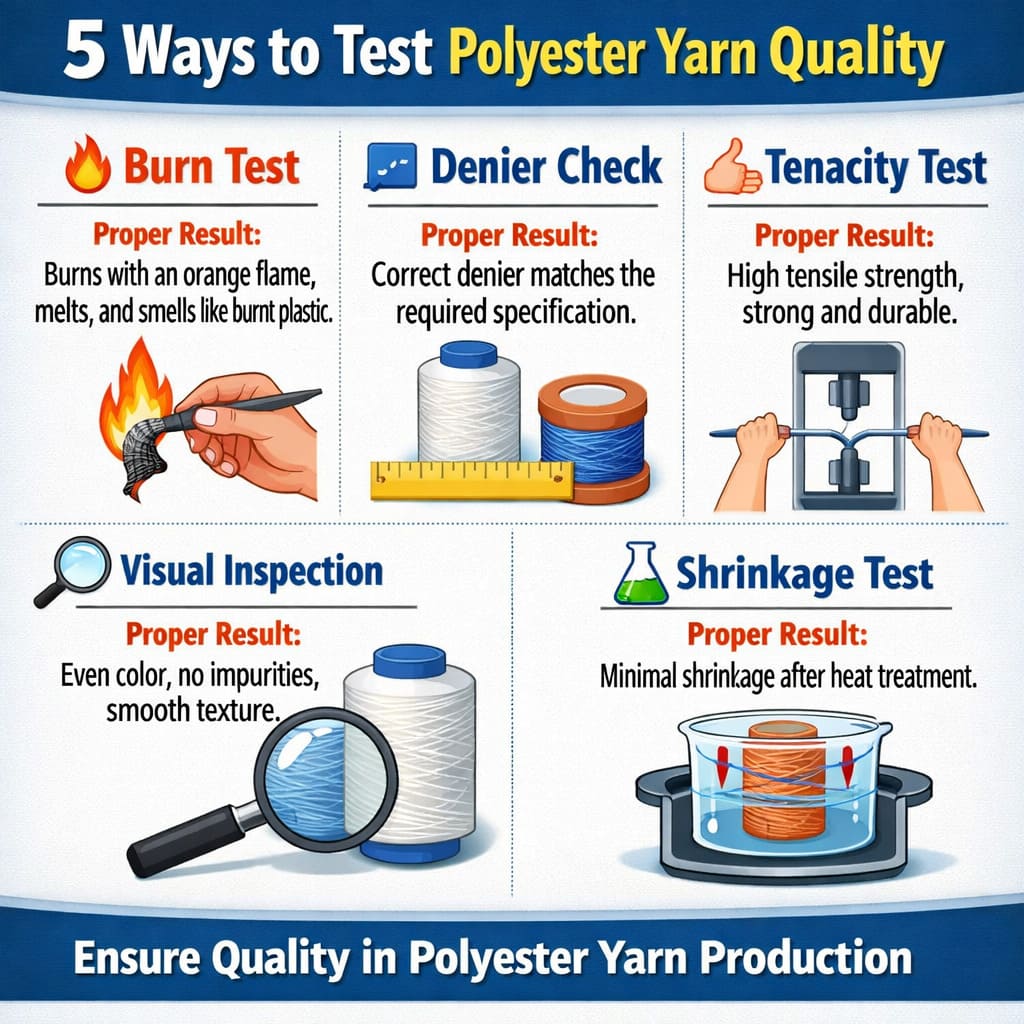
🧪 The 5 Tests — Overview
| Test | What It Checks | Equipment Needed | Time Required |
|---|---|---|---|
| 1. Burn Test | Fiber content — is it really polyester? | Lighter or matches | 2 minutes |
| 2. Visual Inspection | Evenness, surface quality, lustre consistency | Eyes + good lighting | 5 minutes |
| 3. Denier Check | Is the actual weight/thickness correct? | Scale + ruler | 15 minutes |
| 4. Shrinkage Test | Dimensional stability after heat/wash | Hot water + ruler | 30 minutes |
| 5. Tenacity & Break Test | Strength — does it break too easily? | Hands or tensile tester | 5 minutes |
🔬 Test Details — Step by Step
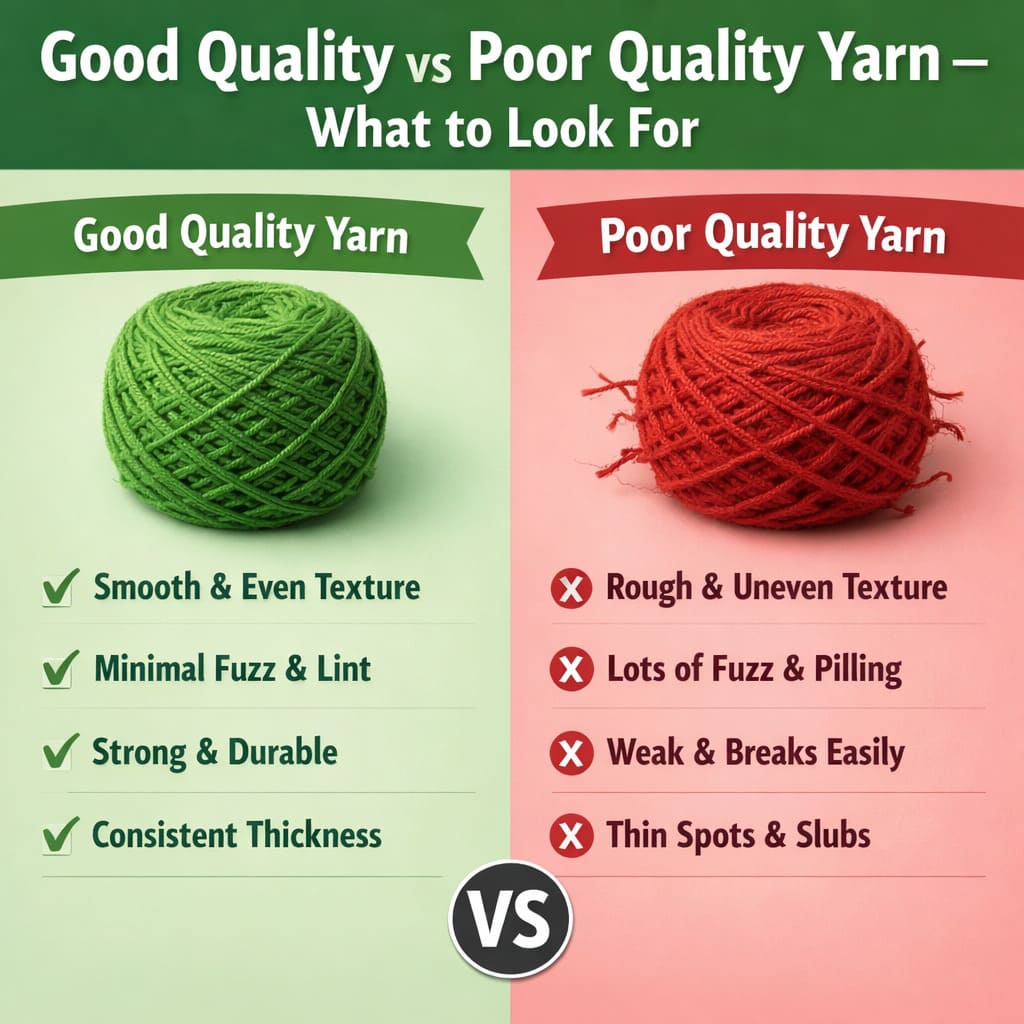
👁️ Good Quality vs Poor Quality — What to Look For
- Uniform diameter — no thick or thin spots
- Consistent lustre throughout the cone
- Minimal surface hairiness (especially FDY)
- Clean, even colour — no streaks or patches
- Denier within ±3–5% of specification
- Boiling water shrinkage below 3–5%
- Consistent break force across test samples
- No knots, splices, or hard spots on winding
- Cone wound evenly — no loose or tight sections
- Comes with mill quality certificate
- Thick-thin variation (neps, slubs, uneven count)
- Inconsistent lustre — dull patches or colour variation
- Excessive hairiness or flyaway fibres
- Colour streaks, yellowing, or uneven whiteness
- Underweight denier (below specification)
- High boiling water shrinkage (>5–8%)
- Inconsistent or low break strength
- Frequent knots or splices visible on cone
- Loose or uneven winding — collapses when unwound
- No quality certificate or refuses to provide one
🔬 When to Use Professional Lab Testing
The 5 tests above can be done with minimal equipment at your office or factory. But for large orders or critical applications, professional laboratory testing gives you precise, documented results that can be used in any dispute. 🏭
| Test Parameter | Standard | When Required |
|---|---|---|
| Denier / Linear Density | ASTM D1907 / ISO 2060 | All high-volume orders |
| Tenacity & Elongation | ASTM D2256 / ISO 2062 | Technical textile, FDY warp yarn |
| Boiling Water Shrinkage | ASTM D2259 | DTY for fabric mills with heat processes |
| Moisture Regain | ASTM D2495 | Blended yarn (TC, PV, PC) |
| Crimp Contraction (DTY) | ISO 7211 | DTY for stretch fabric |
| Blend Ratio Verification | Chemical dissolution | Any blended yarn (TC, CVC, PV) |
| OEKO-TEX / REACH | OEKO-TEX Standard 100 | Children's clothing, EU market |
For any order placed with Yaakan, you can request a pre-shipment SGS or Bureau Veritas inspection. An independent inspector visits our warehouse before shipment, verifies quantity, checks random samples against your specification, and issues a formal inspection report. Cost is typically USD 200–400 per inspection and is worth every dollar on orders above $10,000. 📄
⚠️ Red Flags — When to Walk Away from a Supplier
- Supplier refuses to send samples before mass order — no legitimate supplier does this
- No mill quality certificate available — every professional spinning mill issues one
- Price dramatically below market — often means lower denier, blending issues, or recycled waste fiber passed as virgin
- Burn test shows non-polyester characteristics — fiber substitution is real
- Denier more than 8–10% below specification — deliberate underweight
- High boiling shrinkage on DTY — indicates POY-quality yarn sold as DTY
- Refuses SGS or third-party inspection — has something to hide
📋 Sample Evaluation Checklist
Use this checklist every time you receive a new yarn sample from a supplier: 📝
| # | Check Item | Method | Pass Criteria |
|---|---|---|---|
| 1 | Fiber content confirmed | Burn test | Polyester burn characteristics ✓ |
| 2 | Visual uniformity | Visual inspection under light | No thick-thin, consistent lustre ✓ |
| 3 | Denier accuracy | Weigh 90m sample | Within ±5% of spec ✓ |
| 4 | Boiling shrinkage | Boil 1m sample, remeasure | <5% shrinkage ✓ |
| 5 | Break strength | Hand break test ×10 | Consistent force, no thin-spot breaks ✓ |
| 6 | Cone winding quality | Unwind 5–10m | Even tension, no knots ✓ |
| 7 | Mill certificate | Request from supplier | Document provided with full spec ✓ |
Every order from Yaakan comes with a mill quality certificate confirming denier, tenacity, elongation, moisture, and lustre. We work with certified spinning mills that maintain ISO quality systems. For first-time buyers, we offer free samples — pay only shipping. We welcome SGS inspection on any order. 📦
📝 Summary
- 🔥 Burn test — confirms fiber content; polyester melts, forms hard bead, smells chemical
- 🔍 Visual inspection — check for evenness, lustre consistency, hairiness, colour uniformity
- 📏 Denier check — weigh 90m sample; actual denier should be within ±5% of spec
- 🧺 Shrinkage test — boil 1m sample; good polyester shrinks less than 3–5%
- 💪 Tenacity test — break by hand ×10; consistent force = consistent quality
- 📋 Always request a mill quality certificate — refuse any supplier who won't provide one
Concerned about quality on your next yarn order? Contact Yaakan — we supply DTY, FDY, poly-cotton and all major yarn types with full quality documentation. Free samples available. 👇
Request a Free Yarn Sample
Not sure about quality? Request a free sample before committing to a full order. We ship samples via DHL within 3–5 working days — you pay only the courier cost.