Bangladesh, Pakistan, Vietnam —
The World's Top 3 Textile Sourcing Destinations Compared
If you're sourcing garments or textile products from Asia, three countries dominate the conversation: Bangladesh, Pakistan, and Vietnam. Together they account for a significant share of the world's garment and textile exports — and each has a distinct profile in terms of what they make, how competitive they are, and what raw materials they need. 🌍
For polyester yarn suppliers like Yaakan, understanding these three markets is essential — because what the factories in these countries produce determines what yarn they need to buy. This article gives you an honest, data-grounded comparison of all three. ✅
📊 Country Snapshot — At a Glance
🇧🇩 Bangladesh — The World's Knitwear Factory
Bangladesh is the second-largest garment exporter in the world after China, and by far the world's largest exporter of knitwear. The country's garment industry employs over 4 million workers — the majority of them women — and accounts for more than 80% of Bangladesh's total export earnings. 👗
What Bangladesh Produces
- 🧥 Knitwear — T-shirts, polo shirts, sweatshirts, hoodies (dominant category)
- 👕 Woven RMG — trousers, shirts, jackets, denim
- 🏭 Home textiles — bed linen, towels (growing sector)
- 🎽 Activewear — sportswear for European and US brands
What Yarn Bangladesh Needs from China
Bangladesh has a large domestic spinning industry but still imports significant volumes of yarn — particularly filament yarn — from China. The key yarn types needed: 🧵
| Yarn Type | Application in Bangladesh | Volume Demand |
|---|---|---|
| Polyester DTY | Knit fabric for T-shirts, sportswear, fleece | ⭐ Very High |
| Polyester FDY | Woven lining, taffeta, embroidery thread | High |
| Poly-Cotton TC | Uniform fabric, woven shirting, workwear | High |
| Polyester Staple Fiber | Blended yarn spinning (domestic mills) | Medium |
| Polyester Spun Yarn | Sewing thread, industrial fabric | Medium |
Bangladeshi buyers are typically high-volume, price-sensitive, and specification-focused. They order in large quantities (5–50 tons per shipment), require consistent quality across lots, and often need Form E Certificate of Origin for duty reduction under the ASEAN-China FTA (Bangladesh receives GSP benefits in EU). Lead time and reliability are critical — production schedules are tight. 📦
🇵🇰 Pakistan — The Cotton Powerhouse
Pakistan is unique among major textile exporters because it has a fully integrated domestic cotton supply chain — from cotton farming to spinning, weaving, finishing, and export. The country grows significant cotton and has over 1,200 textile mills. This vertical integration makes Pakistan highly competitive in cotton-based products but creates a different dynamic for polyester yarn imports. 🌾
What Pakistan Produces
- 👖 Denim fabric and garments — Pakistan is one of the world's largest denim producers
- 🛁 Home textiles — towels, bed sheets, pillow covers (major export category)
- 👕 Knitwear — T-shirts, casual wear (growing)
- 🧵 Yarn and fabric — exported to other manufacturing countries
What Yarn Pakistan Needs from China
Because Pakistan has strong domestic cotton spinning, it primarily imports polyester filament yarn and blended yarn raw materials that its domestic industry cannot produce competitively: 🧶
| Yarn Type | Application in Pakistan | Volume Demand |
|---|---|---|
| Polyester DTY | Knit fabric, sportswear, synthetic garments | High |
| Polyester FDY | Woven fabric, lining, embroidery | High |
| Polyester Staple Fiber | Blending with domestic cotton in spinning mills | ⭐ Very High |
| PV Yarn | Suiting fabric for domestic and export market | Medium |
| Poly-Cotton TC | School/corporate uniform fabric | Medium |
Pakistani buyers tend to be technically sophisticated — many come from spinning or weaving mill backgrounds and understand fiber specifications in detail. They are quality-conscious and often request SGS inspection or third-party testing. PSF buyers typically purchase in full container loads (20FCL). Payment terms are often T/T with some L/C for larger orders. Port: Karachi — transit time from Xiamen approximately 12–18 days. 🚢
🇻🇳 Vietnam — The Fastest-Growing Textile Hub
Vietnam has become one of the most dynamic textile and garment manufacturing hubs in the world. Driven by foreign direct investment from Korean, Japanese, and Taiwanese companies, Vietnam has rapidly built a sophisticated manufacturing base focused on sportswear, technical textile, and high-value garments. 🏭
Vietnam is the preferred sourcing destination for major US and EU sportswear brands — Nike, Adidas, and many others have significant production in Vietnam. This creates strong demand for high-quality polyester filament yarn. ⚡
What Vietnam Produces
- 🎽 Sportswear and activewear — dominant category; Nike, Adidas, Under Armour etc.
- 👟 Footwear — world's #2 footwear exporter (uses polyester fabric components)
- 🧥 Outerwear and technical garments — performance fabrics, outdoor gear
- 🏠 Home textiles — growing sector
What Yarn Vietnam Needs from China
Vietnam is a major importer of polyester filament yarn from China — its domestic yarn production capacity is limited, creating strong ongoing demand: 🧵
| Yarn Type | Application in Vietnam | Volume Demand |
|---|---|---|
| Polyester DTY | Sportswear knit fabric, activewear, fleece | ⭐ Very High |
| Polyester FDY | Woven technical fabric, lining, taffeta | ⭐ Very High |
| Polyester POY | Domestic texturing mills (DTY production) | High |
| Polyester Staple Fiber | Nonwoven fabric, filling, blended yarn | Medium |
| Poly-Cotton TC | Uniform and casual wear fabric | Low-Medium |
Vietnam's major garment factories supply global brands that have strict sustainability requirements. GRS-certified recycled polyester (rPET) is increasingly requested — especially for sportswear brands with 2025–2030 recycled content targets. Buyers in Vietnam are also more likely to request OEKO-TEX certification on yarn. For suppliers, having GRS-certified rPET available is becoming a competitive advantage in this market. ♻️
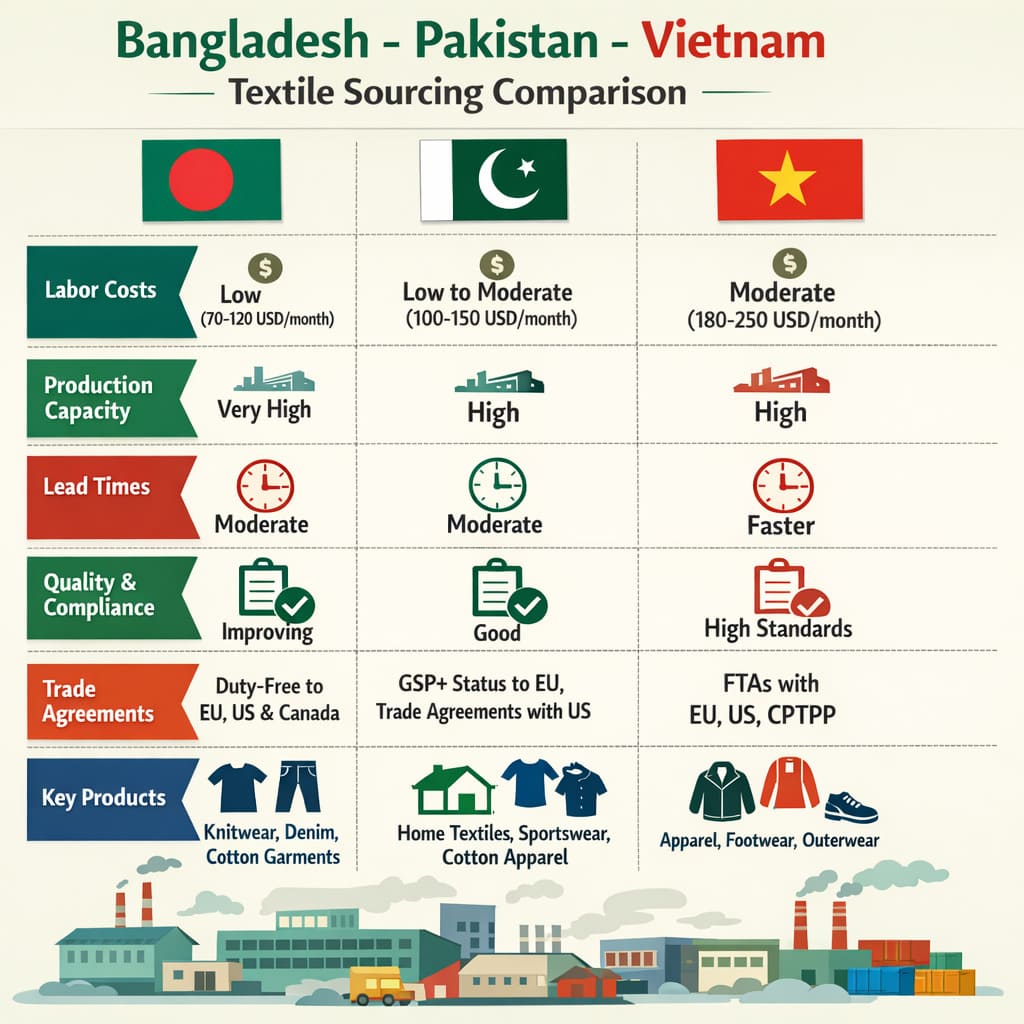
📋 Full Comparison — Bangladesh vs Pakistan vs Vietnam
| Factor | 🇧🇩 Bangladesh | 🇵🇰 Pakistan | 🇻🇳 Vietnam |
|---|---|---|---|
| Textile Export Value | ~$47B | ~$16B | ~$44B |
| Key Strength | Knitwear volume & price | Cotton integration & home textiles | Sportswear & technical quality |
| Labour Cost | Lowest globally | Low-medium | Medium (rising) |
| Lead Time | 45–75 days | 45–90 days | 30–60 days |
| Quality Level | Good — wide range | Good — cotton speciality | High — brand-grade |
| EU GSP/EBA Status | Yes — EBA (0% duty) | Yes — GSP+ | EVFTA (graduated) |
| US Trade Access | No preferential | No preferential | MFN — competitive |
| Top Yarn Need | DTY + TC spun yarn | PSF + FDY | DTY + FDY (premium) |
| Sustainability Focus | Growing (BGMEA push) | Moderate | High (brand-driven) |
| Transit from Xiamen | 10–14 days | 12–18 days | 4–7 days |
💡 What This Means for Yarn Buyers in Each Country
If you're a yarn buyer, trader, or fabric mill in one of these three countries, here's what the market context means for your sourcing strategy: 🎯
🇧🇩 If You're in Bangladesh
Your primary yarn needs are DTY for knitwear and TC spun yarn for woven uniform fabric. Price competitiveness is critical — Bangladesh factories win on volume and cost. Order in full containers (20FCL or 40FCL) to minimise per-kg logistics cost. Take advantage of Form A/GSP certificates when importing from China to reduce import duty. Lead time management is crucial — order 6–8 weeks ahead of your fabric mill's production schedule.
🇵🇰 If You're in Pakistan
Your key import from China is likely polyester staple fiber (PSF) for blending with domestic cotton, plus FDY and DTY for synthetic fabric production. Quality testing is important — request mill quality certificates for every shipment. Pakistan's strong domestic cotton spinning means polyester spun yarn from China competes directly with local production, so pricing must be sharp.
🇻🇳 If You're in Vietnam
You likely need high-quality DTY and FDY — often for brand-name sportswear production with strict quality specifications. Lead time is shorter than Bangladesh due to proximity. GRS-certified rPET yarn is increasingly important for clients supplying European and US sportswear brands. Premium specifications (high filament count, low denier) are common requirements.
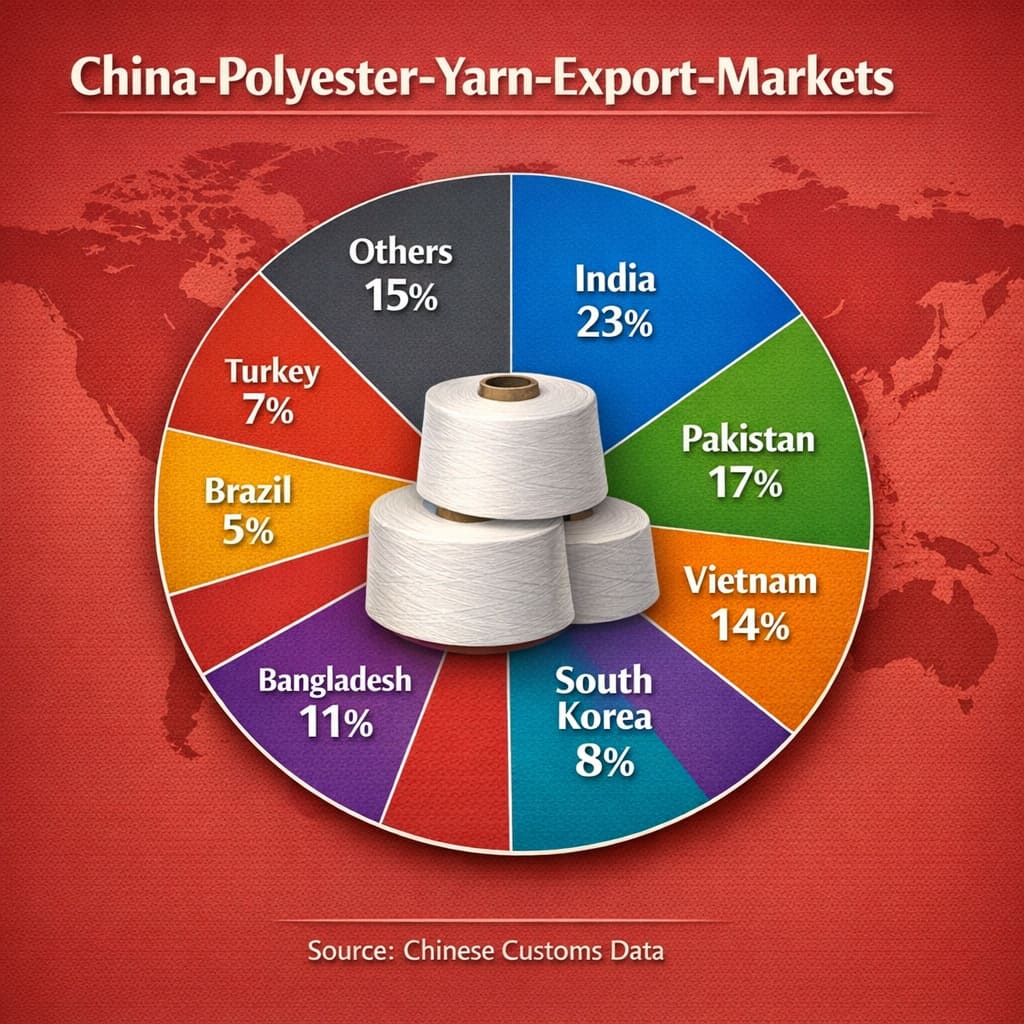
🚢 Yaakan's Experience in These Three Markets
Yaakan has been supplying polyester yarn to buyers in Bangladesh, Pakistan, and Vietnam for over 18 years. All three markets are core to our export business:
- 🇧🇩 Bangladesh — regular shipments to Chittagong; DTY and TC yarn for fabric mills and yarn traders; Form A and Form E certificates available
- 🇵🇰 Pakistan — regular shipments to Karachi; PSF and FDY are the most requested products; SGS inspection available on request
- 🇻🇳 Vietnam — regular shipments to Ho Chi Minh City and Haiphong; DTY and FDY for sportswear factories; GRS-certified rPET available
All orders ship FOB Xiamen. Transit times are short — 4–7 days to Vietnam, 10–14 days to Bangladesh, 12–18 days to Pakistan. MOQ is 500 kg for spun yarn and 1,000 kg for filament yarn per specification. 📦
📝 Summary
- 🇧🇩 Bangladesh — world's largest knitwear exporter; primary need is DTY + TC yarn; price and volume focused; EBA duty-free access to EU
- 🇵🇰 Pakistan — vertically integrated cotton supply chain; primary import need is PSF + FDY; technically sophisticated buyers; strong in home textiles and denim
- 🇻🇳 Vietnam — fastest-growing market; high-quality DTY + FDY for sportswear brands; proximity to China (4–7 days transit); growing sustainability requirements
- 🚢 All three markets are within 4–18 days transit from Xiamen Port — ideal for FOB China sourcing
Are you a buyer in Bangladesh, Pakistan, or Vietnam? Contact Yaakan for current FOB Xiamen pricing on DTY, FDY, PSF, or blended yarn — we respond within 24 hours. 👇
Sourcing Yarn for Bangladesh, Pakistan or Vietnam?
Tell us your product, specification, quantity and destination port. We'll send you competitive FOB Xiamen pricing within 24 hours — with the right Certificate of Origin for your import duty requirements.