What Affects Polyester Yarn Prices?
A Buyer's Guide to Market Trends in 2025
One month the price is stable. The next month it jumps 8%. A quarter later it drops back down. If you've been buying polyester yarn for more than a year, you've almost certainly experienced this frustrating volatility — and wondered why it happens. 📊
Polyester yarn pricing is driven by a specific set of upstream factors. Once you understand what they are and how they interact, you can make smarter buying decisions — timing your orders when prices are favourable and protecting your margins when costs are rising. This guide explains everything. ✅
🏭 The Polyester Supply Chain — Why Prices Move
To understand polyester yarn pricing, you first need to understand where polyester comes from. The supply chain has four key stages: 👇
| Stage | Product | Made From | Price Driver |
|---|---|---|---|
| 1. Crude Oil | Petroleum | Extracted from oil fields | Global oil market (OPEC, geopolitics) |
| 2. Petrochemicals | PX (Paraxylene) + Ethylene | Crude oil refining | Refinery capacity, crude oil price |
| 3. Raw Materials | PTA + MEG | PX + Ethylene | PX/ethylene price, capacity utilisation |
| 4. Polyester | PET chips → PSF / POY / DTY / FDY | PTA + MEG polymerisation | PTA + MEG cost, demand, inventory |
The key takeaway: polyester yarn price = PTA cost + MEG cost + manufacturing margin + market conditions. When crude oil rises, PTA and MEG follow, and polyester yarn prices rise with them — often with a 2–6 week lag. 🛢️
For buyers interested in the upstream chemical market, SinoLook Chemical — our upstream partner — specialises in fine chemicals and petrochemical intermediates including those used in polyester production.
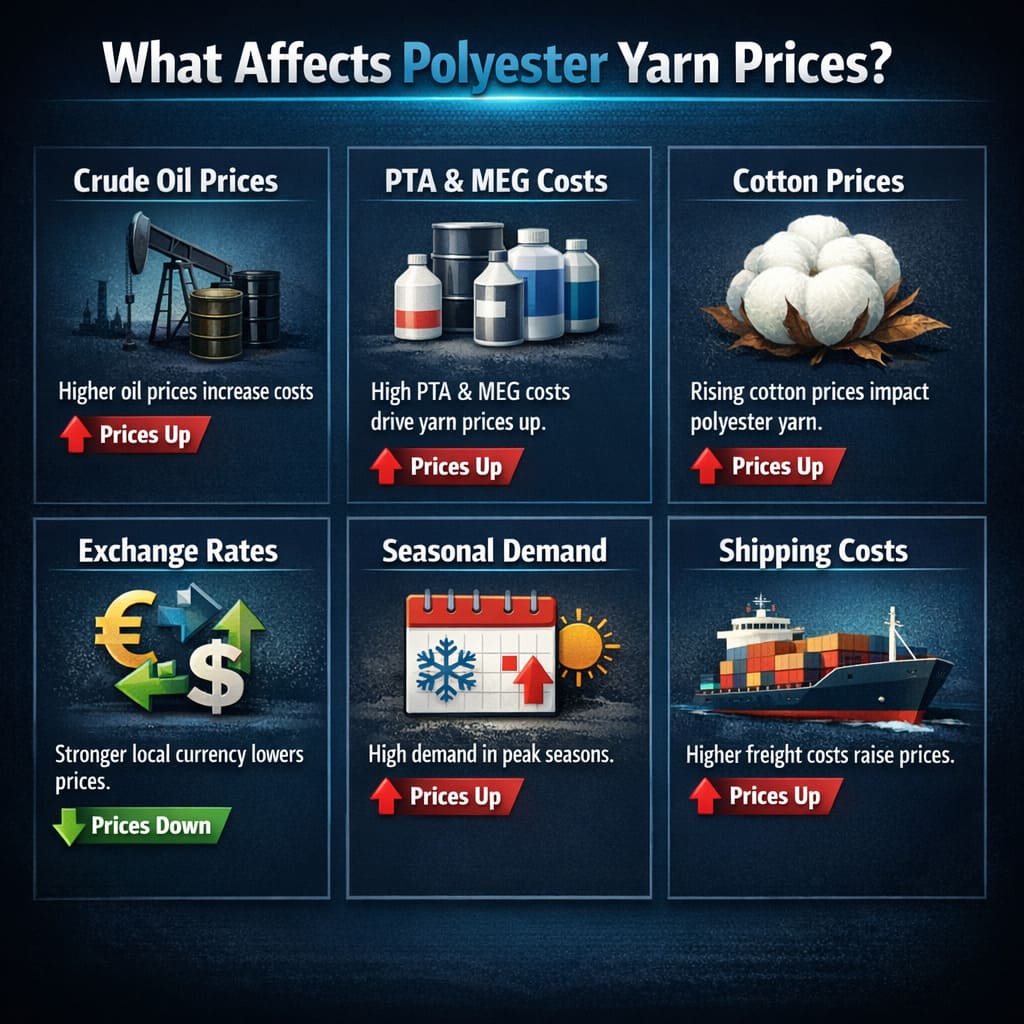
🔑 The 6 Key Factors That Drive Polyester Yarn Prices
📈 2025 Market Overview — Key Trends
Based on market conditions through early 2025, here are the key trends shaping polyester yarn pricing for buyers this year: 🌍
| Factor | 2025 Status | Price Impact |
|---|---|---|
| Crude Oil | Moderate — Brent trading $70–$85 range | ⬌ Relatively stable |
| PTA Supply | New capacity additions in China — mild oversupply | ↓ Slight downward pressure |
| MEG Supply | Tight — coal-based MEG plants utilisation high | ↑ Some upward pressure |
| Cotton Price | Soft — global cotton production strong in 2024/25 | ⬌ Limited substitution effect |
| RMB/USD Rate | RMB stabilised around 7.1–7.3 range | ⬌ Neutral for most buyers |
| China Domestic Demand | Recovery underway but uneven across sectors | ⬌ Mixed — watching Q2/Q3 |
| Ocean Freight | Elevated vs 2023 lows — Red Sea disruption impact | ↑ Adds to landed cost |
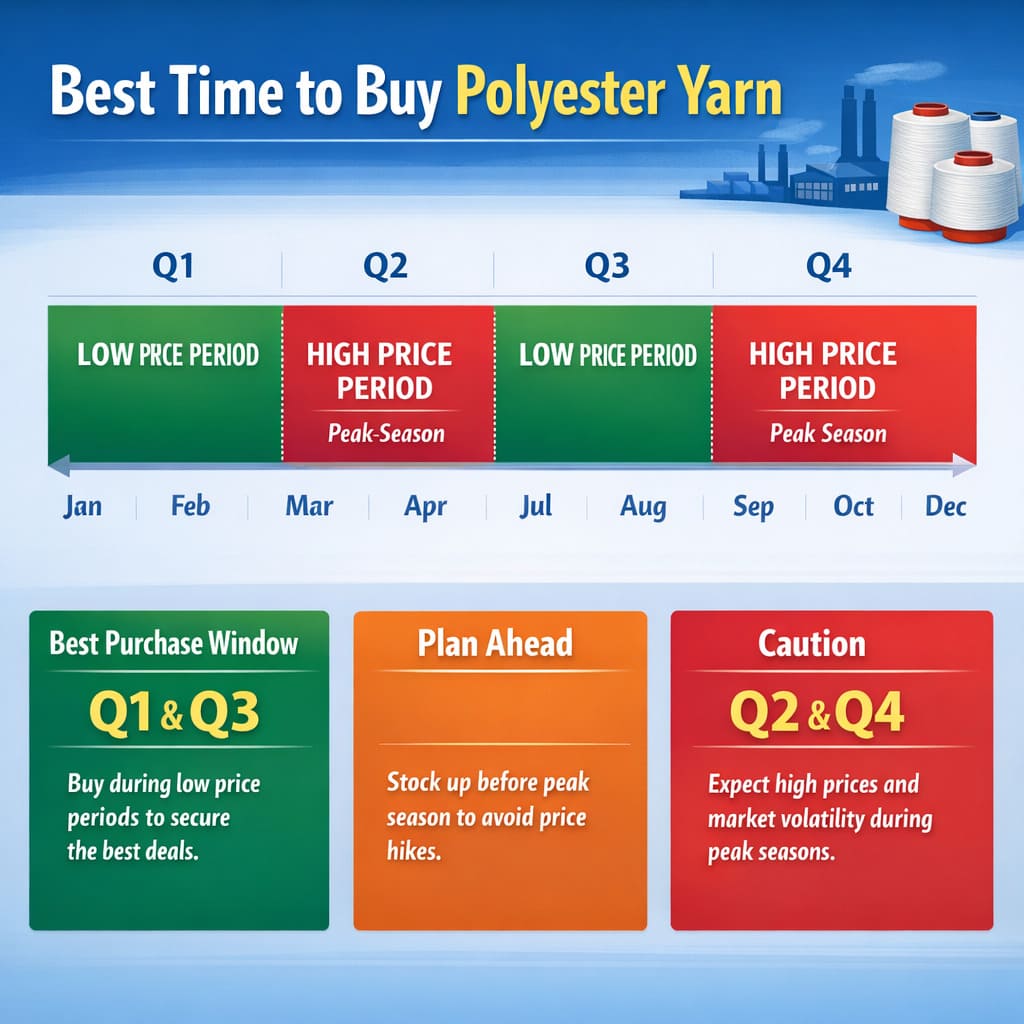
Polyester yarn prices in 2025 are likely to remain range-bound with moderate volatility — neither the dramatic spikes of 2021–22 nor the deep lows of 2023. The biggest risk factor is crude oil — any significant supply disruption (Middle East conflict, OPEC cuts) could push prices up 10–15% quickly. For buyers, the strategy is to maintain 4–6 weeks of buffer stock and place orders during Q1 and Q3 when demand is typically lower. 📦
📅 Seasonal Buying Guide — When to Order
Timing your purchases with the seasonal demand cycle can save 5–10% on yarn costs over the course of a year. Here's how the calendar typically plays out: 🗓️
🛒 5 Practical Tips for Smarter Yarn Buying
- Watch crude oil, not just yarn prices. Brent crude is a leading indicator — if oil has been rising for 2–3 weeks, expect yarn prices to follow. Track WTI or Brent weekly as part of your procurement routine. 🛢️
- Lock in prices when the market is soft. Q1 and Q3 are historically the weakest demand periods. Use these windows to place forward orders or build buffer stock at more favourable prices. 📦
- Don't buy hand-to-mouth during peak season. Buying in small quantities during Q4 or Q2 peaks means paying top-of-market prices AND facing longer lead times. Plan 6–8 weeks ahead. 📅
- Factor freight into your total cost, not just FOB. A $0.05/kg saving on FOB price can be wiped out by a $100–$200/CBM increase in freight. Always calculate CIF equivalent when comparing supplier quotes. 🚢
- Ask your supplier for market updates. A good supplier will give you honest market intelligence — when prices are rising, when to hold, and when to buy. We send market updates to our regular buyers on request. 📩
- Crude oil breaking above $90/barrel — expect yarn price increases within 3–4 weeks
- RMB strengthening rapidly past 7.0 vs USD — Chinese exporters may revise prices upward
- Major Red Sea or Suez Canal disruptions — freight surcharges can add $200–500/container overnight
- Cotton price spike above 90 cents/lb — may increase polyester demand and pricing
📝 Summary
- 🛢️ Crude oil is the single biggest driver — watch Brent weekly
- ⚗️ PTA & MEG account for 70–80% of polyester cost — track these for early warning
- 🌾 Cotton prices affect polyester demand indirectly — high cotton = more polyester buying
- 💱 RMB/USD rate affects FOB pricing — a stronger RMB can push export prices up
- 📅 Best buying windows: Q1 (Jan–Mar) and Q3 (Jul–Aug)
- 🚢 Always calculate landed cost — freight is a major variable in 2025
Want current market pricing for DTY, FDY, poly-cotton or staple fiber? Contact us for a live FOB Xiamen quote — we respond within 24 hours. 👇
Get Current Market Pricing
Our team monitors PTA, MEG and freight rates daily. Contact us for a live FOB Xiamen quote and honest market advice — no obligation.