Yarn Count Explained — Ne, Nm and Tex:
What Every Buyer Needs to Know
You've seen it written as Ne 30/1, Nm 50, or 20 Tex. All three describe the same thing — yarn count, or how thick or thin a yarn is. But they use completely different numbering systems, which makes ordering yarn confusing if you don't know what each one means. 🤔
This guide explains all three yarn count systems — Ne, Nm, and Tex — in plain English. By the end, you'll be able to read any yarn count on a price list, convert between systems, and order the right yarn thickness for your fabric every time. ✅
📐 The Three Yarn Count Systems
The world uses three main systems to measure how thick or thin a yarn is. The frustrating part: two of them work backwards from what you might expect. Here's a quick overview before we dive in. 👇
- Higher number = finer (thinner) yarn
- Most common for spun yarn (cotton system)
- Used in South Asia, Africa, Middle East
- Also written as "s" e.g. 30s, 40s
- Range: Ne 6 (coarse) to Ne 80 (fine)
- Higher number = finer (thinner) yarn
- Common in Europe & worsted spinning
- Used for wool, PV, and blended yarn
- Easy to remember: metres per gram
- Range: Nm 10 (coarse) to Nm 100+ (fine)
- Higher number = thicker (heavier) yarn
- The only "direct" system — works as expected
- Used in technical textiles, industrial yarn
- Also used for filament yarn (dtex = denier/10)
- Range: 10 Tex (fine) to 200+ Tex (heavy)
Ne and Nm are indirect systems — higher number means finer yarn. Tex is a direct system — higher number means thicker yarn. This is the single most important thing to understand about yarn count. Once you have this, everything else follows logically. 🎯
🟢 Ne — English Count (The Most Common for Spun Yarn)
Ne (English Count) is the system you'll encounter most often when buying poly-cotton yarn, polyester spun yarn, or polyester viscose yarn from China. It is the standard count system for cotton-system spun yarn worldwide. 🌍
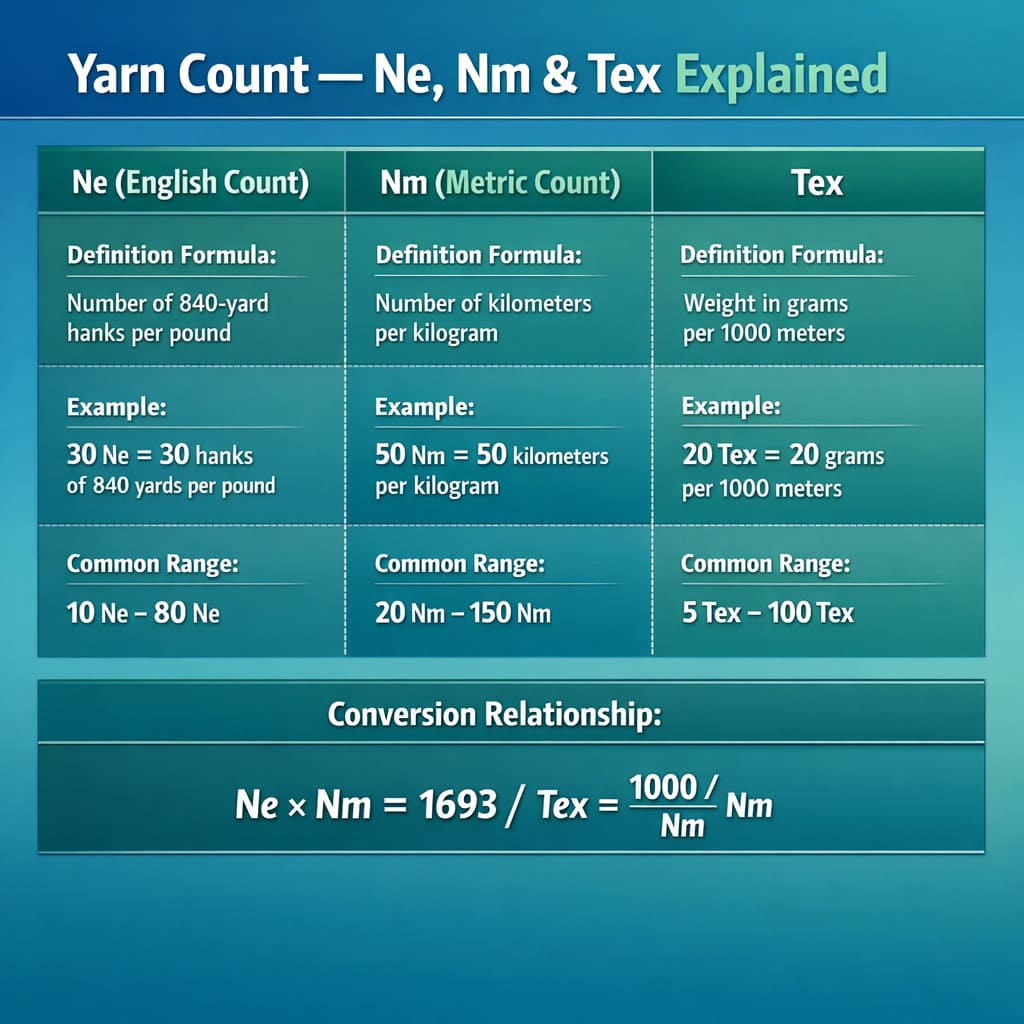
The Ne count tells you how many 840-yard lengths of yarn make up one pound (453g) of yarn. So Ne 30 means 30 × 840 yards = 25,200 yards per pound. The more lengths you can fit into a pound, the finer the yarn must be — which is why higher Ne = thinner yarn.
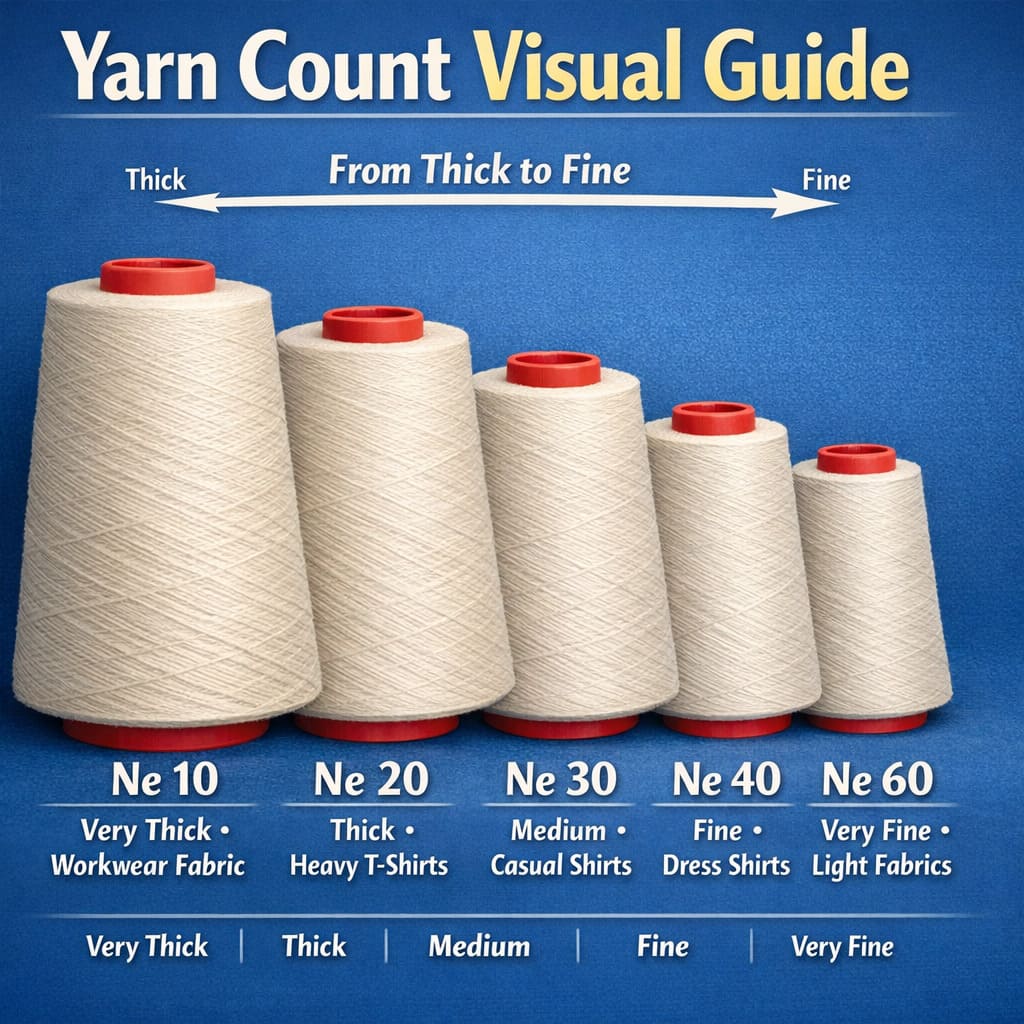
Ne Thickness Reference Guide
What Does "30/1" or "30/2" Mean? — Understanding Ply
You'll often see yarn count written as Ne 30/1 or Ne 30/2. The number after the slash is the ply — how many individual strands are twisted together to make the final yarn. 🔀
| Notation | Meaning | Effective Count | Application |
|---|---|---|---|
| Ne 30/1 | Single strand, Ne 30 | Ne 30 | Knit fabric (T-shirt, jersey) |
| Ne 30/2 | Two Ne 30 strands twisted together | ~Ne 15 (thicker) | Woven fabric, sewing thread |
| Ne 40/1 | Single strand, Ne 40 | Ne 40 | Fine knit, quality shirting |
| Ne 40/2 | Two Ne 40 strands twisted | ~Ne 20 (thicker) | Strong woven fabric, thread |
| Ne 20/3 | Three Ne 20 strands twisted | ~Ne 6.7 (very thick) | Sewing thread, rope |
For knit fabric (T-shirts, jersey, sportswear), always use single ply (Ne XX/1) — single strands knit more easily and produce softer fabric. For woven fabric (shirting, lining), 2-ply (Ne XX/2) gives added strength and evenness. Sewing thread is typically 3-ply or higher for durability. 🧵
🔵 Nm — Metric Count
Nm (Metric Count) is simpler to understand than Ne. It tells you how many metres of yarn you get per gram. So Nm 50 means 50 metres per gram — a very straightforward definition. Like Ne, higher Nm = finer yarn. 📏
Nm is commonly used for:
- 🇪🇺 European fabric mills and yarn specifications
- Worsted and woollen system spinning (wool blends, PV yarn)
- Polyester viscose (PV) yarn — commonly specified in Nm
- Technical yarn specifications in metric-system countries
| Nm Count | Approx Ne Equivalent | Yarn Character | Typical Use |
|---|---|---|---|
| Nm 20 | ~Ne 11.8 | Coarse | Heavy fabric, thick PV suiting |
| Nm 30 | ~Ne 17.7 | Medium-coarse | Standard PV suiting fabric |
| Nm 48 | ~Ne 28.3 | Medium ⭐ | PV 65/35 standard suiting — most common |
| Nm 60 | ~Ne 35.4 | Medium-fine | Fine suiting, quality dress fabric |
| Nm 80 | ~Ne 47.2 | Fine | Premium suiting, fine blended fabric |
🟡 Tex — The Direct System
Tex is the only "logical" count system — heavier yarn has a higher Tex number. It measures grams per 1,000 metres of yarn. A 20 Tex yarn weighs 20 grams per 1,000 metres. Double the thickness, double the Tex. Simple. ⚖️
Tex is most commonly used in:
- Technical and industrial textiles
- Sewing thread specifications (where Tex 40, Tex 60, Tex 80 are common thread sizes)
- Scientific and research contexts
- dtex (decitex) — used for filament yarn; dtex = Tex × 10, same as denier ÷ 9
If you've ordered filament yarn (DTY/FDY), you'll know denier (D). Denier and dtex are almost identical: 1 denier ≈ 1.1 dtex, and both measure weight per length. So 150D DTY is approximately 165 dtex. For practical buying purposes, you can treat denier and dtex as the same number. 🔗
🔄 Yarn Count Conversion Formulas
Here are the exact formulas for converting between Ne, Nm, and Tex — plus a quick reference table for the most common counts. 📊
| Ne | Nm | Tex | Yarn Character | Common Application |
|---|---|---|---|---|
| Ne 10 | Nm 16.9 | 59 Tex | Coarse | Heavy workwear, industrial fabric |
| Ne 20 | Nm 33.9 | 30 Tex | Medium-coarse | Standard workwear shirting |
| Ne 30 | Nm 50.8 | 20 Tex | Medium ⭐ | T-shirts, casual wear, uniform |
| Ne 40 | Nm 67.7 | 15 Tex | Medium-fine | Dress shirts, quality fabric |
| Ne 60 | Nm 101.6 | 10 Tex | Fine | Premium shirting, fine fabric |
🛒 Which Count System Will You Encounter?
The count system you'll see depends on the yarn type and where your supplier is based. Here's a quick reference: 🌍
| Yarn Type | Count System Used | Example |
|---|---|---|
| Poly-Cotton Yarn (TC/CVC) | Ne (English Count) | Ne 30/1, Ne 40/2 |
| 100% Polyester Spun Yarn | Ne (English Count) | Ne 20/1, Ne 30/1 |
| Polyester Viscose Yarn (PV) | Nm (Metric Count) | Nm 48/2, Nm 32/2 |
| Polyester DTY Yarn | Denier (D) | 150D/48F, 75D/36F |
| Polyester FDY Yarn | Denier (D) | 75D/36F, 100D/36F |
| Sewing Thread | Tex or Ne | Tex 40, Ne 40/3 |
| Technical / Industrial Yarn | Tex or Dtex | Tex 80, 167 dtex |
🧾 Real Buying Example
A garment factory in Bangladesh is producing three products and needs to order yarn for each: 👕🧥👔
- Factory uniform T-shirts — comfortable, not too thin, good durability → Ne 30/1 TC 65/35 — medium count poly-cotton, standard for uniform T-shirts worldwide
- Office dress shirts — finer fabric, more professional appearance → Ne 40/1 TC 65/35 — finer count, produces a smoother, more refined fabric surface
- Suit lining — smooth, flat, slightly formal → Nm 48/2 PV 65/35 — PV yarn in metric count, standard for suiting fabric worldwide
Three different products, three different count systems — all from the same supplier. Knowing how to read each count means you can place all three orders in a single email with no confusion. 📧
- Buying TC / PC / 100% polyester spun yarn → specify in Ne
- Buying PV yarn or worsted-system yarn → specify in Nm
- Buying DTY / FDY / filament yarn → specify in Denier (D)
- Buying sewing thread or technical yarn → use Tex or ask supplier
📝 Summary
- 🟢 Ne (English Count) — higher = finer; used for spun yarn (TC, PC, polyester spun); most common in South Asia and Africa
- 🔵 Nm (Metric Count) — higher = finer; used for PV yarn and European specs; metres per gram
- 🟡 Tex — higher = thicker; grams per 1,000m; used in technical and industrial yarn
- 🔄 Key conversion: Nm = Ne × 1.693 | Tex = 590.5 ÷ Ne
- 📌 Always specify ply: Ne 30/1 for knit, Ne 30/2 for woven
Not sure which count and ply is right for your fabric? Send us your fabric specification and we'll recommend the exact yarn count — and send a FOB Xiamen price within 24 hours. 👇
Need Help Choosing the Right Yarn Count?
Tell us your fabric type, end application, and GSM requirement. We'll recommend the right Ne or Nm count and send you competitive FOB Xiamen pricing within 24 hours.