What is Polyester Staple Fiber (PSF)? A Complete Buyer's Guide
You've seen it listed on price sheets as "1.5D × 38mm PSF" or "7D hollow conjugated fiber". You know it's used in pillows, stuffed toys, and nonwoven fabric. But what exactly is polyester staple fiber — and how do you know which specification to order for your product? 🤔
This guide explains everything: what PSF is, how it differs from filament yarn, the key parameters you need to understand, and how to choose the right type for your application. Whether you're buying PSF for spinning yarn, filling pillows, or making nonwoven fabric, this guide has you covered. ✅
🔬 What is Polyester Staple Fiber (PSF)?
Polyester staple fiber (PSF) is polyester in short-cut fiber form — not a continuous filament, but individual fibers cut to a specific length (typically 32mm to 64mm). The word "staple" in textiles means short fiber, as opposed to filament which is continuous and unbroken.
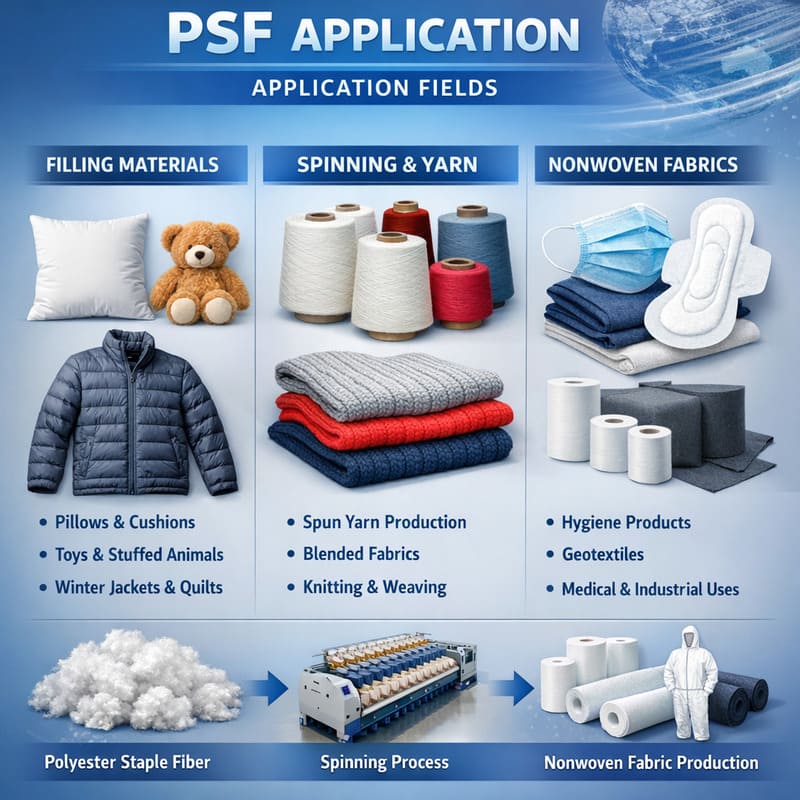
PSF is the raw material used to make three major product categories:
- 🧵 Spun yarn — PSF fibers are carded, drawn, and twisted into yarn (polyester spun yarn, poly-cotton blended yarn, PV yarn)
- 🛋️ Filling / stuffing — loose or siliconized PSF used to fill pillows, duvets, stuffed toys, and upholstered furniture
- 🏭 Nonwoven fabric — PSF is needle-punched or thermally bonded into felt, geotextile, filter media, and automotive fabric
Filament yarn (DTY/FDY/POY) is made of continuous unbroken filaments — like a single long thread. PSF is the same polyester material, but cut into short lengths and used as loose fiber. Filament yarn goes directly to weaving or knitting machines. PSF goes to spinning mills, filling factories, or nonwoven production lines.
🧬 PSF Fiber Types — Hollow, Solid, Low-Melt & More
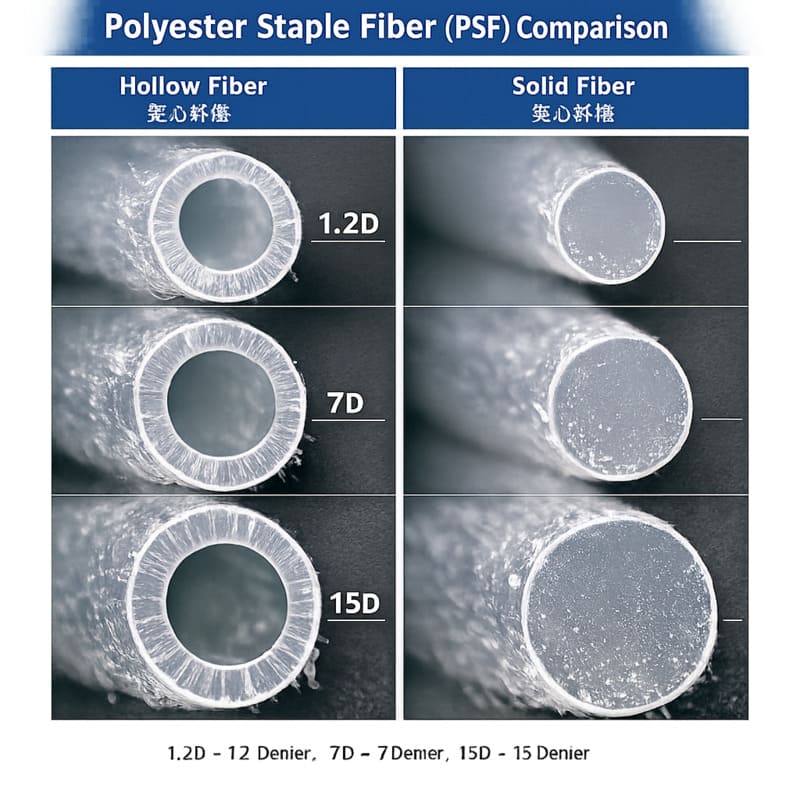
Not all PSF is the same. The cross-sectional shape and structure of the fiber determines what it's used for. Here are the four main types you'll encounter: 👇
- Air pocket inside each fiber
- Lightweight & excellent loft
- Soft, springy feel
- Better thermal insulation
- Used in pillows, duvets, jackets
- No air pocket — fully solid
- Stronger than hollow
- Heavier per unit volume
- Better for spinning into yarn
- Used in yarn, nonwoven, geotextile
- Melts at 110–180°C (vs 250°C normal)
- Acts as binder in nonwoven fabric
- Fuses other fibers together when heated
- No glue needed — cleaner process
- Used in automotive fabric, filter media
- Coated with silicone during production
- Ultra-smooth, silky surface feel
- Better resilience — springs back after compression
- Doesn't clump or matt together
- Used in premium pillows, stuffed toys, down alternatives
📏 Key Parameters: Denier and Fiber Length
Every PSF specification has two primary parameters: Denier (D) and Cut Length (mm). These two numbers together tell you almost everything you need to know about the fiber. 🔢
Denier — How Fine is the Fiber?
Just like in filament yarn, denier measures fiber fineness. But in PSF, the denier range is much broader — from ultra-fine microfiber (0.9D) to coarse industrial fiber (15D+).
Cut Length — How Long is Each Fiber?
The cut length determines which production process the fiber is compatible with. This is critical — the wrong cut length will cause processing problems on your machines. ⚙️
| Cut Length | Process | Application |
|---|---|---|
| 32mm | Cotton system spinning | Blended yarn (PC, PV), fine fabric yarn |
| 38mm | Cotton system spinning ⭐ Most Common | All spun yarn types — the universal standard |
| 51mm | Wool system / worsted spinning | Worsted blends, medium-length fiber yarn |
| 64mm | Wool system spinning | Wool-blend yarn, coarser textile yarn |
| Variable | Filling & nonwoven | Length less critical — typically 32–64mm |
If you are buying PSF to spin into yarn, always confirm the cut length with your spinning mill before ordering. Most cotton-system spinning mills use 38mm — this is the global standard. Ordering the wrong length means the fiber won't run properly through your carding and drawing machines.
♻️ Virgin PSF vs Recycled PSF (rPET)
This is one of the most important distinctions in today's PSF market — especially for buyers supplying European or US brands that have sustainability requirements. 🌱
- Produced from virgin petrochemical raw materials
- Consistent quality, tight specification control
- Slightly lower price in most market conditions
- No certification required
- Standard for most industrial and commercial applications
- Produced from post-consumer recycled PET bottles
- GRS (Global Recycled Standard) certification available
- Required by many European & US sustainability programs
- Slightly higher price — premium for eco-credentials
- Growing demand: outdoor brands, home textiles, fashion
If your buyer requires recycled content certification, ask your supplier for a GRS (Global Recycled Standard) Transaction Certificate. This certifies that the recycled fiber content has been verified through the supply chain. Yaakan can supply GRS-certified recycled PSF on request. The GRS certification adds a small premium but opens access to sustainability-focused brands and markets. 🌍
🏭 PSF Applications — Where Does It End Up?
Polyester staple fiber has three major end-use categories, each with different specification requirements. 👇
| Application | Best PSF Type | Typical Spec | Key Requirement |
|---|---|---|---|
| Pillow & Cushion Filling | Hollow siliconized | 7D × 64mm, siliconized | High loft, soft feel, spring-back |
| Duvet & Quilt Filling | Hollow conjugated | 3D–7D × 32–64mm | Lightweight, thermal insulation |
| Stuffed Toy Filling | Hollow siliconized | 6D × 64mm, siliconized | Safe, soft, non-toxic |
| Yarn Spinning (Cotton Sys.) | Solid virgin | 1.4D–1.5D × 38mm | Consistent denier, low crimp variation |
| Yarn Spinning (Wool Sys.) | Solid virgin | 3D–6D × 51–64mm | Longer length for worsted system |
| Nonwoven — Geotextile | Solid coarse | 6D–15D × 64mm | High tenacity, UV resistant |
| Nonwoven — Filter Media | Solid fine + low-melt | 1.5D–4D mix with low-melt | Filtration efficiency, thermal bonding |
| Automotive Felt | Low-melt binder | 4D–6D with 15% low-melt | Dimensional stability after forming |
📋 How to Read a PSF Specification
A complete PSF specification looks like this: "1.5D × 38mm SD Virgin Solid PSF". Here's what each part means: 🔍
| Parameter | Example | What It Means |
|---|---|---|
| Denier | 1.5D | Fiber fineness — 1.5 denier is standard fine fiber for yarn spinning |
| Cut Length | 38mm | Length of each fiber — 38mm for cotton-system spinning machines |
| Luster | SD | Semi-Dull (matte) or Bright (shiny) — SD is standard for most applications |
| Origin | Virgin | Virgin (new material) or Recycled (rPET from PET bottles) |
| Structure | Solid | Solid or Hollow — hollow for filling, solid for yarn spinning |
| Treatment | — | Siliconized (smooth coating) or Untreated — siliconized for premium filling |
| Crimp | — | Normal crimp or Conjugated (bi-component, higher loft) for filling |
🛒 5 Things to Confirm Before Ordering PSF
- Confirm denier AND cut length together. These two numbers must match your processing equipment. A spinning mill using cotton-system cards needs 38mm. Asking for "1.5D PSF" without specifying cut length often results in the wrong product. 📏
- Specify hollow or solid upfront. Hollow fiber (for filling) and solid fiber (for spinning) are produced differently and priced differently. Always state which structure you need. 🔬
- Ask about virgin or recycled. If your buyer requires GRS certification or recycled content, specify this at the inquiry stage — not after pricing is agreed. Recycled PSF costs more and requires advance planning. ♻️
- Request a fiber quality test report. A good PSF supplier provides a mill certificate showing denier CV%, tenacity, elongation, moisture, and crimp number. For yarn-grade PSF, these parameters are critical. 📄
- MOQ for PSF is per container. Unlike yarn where MOQ is per specification, PSF is typically sold by the 20FCL (approximately 20 tonnes). If you need smaller quantities, ask your supplier if they can consolidate multiple specifications in one container. 🚢
- Denier: 1.4D – 15D
- Cut Length: 32mm, 38mm, 51mm, 64mm
- Types: Solid, Hollow, Low-Melt, Siliconized
- Origin: Virgin & GRS Recycled (rPET)
- Luster: Semi-Dull, Bright
- MOQ: 1 × 20FCL per specification
- Incoterm: FOB Xiamen
According to Textile Exchange's Preferred Fiber & Materials Report, recycled polyester now accounts for over 15% of total polyester production globally — and demand is growing rapidly as brands commit to sustainability targets. Understanding the difference between virgin and recycled PSF is increasingly important for buyers supplying international brands. 🌍
📝 Summary
- 🔬 PSF is short-cut polyester fiber — the raw material for yarn spinning, pillow filling, and nonwoven fabric
- 🧬 Main types: Hollow (filling), Solid (yarn/nonwoven), Low-Melt (binder), Siliconized (premium filling)
- 📏 Always specify both denier AND cut length — 1.5D × 38mm is the global standard for yarn spinning
- ♻️ Virgin or Recycled (rPET/GRS) — specify upfront, especially if your buyer requires sustainability certification
- 🚢 MOQ is 1 × 20FCL per specification, FOB Xiamen
Ready to source PSF for your spinning mill, filling factory, or nonwoven production line? Browse our full PSF specifications and pricing, or contact us directly with your requirements. We respond within 24 hours. 👇
Ready to Order Polyester Staple Fiber?
Tell us your denier, cut length, fiber type (hollow/solid), and monthly quantity. We'll send you a competitive FOB Xiamen price within 24 hours. MOQ 1 × 20FCL.