How to Read Polyester Yarn Specifications — A Plain-English Guide
You've just received a quotation from a Chinese supplier. It reads: "DTY 150D/48F SD NIM — FOB Xiamen USD X.XX/kg". You know you need polyester yarn. But what exactly does 150D/48F SD NIM mean — and how do you know if it's the right specification for your fabric? 🤔
This guide decodes every part of a standard polyester yarn specification, so you can read any supplier's price list with confidence — and order exactly the right yarn the first time. 🎯
🔍 Anatomy of a Yarn Specification
Let's take the most common DTY specification in the world and break it down piece by piece:
Now let's go through each parameter one by one. 👇
1️⃣ Denier (D) — How Thick is the Yarn?
Denier is the weight of 9,000 metres of yarn in grams. It is the most important number in any polyester yarn specification — it tells you how thick and heavy the yarn is, which directly determines how heavy your finished fabric will be.
| Denier | Weight Category | Typical Fabric | Common Applications |
|---|---|---|---|
| 30D – 50D | Ultra Fine | 15–40 g/m² | Sheer lining, thin chiffon, hosiery |
| 75D | Fine | 50–80 g/m² | Light sportswear, thin lining, georgette |
| 100D | Light-Medium | 80–120 g/m² | Standard lining, light knit fabric |
| 150D | Medium | 120–180 g/m² | Standard T-shirt, sportswear, taffeta ⭐ Most Popular |
| 200D – 300D | Medium-Heavy | 180–280 g/m² | Outdoor fabric, workwear, bags |
| 450D – 600D | Heavy | 280–500 g/m² | Luggage, tarpaulin, heavy canvas |
If you're not sure what denier you need, ask your fabric mill: "What is the fabric weight in GSM (grams per square metre)?" Then match it to the table above. A 180 GSM sportswear fabric typically needs 150D yarn.
2️⃣ Filament Count (F) — How Soft is the Yarn?
The number after the slash (e.g. 150D/48F) tells you how many individual filaments (fibres) are twisted together to form the yarn. Think of it like this: a rope made of 100 thin threads feels softer than a rope made of 10 thick threads — even if both ropes are the same thickness. 🧵
| Filament Count | Yarn Character | Fabric Feel |
|---|---|---|
| 36F (for 150D) | Fewer, thicker filaments | Coarser, stronger, more structured |
| 48F (for 150D) | Standard count | Balanced — the global standard ⭐ |
| 72F (for 150D) | More filaments | Softer, smoother, finer surface |
| 96F (for 150D) | Many thin filaments | Very soft, silky, premium feel |
| 144F (for 150D) | Microfibre territory | Extremely soft — approaching silk |
For most standard sportswear and garment fabric, 150D/48F is the industry default — reliable, widely available, and cost-effective. If your buyer specifies "soft hand feel" or "premium touch", upgrade to 150D/96F or 150D/144F.
3️⃣ Lustre / Finish (SD, FD, Bright) — How Shiny is the Fabric?
The lustre code tells you how shiny or matte the finished yarn — and therefore the fabric — will appear. This is controlled during manufacturing by adding titanium dioxide (TiO₂) to the polyester melt. More TiO₂ = more matte. ✨
| Code | Full Name | Appearance | Best For |
|---|---|---|---|
| Bright / FBT | Fully Bright | High shiny lustre — like silk | Satin, high-lustre lining, decorative fabric |
| SD | Semi-Dull | Soft sheen — slightly matte ⭐ | Sportswear, standard fabric, most apparel |
| FD | Full Dull | Completely matte — no shine | Military fabric, technical textile, non-reflective cloth |
| Trilobal Bright | Trilobal Cross-Section | Extra intense sparkle | Satin ribbon, formal wear, evening dress fabric |
When in doubt, order SD (Semi-Dull). It is the most versatile and the most widely used. SD fabric dyes evenly, doesn't look too synthetic, and is accepted by virtually all garment buyers globally. Bright is reserved for applications where high shine is specifically desired.
4️⃣ Interlacing Level (NIM, SIM, HIM) — How is the Yarn Held Together?
This is the parameter most new buyers ignore — and occasionally regret. Interlacing refers to how tightly the individual filaments inside the yarn are intertwined using air jets during the texturing process. It affects how the yarn behaves on your knitting or weaving machine. ⚙️
| Code | Full Name | Interlacing | Best For |
|---|---|---|---|
| NIM | Non-Interlaced / Low Interlaced | Loose — filaments move freely | Circular knitting machines, elastic fabric, standard T-shirt |
| SIM | Semi-Interlaced / Medium | Medium — balanced cohesion | Warp knitting, general woven fabric |
| HIM | High Interlaced | Tight — very cohesive yarn | High-speed weaving looms, yarn that must not split during processing |
If your fabric mill uses circular knitting machines (the most common setup for T-shirt and sportswear fabric): order NIM. If they use weaving looms: ask your mill directly — they will specify SIM or HIM based on their machine settings.
5️⃣ Reading FDY Specifications
FDY yarn specifications follow the same Denier/Filament/Lustre structure, but without an interlacing code — because FDY is not textured. A typical FDY spec looks like this:
FDY also comes in a special variant called Trilobal Bright — a cross-shaped filament profile that creates an intensely shiny, sparkle-like surface. You'll see this specified as "75D/36F Trilobal Bright" or simply "75D/36F TB". It is widely used in satin fabric, ribbon, and formal evening wear. 🌟
📋 Common Specifications — Quick Reference
Here are the most frequently ordered specifications and what they're used for:
🛒 How to Order the Right Specification
Follow these three steps every time you place a yarn order:
- Ask your fabric mill for their yarn specification. Any professional fabric mill will know exactly what yarn they need — denier, filament count, lustre, and interlacing. Just ask: "What polyester yarn specification do you use for this fabric?" 💬
- Confirm the yarn type (DTY or FDY). Knit fabric mills almost always use DTY. Woven fabric mills usually use FDY for warp and sometimes DTY for weft. If unsure, ask: "Is your machine a knitting machine or a weaving loom?" 🏭
- Send the exact specification to your supplier. A complete specification looks like: "150D/48F DTY SD NIM, raw white, cone packing, 1,500 kg FOB Xiamen." The more specific you are, the faster and more accurate your quote will be. 📧
- Yarn type (DTY / FDY / POY)
- Denier × Filament (e.g. 150D/48F)
- Lustre (SD / Bright / FD / Trilobal)
- Interlacing for DTY (NIM / SIM / HIM)
According to Fibre2Fashion, specification mismatches are one of the most common causes of production problems in polyester yarn sourcing. Getting the specification right before ordering saves weeks of delay and costly reshipments. 🚢
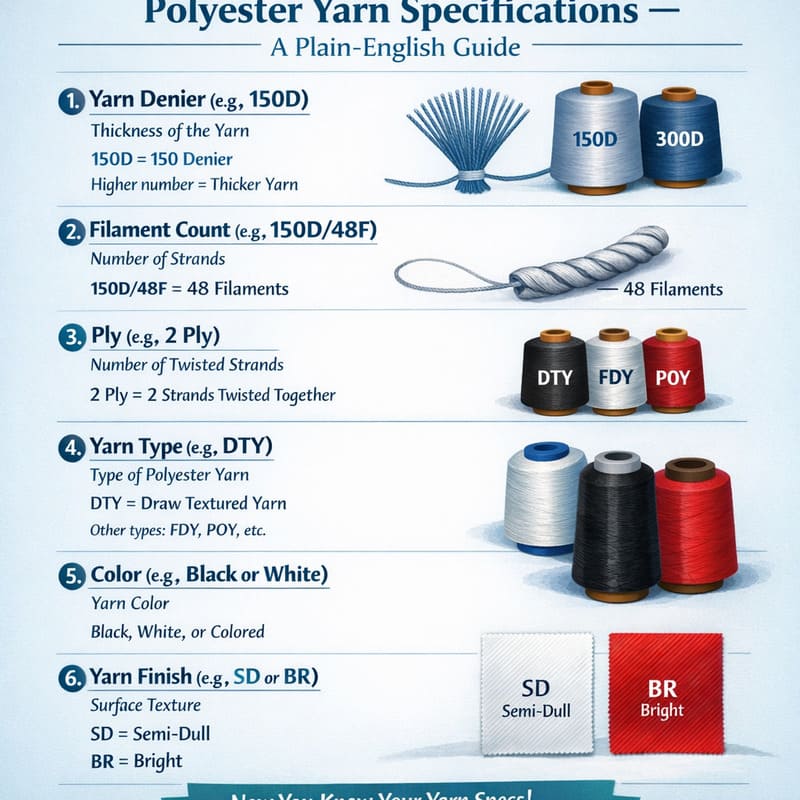
📝 Summary — Cheat Sheet
| Parameter | What It Means | Common Values |
|---|---|---|
| D (Denier) | Yarn thickness / fabric weight | 75D / 150D / 300D / 600D |
| F (Filament) | Number of fibres — more = softer | 36F / 48F / 72F / 96F / 144F |
| Lustre | Surface shine level | SD / FD / Bright / Trilobal |
| Interlacing | How filaments are held together (DTY only) | NIM / SIM / HIM |
| Colour | Pre-dye colour of yarn | Raw White / Optical White / Dyed |
Once you understand these five parameters, you can read any polyester yarn specification in seconds — and communicate confidently with any supplier worldwide. 🌍
If you're still not sure about the right specification for your fabric, contact our team. We supply DTY, FDY, and POY yarn FOB Xiamen, and we're happy to advise on the correct specification for your application — no obligation. 👇
Need Help Choosing the Right Specification?
Send us your fabric type and application — we'll recommend the exact yarn specification and send you a FOB Xiamen price within 24 hours.